

May 22, 2026
SEOUL – South Korea shifted into election mode Thursday, with candidates and campaigners permitted to use microphones and sound trucks for two weeks.
From Thursday until June 2, a day before the local election, eligible candidates and campaigners may use microphones and operate sound trucks for campaigning in open spaces from 7 a.m. to 9 p.m., according to election authorities.
Screens on the trucks may remain on until 11 p.m., but loudspeakers are restricted from 9 p.m.
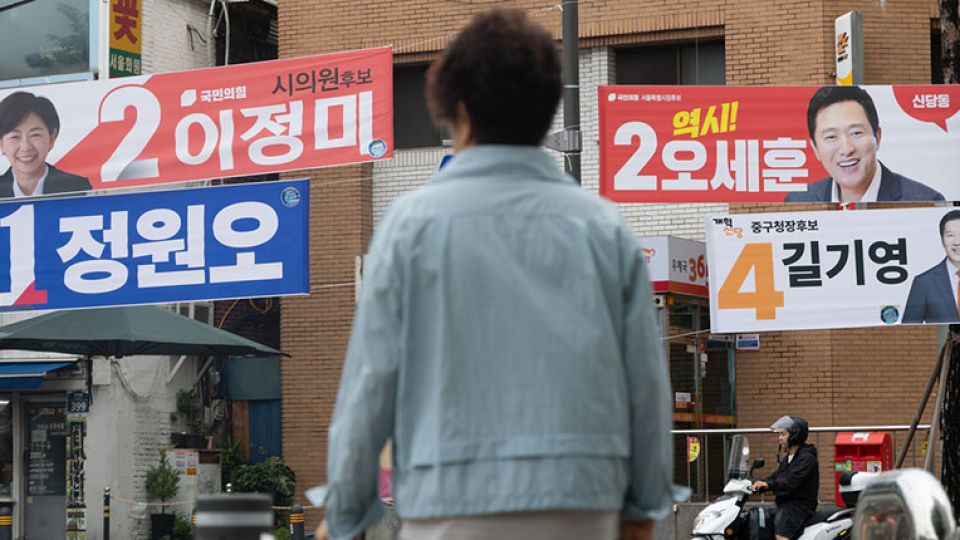
Campaigning in South Korea is regulated under the Public Official Election Act. During the two-week campaigning period, candidates and campaigners may deliver speeches in open spaces, distribute name cards and hang campaign banners while wearing jackets, jerseys or sashes bearing party symbols, such as colors or assigned ballot numbers.
In the meantime, election officials will place posters showing candidates’ faces and ballot numbers in designated locations by Friday. Election-related materials will be delivered to voters’ homes by Sunday.
Political parties in South Korea launched their election campaigns shortly after midnight Thursday.
The ruling Democratic Party of Korea’s chair, Rep. Jung Chung-rae, attended the midnight kickoff ceremony for the party’s Seoul mayoral candidate Chong Won-o on Thursday, while the main opposition People Power Party’s chair, Rep. Jang Dong-hyeok, joined Gyeonggi Province governor candidate Yang Hyang-ja just past midnight. Yang, a former Samsung Electronics executive, was on a hunger strike calling for a resolution to Samsung’s wage deadlock.
Up for grabs in the election are 16 leadership posts in South Korea’s key municipalities, including Seoul and Busan; a combined 227 mayoral, county head and ward office chief posts; and 16 education superintendent posts. Elections will also be held for nearly 4,000 councilors nationwide.
Parliamentary by-elections will also be held in 14 of the country’s 254 constituencies.
Polling stations on Election Day will be open from 6 a.m. to 6 p.m. Advance voting will be held from May 29-30, also from 6 a.m. to 6 p.m.
The number of voters will be confirmed Friday.
The National Election Commission unveiled plans Thursday to hold televised debates for contenders for leadership posts in 16 municipalities, as well as for lawmakers and education superintendents, from Thursday until May 28.
Key battlefields in this year’s local election include the races for Seoul mayor, Gyeonggi Province governor and Busan mayor. Polls have shown that the ruling Democratic Party’s candidates there — Chong Won-o, Choo Mi-ae and Chun Jae-soo, respectively — are currently leading.
The debate for Seoul mayoral candidates will air on SBS at 11 p.m. on May 28. The Gyeonggi Province governor candidates’ debate will air on KBS at 11 p.m. on May 27. Busan mayoral candidates will hold their debate on KBS at 11 p.m. Tuesday.
By-elections in the Busan Buk-A constituency and Pyeongtaek-B district are also drawing keen voter attention. Candidates for the Busan Buk-A constituency will hold a televised debate on MBC at 1:55 p.m. on May 28, while those running for Pyeongtaek-B will hold one at 8 p.m. on May 27.