

February 5, 2026
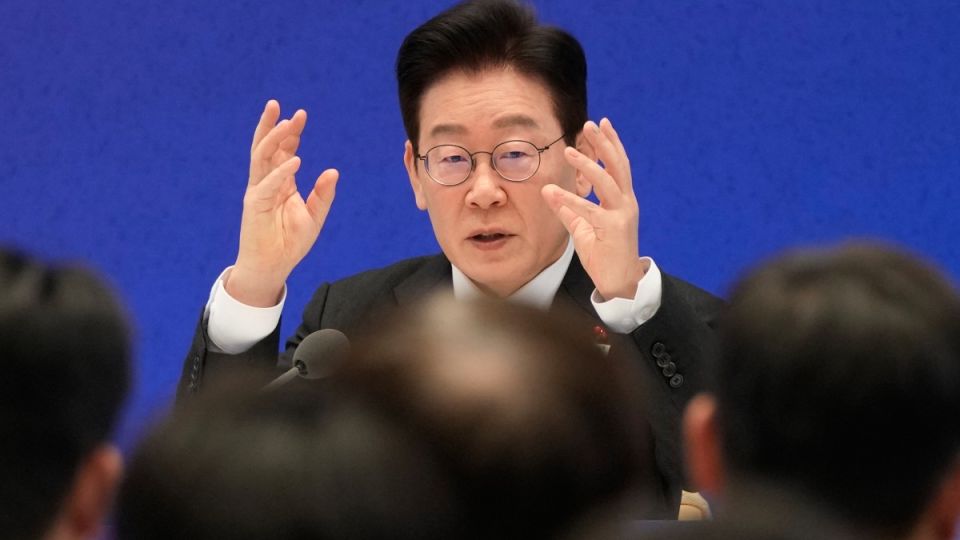
SEOUL – President Lee Jae Myung on Wednesday urged South Korea’s conglomerate leaders to spread investment beyond the capital region and expand youth hiring, sharing the gains of growth more broadly across society.
Lee also pledged government backing through leader-level diplomacy aligned with companies’ business needs during the meeting, titled “corporate meeting for the expansion of youth employment and regional investment,” at Cheong Wa Dae.
The two-hour meeting was attended by leaders from 10 major groups: Samsung, SK, Hyundai Motor, LG, Lotte, Posco, Hanwha, HD Hyundai, GS and Hanjin, as well as representatives from the Federation of Korean Industries and the Korea Chamber of Commerce and Industry.
“The government will make efforts as well. But in any case, I hope that the fruits of growth and the growth opportunities will spread evenly — to small and medium-sized enterprises, and to regional areas in a country still centered on the capital region,” Lee told conglomerate leaders.
“I hope that warmth will reach not only the established generations already in secure positions, but also the younger generation entering our society.”
Lee called for conglomerates’ efforts to address widening regional disparities, describing them as “one of the most serious challenges.” Economic concentration in the capital region remains severe, despite the country’s relatively small size.
“The government has decided, on a large scale, to create new core pillars of development in the regions under the so-called five-mega-regions and three-special-provinces framework, and will concentrate investment there,” Lee said during the meeting. “It would be good if our companies could also align with that effort.”
The Lee administration seeks to establish five regional hubs by grouping the Seoul metropolitan area, the Chungcheong region, the Honam region, the Daegu–North Gyeongsang region and the Busan–Ulsan–South Gyeongsang region into ultrawide economic zones. The blueprint also calls for strengthening the special self-governing authority of Gangwon, North Jeolla and Jeju Island, supporting independent development models tailored to each region’s characteristics.
During the meeting, Lee urged conglomerate leaders to expand hiring — particularly youth employment — while expressing gratitude for their efforts to significantly increase employment and carrying out their plans last year.
“I ask that you make a bit more effort as well in the work of enhancing young people’s capabilities and expanding their employment opportunities through cooperation between the private sector and the public sector,” Lee said.
In response, Ryu Jin, chair of the Federation of Korean Industries and head of Poongsan Group, said, “The country’s 10 major business groups are planning regional investments totaling about 270 trillion won ($186 billlion) over the next five years.”
“In addition to the 10 groups, the total could reach about 300 trillion won if taken together,” Ryu added.
During a press briefing following the meeting, Lee Kyu-yeon, senior presidential secretary for public relations and communication, said 66 trillion won is slated to be invested this year through planned regional investment by 10 major groups, an increase of about 16 trillion won from last year.
On hiring, the 10 business groups plan to recruit a combined 51,600 employees this year, up 2,500 from a year earlier. Of the total, 66 percent — or 34,200 positions — will be filled by entry-level hires rather than experienced workers, according to the senior secretary.
Summit diplomacy for business
During the meeting, President Lee also pledged to pave the way for companies to expand private-sector economic cooperation with foreign countries through leader-level diplomacy and summits.
“Summits can be tiring, but there are few opportunities as effective as summits when it comes to opening the door to economic cooperation or expanding and deepening it,” Lee told business leaders.
Lee said he has instructed Cheong Wa Dae’s policy office to approach summit diplomacy systematically, focusing on the countries and issues most relevant to individual companies’ needs.
“If economic groups or individual companies actively suggest which items would be suitable with which countries and at what timing, we will reflect that in our overseas trip schedules and restructure the content of summit events around those priorities,” Lee said.
On overseas issues, President Lee also urged companies to make efforts to ensure that the diplomatic momentum from his back-to-back visits to China and Japan in January translates into substantive economic cooperation, Lee Kyu-yeon said during the briefing
The senior secretary added, however, that the meeting did not address recent tariff warnings by Donald Trump, who has said he would raise tariffs on South Korean automobiles, lumber and pharmaceuticals — along with other “reciprocal” tariffs — from 15 percent to 25 percent.
Lee Kyu-yeon said President Lee “urged companies to make efforts to ensure that this leads to substantive economic cooperation, as the back-to-back visits to China and Japan early this year laid the groundwork for a breakthrough improvement in relations with both countries.”
The senior secretary added, however, that the meeting did not cover US President Donald Trump’s warning that he would raise tariffs on South Korean automobiles, lumber and pharmaceuticals—along with other “reciprocal” tariffs—from 15 percent to 25 percent.
From the business sector, attendees included Samsung Electronics Chair Lee Jae-yong; Hyundai Motor Group Executive Chair Chung Euisun; LG Group Chair Koo Kwang-mo; Lotte Group Chair Shin Dong-bin; and Posco Group Chair Chang In-hwa. They were joined by HD Hyundai Chairman Chung Ki-sun; GS Group Chair Huh Tae-soo; Korean Air Chair Cho Won-tae; SK Group vice chair Chey Chang-won; and Hanwha Group Vice Chair Kim Dong-kwan.
From major economic organizations, Ryu Jin and Park Il-jun, executive vice chairman of the Korea Chamber of Commerce and Industry, were present.
The meeting followed Lee’s discussion on Jan. 28, when he met with representatives from seven foreign chambers of commerce in Korea and 31 foreign-invested companies to seek their views and encouraged them to invest in ways that would create more opportunities for young people and local regions.