

April 10, 2026
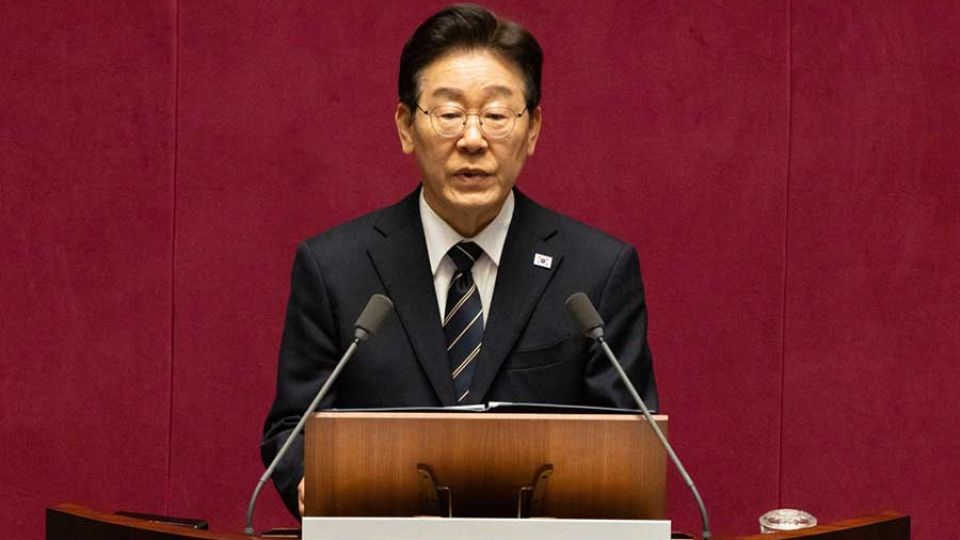
SEOUL – President Lee Jae Myung on Thursday said the Middle East war could usher in a markedly different world and urged officials to prepare thoroughly, while cautioning against premature optimism over the ceasefire.
“The situation in the Middle East, which had been spiraling toward further escalation, is now entering a new phase following the United States and Iran’s agreement on a two-week ceasefire,” Lee said during a weekly meeting with senior aides and secretaries at Cheong Wa Dae.
“It is still too early to be optimistic about the outcome, and even if negotiations proceed smoothly, there are strong concerns that the shock from the war will persist for a considerable period,” Lee added.
Seoul remains on high alert over the prolonged economic fallout from the Middle East war, even amid a temporary pause in hostilities following a conditional two-week ceasefire between Washington and Tehran on Tuesday.
Lee called for the government “not to let down its guard in the slightest and to push forward more detailed and preemptive measures based on all possible scenarios.”
“The most urgent task is to ensure the safe return of our nationals — the crew members and vessels currently stranded in the Strait of Hormuz,” Lee underscored, referring to the ships awaiting passage through the strait.
“We must mobilize all of our diplomatic capabilities and networks and engage in active consultations based on close coordination with the international community.”
About a month after the strait was effectively blocked following US and Israeli strikes on Iran beginning on Feb. 28, 26 South Korean-flagged vessels and 173 crew members remain in the Persian Gulf.
However, despite the announcement of a ceasefire, ship traffic in the Strait of Hormuz remains throttled.
Lee also called for all-out efforts to secure additional crude oil and key industrial feedstocks, including naphtha.
“In particular, we must ensure stable management of items that have recently raised concerns over supply disruptions, including plastics and medical supplies,” he said.
He underscored that the conflict could fundamentally reshape the global landscape regardless of how it ends, and investment in alternative energy sources will be crucial.
“We need to accelerate the diversification of energy supply sources, the transition toward a renewable energy-centered society, and innovation in industrial structures,” he said.
Lee also stressed the need to “step up efforts to foster future growth engines such as advanced artificial intelligence, next-generation small modular reactors, robotics and others.”
Nuclear power, refinery flexibility
Lee’s remarks came after he convened the inaugural meeting of the presidential National Economic Advisory Council on Thursday morning amid Middle East oil shocks to discuss ways to overcome the economic fallout from the war and pursue a strategy for sustainable growth.
“In the short term, the war in the Middle East is posing a very serious threat to our economy,” Lee said in his opening remarks, referring to South Korea by its official name. “In the longer term, I believe the time has come for the Republic of Korea’s economic system to undergo fundamental change.”
Lee underscored that “In one sense, this is a crisis, but in another, it is also an opportunity,” calling for preparedness to make this crisis a “valuable turning point — an opportunity for renewed takeoff and to build a new system for the future.”
During the meeting, Park Won-joo, head of the council’s strategic economic cooperation division and a former senior presidential secretary for economic affairs under the Moon Jae-in administration, said the current crisis differs fundamentally from past oil shocks or the Libya crisis, when underlying infrastructure remained intact.
Park warned that the current oil crisis is now spreading beyond energy into food systems, including nitrogen fertilizers, and industrial supply chains such as aluminum.
“The two-week ceasefire period is a golden window. During this time, we must secure as much energy supply as possible,” Park said.
“We need to urgently secure crude oil and LNG (Liquefied Natural Gas) from Russia or Iran, and naphtha should be imported to the fullest extent possible from countries such as China and Russia.”
Park also underlined the need to make full use of nuclear energy.
“We should adjust maintenance schedules to maximize the operation of nuclear plants this winter, and also establish a basis to allow the temporary continued operation of reactors whose design lifespans have expired,” Park said.
For the mid-term plan, Park highlighted the need to prioritize greater flexibility in refining capacity, explaining that tax incentives should be funnelled into upgrades that would allow for the processing of non-Middle Eastern crude.
“Korea’s refining infrastructure is currently geared toward heavy crude, which makes it difficult when processing lighter crude from countries like the United States,” Park said.
Park noted that countries such as Indonesia, Malaysia, Vietnam and Australia provide alternatives to using the Strait of Hormuz. “We need to pay closer attention to securing crude from these regions.”