

March 5, 2026
SEOUL – South Korea’s stock market extended its sharp losses Wednesday, with the benchmark Kospi plunging more than 12 percent and the secondary Kosdaq tumbling 14 percent, marking their steepest one-day declines on record.
Both bourses were hit by a 20-minute trading halt as the exchange operator temporarily suspended trading amid heightened volatility.
The Kospi closed at 5,093.54 on the day, shedding 12.06 percent from the previous session’s close.
After kicking off the session at 5,592.29, the index extended losses, falling as low as 5,059.45, down 12.65 percent and marking the largest intraday drop on record. The decline surpassed the 12.02 percent fall on Sept. 12, 2001, when the investor sentiment froze up following the 9/11 terrorist attacks on the US.
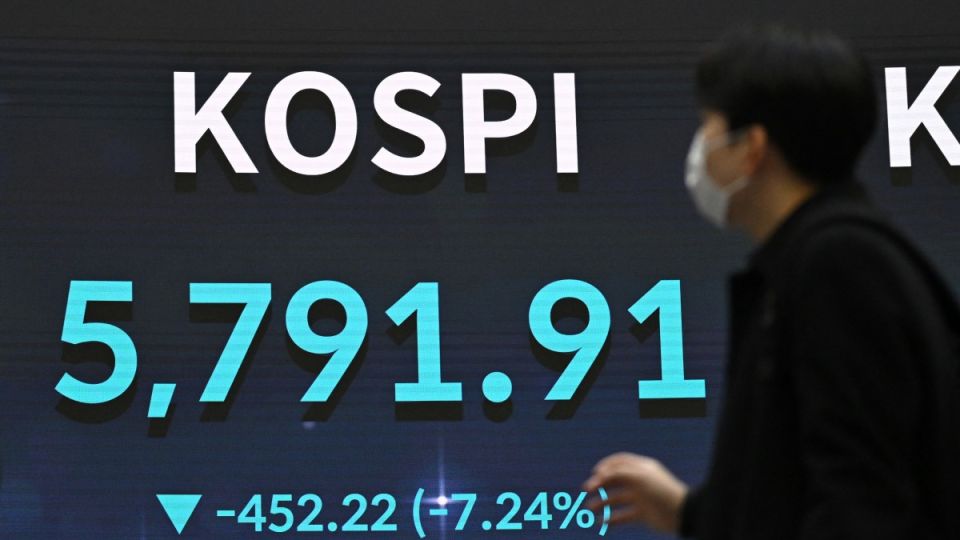
The decline follows a 7.24 percent plunge in the previous session. The index extended its losses in Tuesday’s after-hours trading, with the sell-off carrying through Wednesday.
Earlier in the day, the Korea Exchange activated a circuit breaker to suspend trading for 20 minutes on the Kospi, following a sell-side sidecar measure. It was the seventh circuit breaker ever triggered on the Kospi.
On the Kospi, retail investors and foreign investors were net buyers of shares worth 79.7 billion won ($54 million) and 231.2 billion won, respectively, but their purchases were not enough to keep the index afloat as institutional investors dumped 588.8 billion won.
Market bellwethers Samsung Electronics plunged 11.74 percent, while SK hynix fell 9.58 percent. Hyundai Motor dropped 15.8 percent, and LG Energy Solution fell 11.58 percent.
Although defense shares posted strong gains the previous day, most retraced part of the advances. Hanwha Aerospace and Hanwha Systems fell 7.61 percent and 20.93 percent, respectively.
The Kosdaq followed a similar trajectory, closing at 978.44, down 14 percent. It was the sharpest daily decline for the tech-heavy index as well, surpassing the previous record one-day drop of 11.71 percent set on March 19, 2020.
After opening at 1,112.08, marking a 2.25 percent decline from the previous session, the index failed to pare its losses and extended its slide throughout the day. The KRX suspended trading on the Kosdaq through a circuit breaker and a sidecar as well. It was the 11th activation of the circuit breaker for the Kosdaq.
Wednesday marked the first time the KRX had activated circuit breakers on both markets in a single trading session since Aug. 5, 2024, highlighting widespread market turbulence.
The Korean won also weakened sharply against the US dollar as dollar-buying flows amplified downward pressure on the currency. The won closed at 1,476.2 per dollar, weakening by 10.1 won from the previous session.
In earlier overnight trading, the currency briefly breached the 1,500-won mark, hitting 1,505.8 per dollar as trading volume thinned. Though it returned to the 1,470 level when daytime trading began, it failed to rebound and remained under pressure throughout the session.
The won’s move above the 1,500-won threshold marked its first return to that level in 17 years, since March 10, 2009, when it reached 1,511.50 won per dollar during the 2008 global financial crisis.
The 1,500-won mark is widely regarded as a psychologically important threshold in Korea, as such levels have historically appeared only during periods of major financial turmoil, including the 1997 Asian financial crisis and the global financial crisis.
“Historically, the Korean won is one of the most sensitive emerging market currencies to global risk sentiment,” said Yan Wang, chief of emerging markets at research firm Alpine Macro.
“For now, this is primarily short-term volatility, as the Korean won’s fundamentals do not justify such weak levels,” he said, adding that the conflict is unlikely to cause lasting damage to the won or Korea’s external position unless it drags on far beyond expectations.