

June 3, 2026
SEOUL – South Korea and the US have formally launched interagency talks on nuclear cooperation centered on Seoul’s pursuit of nuclear-powered submarines and greater autonomy over the nuclear fuel cycle.
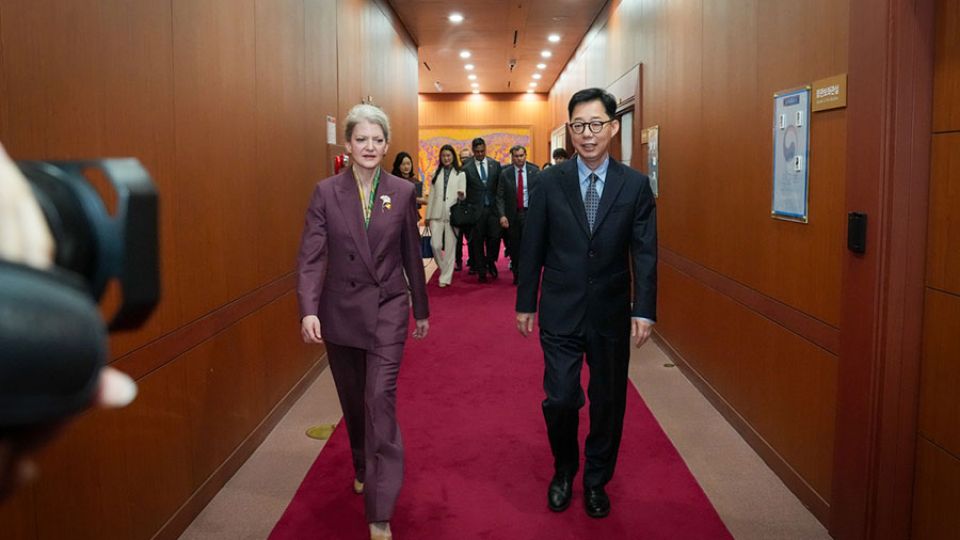
First Vice Foreign Minister Park Yoon-joo and US Undersecretary of State for Political Affairs Allison Hooker convened the launch meeting Tuesday morning at the Foreign Ministry in Seoul, after a delay of several months.
The working-group discussions, which will continue through Wednesday, will focus on how to implement security agreements outlined in the Nov. 14 joint fact sheet, released after the second summit between South Korean President Lee Jae Myung and US President Donald Trump on the sidelines of the 2025 Asia-Pacific Economic Cooperation summit in Gyeongju, North Gyeongsang Province.
After the launch meeting, sector-specific consultations were held under the direction of the two countries’ national security offices. Hooker also met with South Korean national security adviser Wi Sung-lac on Tuesday afternoon. An official dinner hosted by Park was scheduled for Tuesday evening.
The main items on the agenda were South Korea’s bid to develop nuclear-powered submarine and secure the right to civil uranium enrichment and spent fuel reprocessing.
Officials were expected to discuss the two issues in an integrated format, rather than holding separate meetings on each matter, given an overlap in the working-level personnel handling them.
Seoul seeks to move the talks quickly beyond a ceremonial launch and into substantive negotiations, after security consultations — initially expected earlier this year — were delayed.
The delay came amid South Korea’s investigation into a massive data breach involving US-listed e-commerce giant Coupang and a delay in the passage of a special law at the National Assembly to implement Seoul’s $350 billion investment package in the US.
“The significance of this launch meeting lies above all in the fact that the security consultations, which had been repeatedly delayed, have now begun and are back on track,” Park Il, the Foreign Ministry spokesperson, said during a regular briefing.
“Based on the outcome of the discussions, we will make every effort to ensure that both delegations meet as frequently as possible in order to produce substantive progress in the consultations.”
The joint fact sheet contains a US commitment to support the process that would lead to South Korea’s civil uranium enrichment and spent fuel reprocessing, both of which have been effectively barred under the current civilian nuclear cooperation agreement, known as the 123 Agreement. Seoul and Washington first signed the agreement in 1972 and revised it in 2015.
Under the current agreement, Seoul requires US approval to enrich uranium — approval that has never been granted, even to civilian use levels of below 20 percent — while spent fuel reprocessing for commercial purposes remains outrightly prohibited. Only limited research into pyroprocessing has been allowed under a joint Korea-US study framework, but that research has since stalled.
Seoul sees both uranium enrichment and spent fuel reprocessing as increasingly imperative for its nuclear reactor exports and its own energy security. South Korea is the only country at its level of nuclear power capacity that relies entirely on imported nuclear fuel. The country currently operates 26 commercial nuclear reactors.
To that end, Seoul is seeking to expedite revisions to the current nuclear agreement regardless of its scheduled expiration in 2035.
Seoul also needs a separate agreement with the United States to build nuclear-powered submarines under the current Korea-US 123 Agreement, which prohibits nuclear materials, technology and byproducts supplied by Washington from being used for “any military purpose.”
The meeting came after South Korean Defense Minister Ahn Gyu-back unveiled a road map on May 26 to launch the country’s first domestically built nuclear-powered submarine in the mid-2030s, while pledging to uphold its nuclear nonproliferation obligations.
Ahn underscored that South Korea’s guiding principle is to use low-enriched uranium — containing less than 20 percent uranium-235 — to fuel the submarine’s reactor. This would significantly reduce proliferation risks compared with the more highly enriched uranium that can be used in nuclear weapons.
For the two-day meeting, the US delegation includes Ivan Kanapathy, senior director for Asia at the National Security Council; David Wilezol, deputy assistant secretary of state for Northeast Asia; Christopher Klein, acting deputy assistant secretary for nuclear nonproliferation and commercial competitiveness; and Matthew Napoli, deputy administrator for defense nuclear nonproliferation at the National Nuclear Security Administration.
The Korean delegation comprises officials from the presidential National Security Office, Foreign Ministry, Defense Ministry, Ministry of Climate, Energy and Environment, Ministry of Science and ICT, Ministry of Trade, Industry and Resources and Nuclear Safety and Security Commission.