

March 25, 2026
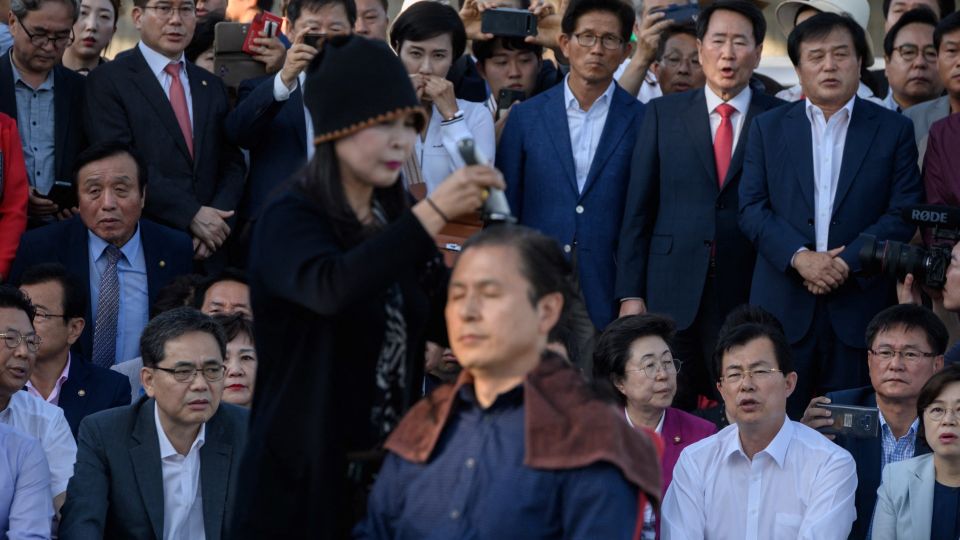
SEOUL – Head-shaving protests have returned to South Korean politics as the local election draws near. But some question the efficacy of such protests, saying the once powerful political tool has been exploited.
The latest politician to have his locks publicly shorn was Oh Jun-hwan, a mayoral hopeful for the city of Goyang, Gyeonggi Province. Shaving his head in front of the People Power Party headquarters in Seoul on Tuesday, Oh claims the party eliminated him from the mayoral race even though he was the front-runner in multiple polls, demanding fairness in the party’s candidate selection process.
Oh was not the only conservative who refused to accept the People Power Party’s candidate nomination results.
Former People Power Party lawmaker Kim Byong-wook had his head shaved Monday after he was eliminated as a potential candidate for mayor of Pohang, North Gyeongsang Province. He also called the party’s selection process unfair, likewise noting his performance in the polls.
Similarly, North Chungcheong Province Gov. Kim Young-hwan protested the party’s decision to eliminate him from the race for the seat he holds. Following the announcement of his elimination on March 16, Kim posted a video on Facebook showing his follicles falling at a local barbershop on Thursday.
“It is only North Chungcheong residents who can cut me off in the race. … We still have hope,” his post read.
Meanwhile, incumbent Busan Mayor Park Heong-joon on Monday also got buzzed — for the first time in his two-decade political career — in front of the National Assembly’s main building in Seoul. He denounced the liberal party-controlled National Assembly’s move to sideline a special bill aimed at providing incentives for investments in Busan and improving its urban infrastructure.
Park’s complaint was that Busan is being discriminated against, given that similar special bills to support Gangwon Province and North Jeolla Province had gained parliamentary committee approval and were set to be tabled at the National Assembly’s plenary session.
Park’s move apparently followed that of Gangwon Province Gov. Kim Jin-tae, who experienced his own depilation in February, when he was calling for a special bill to incentivize investment in Gangwon Province. On March 17, Kim was confirmed as the People Power Party’s candidate for another term as Gangwon Province governor.
Park is one of two contenders in the party’s Busan mayoral race, alongside Rep. Joo Jin-woo.
As lawmakers and councilors butted heads over the heated political debate surrounding the launch of one or more megacities, some of them opted to go under the razor.
Regarding the proposed launch of a megacity through the administrative merger of Daejeon and South Chungcheong Province, Ahn Kyung-ja, a Daejeon city councilor affiliated with the People Power Party, had her scalp laid bare on Feb. 12 to protest the liberal bloc’s unilateral push for the merger of the two administrative bodies.
This followed corresponding actions from liberal politicians in favor of the megacity plan, including Democratic Party Rep. Park Beom-kye. Announcing a bid to lead a newly merged megacity, Park endured his own buzz cut on Feb. 28. The clippers’ efforts went for naught, though, as a merger before the June local elections effectively fell through amid the conservative party’s opposition Park dropped the bid and decided not to pursue any post in the upcoming local election.
Many South Koreans, under the lasting influence of Confucian tradition, have considered the act of shaving one’s head as a way to express unwavering commitment to a certain goal.
But experts doubt today largely doubt the nonviolent protest’s ability to hold the significance of a political message meant to symbolize strong determination and sacrifice. Voters, they say, fundamentally no longer subscribe to the belief that their bodies should be cherished as a gift from their parents.
“In the past, head-shaving ceremonies were performed in an environment where these actions were perceived as a show of desperate need to make such a choice, even though it was considered a great act of disrespect to one’s parents,” Lee Jun-han, vice president for external affairs and a professor of political science at Incheon National University, told The Korea Herald.
“The sense of determination is not being conveyed as much as it used to in the past. … Since politicians (recently) shave their heads ahead of elections and candidate selections, it can be perceived as being far from driven by pure motivations.”
“Today, it seems highly likely that voters will perceive it as a somewhat cliched and anachronistic performance,” said Lee Jae-mook, a professor of political science at Hankuk University of Foreign Studies. “It is questionable how much genuine empathy such outdated behavior can elicit.”