

November 27, 2025
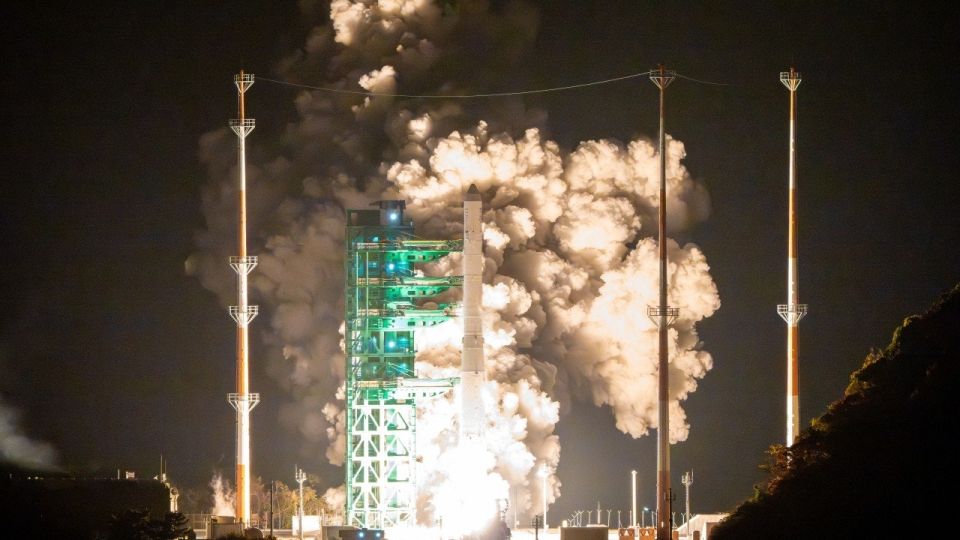
SEOUL – Korea successfully launched the homegrown Nuri rocket, also known as Korea Space Launch Vehicle-II or KSLV-II, into space from the Naro Space Center in Goheung, South Jeolla Province, on early Thursday, signifying the country’s emphasis on empowering the private sector to usher in a new era of space ecosystem.
Although an abnormal signal from the pressure sensor of the umbilical attached to the rocket delayed the launch back to 1:13 a.m. from its originally scheduled liftoff time of 12:55 a.m., the homegrown space launch vehicle eventually blasted off from the launching pad.
The fourth Nuri rocket, which was carrying 13 satellites including the Compact Advanced Satellite-3, or CAS500-3, a 500-kilogram next-generation midsized satellite built to conduct highly light-sensitive science missions, soared into the sky, marking the first nighttime space launch vehicle blastoff in Korea.
The launch was a smooth flight as it was able to complete the separation of the first and second stage engines about two and five minutes after the liftoff, respectively. The Nuri rocket surpassed the 500-kilometer altitude some seven minutes after the blastoff and completed the stoppage of the third engine and orbit entrance some 12 minutes after the launch.
The Nuri rocket successfully shot out its main payload CAS500-3, approximately 13 minutes after the launch into a 600-km orbit with the remaining 12 cube satellites being released into the same orbit in phases with a 20-second-interval between each deployment to complete its mission.
According to the Korea AeroSpace Administration, or KASA, the CAS500-3 made its initial communication with the ground control at the King Sejong Station in Antarctica at 1:55 a.m.. The satellite is expected to make 14 rounds of communication with the ground control centers in Korea, Antarctica and Norway through noon on Thursday.
“The Nuri rocket will enhance its technological stability and trust with two more flights through 2027,” said KASA Administrator Yoon Young-bin in a press briefing following the launch at the Naro Space Center.
“On top of that, KASA will push for the development of a next-generation space launch vehicle that is more advanced than the Nuri rocket based on the experiences of the Nuri rocket development’s experiences and expertise to bolster Korea’s space capabilities.”
Unlike the three previous launches, Hanwha Aerospace took the lead in launching the Nuri rocket for the first time with the fourth launch as it had become the system integrated company to obtain the responsibilities behind the blastoff from the Korea Aerospace Research Institute.
Hanwha will continuously be in charge of the next two launches in 2026 and 2027 as the defense conglomerate zeroes in on strengthening its space launch capabilities to bolster the country’s space ecosystem.
The fourth launch of the Nuri rocket came after Korea became the seventh country in the world to have succeeded in launching payloads with a total weight of 1 metric ton or heavier into the low-Earth orbit with the third launch of the Nuri rocket in May 2023.
“Based on today’s success, we will unwaveringly push for Korea to become the world’s top 5 space powerhouse that develops next-generation space launch vehicles and explores moon and deep space,” said Bae Kyung-hoon, prime minister and minister of Science and ICT.