


December 3, 2025
SEOUL – The martial law declaration by ousted President Yoon Suk Yeol on Dec. 3 lasted only six hours, but a year later, the animosity it unleashed lives on.
Those six short hours fundamentally rewired South Korean politics, seeping into the very bones of the party system and the identities of partisans.
The mass rallies have ebbed, but the mutual hostility that once powered the protests has migrated to the heart of politics and society. Lawmakers and party loyalists are locked into a confrontational mode, and society is divided.
Politics is now driven less by policy debates than by visceral animosity toward the other side.
Moreover, the martial law crisis is not a closed chapter. It sits at the center of today’s politics as the most effective amplifier of partisan animosity.
With June’s local elections approaching, its unresolved nature offers both major parties a reliable, low-cost electoral tactic: Mobilizing deep-seated hostility activates the hardcore base far more efficiently than any complex policy agenda.
The cost of hardball party politics, observers warn, is a self-reinforcing loop: Polarization breeds apathy among exhausted moderates and their withdrawal, which in turn emboldens the radical base; and base-driven politics then widens the gulf — locking the country into a cycle that feeds on its own extremes.

As the Constitutional Court continues its record-long deliberations without announcing a date for the ruling on the impeachment of then-President Yoon Suk Yeol, protesters hold separate one-person demonstrations for and against impeachment outside the court in Jongno-gu, Seoul, on March 28. PHOTO: THE KOREA HERALD
Scholars diverge on a key question: Has political polarization actually worsened overall since Yoon’s martial law declaration?
Yet there is broad agreement on one point: Among committed partisans in both major parties, aversion toward the other camp is deepening — a pattern defined as “affective polarization,” in which political identity is shaped by visceral animosity.
Lee Jae-mook, a professor of political science and diplomacy at Hankuk University of Foreign Studies, said the animosity unleashed in the political arena has increasingly woven itself into daily life.
“There’s growing research showing that the closer a relationship becomes — the more it moves into truly intimate territory — the more people avoid spending time with someone who holds different political views,” Lee told The Korea Herald. “That suggests affective polarization is no longer contained within politics; it’s spilling over into everyday, nonpolitical life.”
Public surveys capture the mood. In Embrain Trend Monitor’s poll of 1,000 adults ages 19 to 59 this May, respondents cited political conflict between the ruling and opposition parties as Korea’s most severe social divide at 49.2 percent, up from 42.7 percent in 2024. Ideological conflict between progressives and conservatives ranked second at 48.1 percent.
A separate annual study released in October by the Center for Social Value Enhancement Studies and Triplelight likewise found political conflict rated most severe at 95.9 percent, ahead of labor-management conflict at 87 percent and generational conflict at 85.7 percent.
“I think political polarization in Korea has plateaued. That is primarily because it is difficult for Korea to become more polarized. It really cannot get much worse, and we see a lot of that in the public opinion numbers,” Karl Friedhoff, a fellow for Asia Studies at the Chicago Council on Global Affairs, told The Korea Herald. “What can change is the intensity of that polarization and the actions people are willing to take against their perceived political enemies.”
However, Kim Jung, a professor of political science at the University of North Korean Studies, cautioned against interpreting today’s animosity as a neatly bifurcated electorate. Surveys show no clear evidence of a bimodal split among the public, making it difficult to argue that polarization at the mass level has sharply advanced.
Instead, Kim draws a line between the electorate overall and the partisan core. Even before the June early presidential election, partisan sorting had already deepened, with affective polarization among party supporters steadily widening.
“What this means is that people who support conservative parties do so because they dislike the progressive party — and vice versa. In highly emotional terms, they make negative judgments about the other side, the core of their partisan identity,” Kim said.
“Among party supporters, the affective distance itself is gradually growing, and even at this point — one year after the martial law declaration — there are more findings suggesting that it has in fact grown further. So, we could say that the level of hatred toward the other side is showing up more strongly.”
According to the “2025 Post-Election Public Perception Survey” released in June by Seoul National University’s Institute for Future Strategy, a web-based poll of 1,500 adults aged 18 and older found strikingly low cross-party favorability scores on a 100-point scale. Supporters of the ruling Democratic Party of Korea gave the People Power Party 14 points, while the main opposition People Power Party supporters gave the Democratic Party 18 points.

People Power Party leader Rep. Jang Dong-hyeok, floor leader Rep. Song Eon-seog and other PPP lawmakers attend an emergency general meeting at the National Assembly in Yeouido, Seoul, on Oct. 13, wearing mourning attire and holding placards calling for the dissolution of the special counsels investigating Former President Yoon Suk Yeol and others close to him. PHOTO: THE KOREA HERALD
Experts say that while underlying societal fractures fuel polarization, antagonistic signals from political elites are the fundamental cause of accelerating affective polarization. Furthermore, digital populism, amplified through platforms such as YouTube and social media, makes that spread faster and harder to contain.
“Political actors on both sides have tended to accelerate rather than dampen these tensions by mobilizing resentment, demonizing opponents, and relying on YouTube-driven outrage politics,” Shin Gi-wook, a professor of contemporary Korea in Stanford University’s Department of Sociology, told The Korea Herald.
Yoon Kwang-il, a professor in the Department of Political Science and International Relations at Sookmyung Women’s University, said, “South Korea’s political polarization, at its core, begins with a widening gap among political elites — and then spreads outward to the public.”
“In general, people are not very interested in politics. Since they are not, they tend to take in the signals — the cues, as we call them — that come from the politicians they support,” Yoon said.
“Because politicians’ language and behavior have become intensely antagonistic as a matter of routine — and that hostility is now amplified not only through traditional media but also online — it is being transmitted to voters.”
Because this intensified antagonism finds its direct expression in the unresolved martial law crisis, animosity among partisans is likely to remain activated and sustained.
As the Lee Jae Myung administration is pressing to hold those complicit in Yoon’s actions to account, the Democratic Party and the People Power Party are locked in a vicious cycle of hard-line, attack-first politics.
“Whatever the details, in the end, this is a war. It’s about survival. The martial law declaration was wrong — that much is clear. But the more the issue is pressed and pressed through judgment and punishment, the more political ground shrinks for the People Power Party and for the broader conservative camp,” Professor Lee Jae-mook said. “So they will try to use it to expand their political space — and to mobilize their side. And that mobilization, in the end, can only work by targeting the Lee Jae Myung administration. That’s the vicious cycle.”
Aram Hur, a professor at the Fletcher School at Tufts University, said the greater escalation risk now lies at home, even if diplomacy appears to be stabilizing by comparison.
“The Lee administration’s pragmatic diplomacy has so far avoided the key nationalist fault lines that tend to trigger left-right polarization,” Hur said. “President Lee has departed from the usual progressive line of being wary of the US and hostile to Japan — two countries that historically represent the pain of Korea’s division for many on the left.”
However, Hur added that foreign policy restraint does not inoculate domestic politics.
“Even if polarization is mitigated in the diplomatic arena, domestically, former President Yoon’s ongoing trial offers a hard test of whether forbearance and mutual tolerance can be upheld in due process. I think the jury — no pun intended — is still out on that.”
Another driver of deepening animosity among partisans, scholars said, is the parties’ growing tendency to pull away from the center — a pattern that becomes sharper as elections near.
“The most worrying trend is that South Korea’s two major parties are not converging toward the center but moving in extreme directions away from each other,” said Ha Sang-eung, a political science professor at Sogang University — a dynamic he said intensifies in the run-up to the June local elections.
Both the Democratic Party and the People Power Party are seeking to shift that architecture by giving greater influence to ordinary, dues-paying members in their primaries, albeit through different approaches.
“In principle, political scientists would say parties should of course be run by their members,” Ha said. “But what we’re seeing now is a drift toward the most fervent, hard-core members — and that is what’s concerning.”
Shin Jung-sub, a political science professor at Soongsil University, said both parties increasingly treat mobilizing their most hard-line supporters as the surest route to locking in votes and winning elections — even if it exhausts the center.
The two parties keep falling back on the same polarizing battles — the Democratic Party on martial law and impeachment, and the People Power Party on President Lee’s legal troubles — instead of debating everyday, bread-and-butter policy issues.
“So these kinds of messages really only keep landing with hard-line supporters. Even though they leave moderates feeling deeply fatigued, parties keep doing it because mobilizing through that base is crucial,” Shin said.
Given that dynamic, the electoral imperative makes the current lull in polarization unlikely to last.
“This is probably the quietest moment. But from early to mid next year, polarization will flare up again, because once election season arrives, parties have no choice but to switch that dynamic back on if they want to win,” Shin said. “When the election draws near, because they have to win, those tendencies will come out much more strongly — and if the race becomes close, it could become even worse.”

A voter casts an early ballot with a child at an early voting station inside the Jungnim-dong Community Service Center in Jung-gu, Seoul, on May 29, the first day of early voting for the 21st presidential election. PHOTO: THE KOREA HERALD
Shin Yul, a political science professor at Myongji University, said the dynamic is driven less by persuasion than by cold electoral calculus. Parties recognize that moderates dislike this kind of confrontation, but keep leaning into it because, as he put it, “It’s an election strategy.”
With turnout typically low, Shin explained, victory can hinge on maximizing base mobilization rather than competing for swing voters.
“Right now, it seems both parties want moderates not to show up — at the polls — and instead to pull in as many of their hardcore supporters as possible, setting up a head-to-head showdown between the two bases,” Shin Yul said. “It’s not that moderates are simply being pushed aside. They’re trying to foster political disgust among moderates — to create the mood of ‘This is their league. What is this? I’m not voting.’”
Other scholars warned the cycle carries a long-run cost.
Kim Jung foresaw that Korea’s party politics is likely to remain structurally oriented toward the extremes, locked into an adversarial mode in which centrists are effectively activated only at election time.
“Even though centrists constitute the majority in the overall distribution of public opinion, if their actual political participation declines and their sense of political efficacy erodes, their influence inevitably shrinks,” Kim said. “And when that happens, the constraints that keep politics from sliding further toward the extremes will break down. That is what worries me most.”
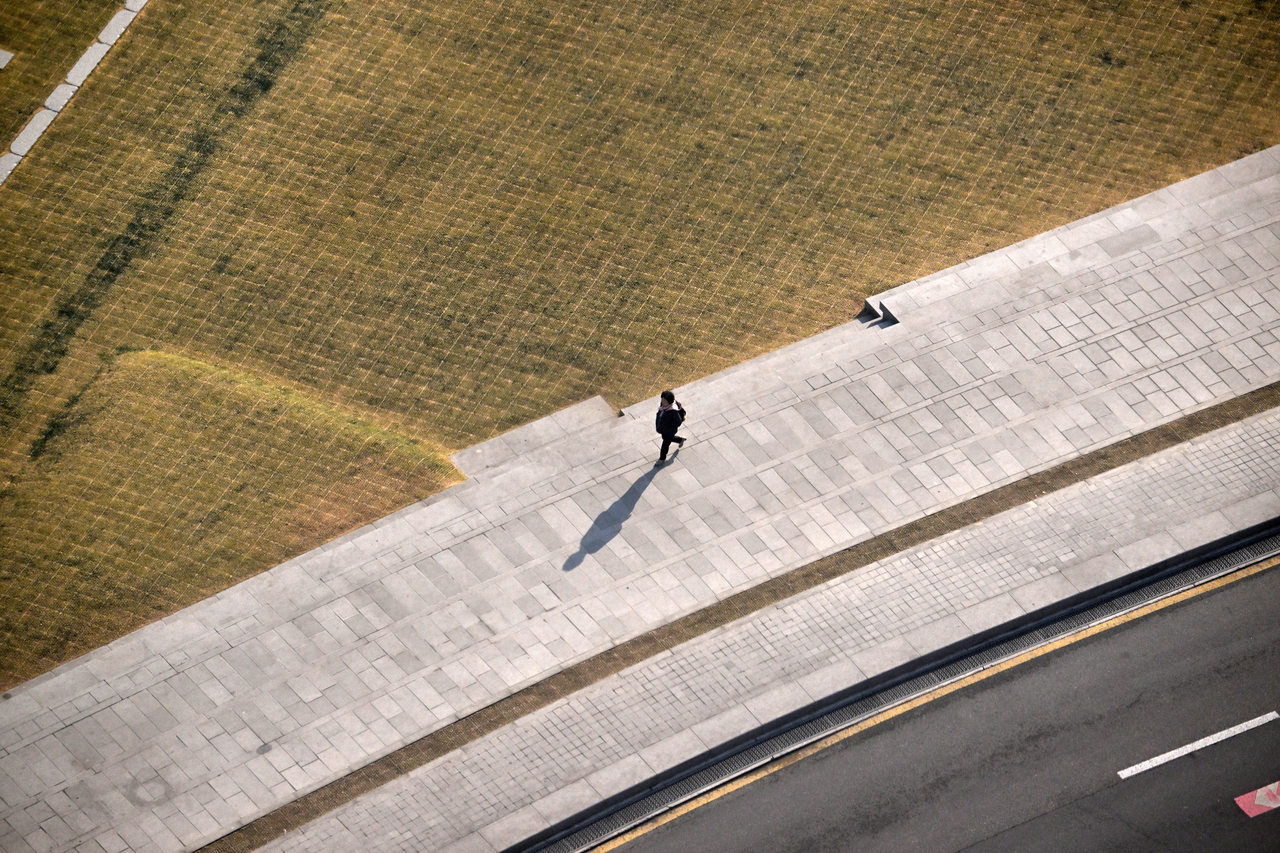
A passerby walks along the sidewalk near Gwanghwamun in Seoul on April 7, after scores of tents were taken down there following the Constitutional Court’s ruling to uphold the impeachment of President Yoon Suk Yeol. PHOTO: THE KOREA HERALD
The long-run risk is not only that polarization persists, but that the system produces uneven participation: a loud, hardened core and a thinner, more exhausted middle.
“I think the trend over the next decade or two will be more towards apathy,” Friedhoff said.
“The polarization we see now is mostly driven by the deep divide between the older Koreans — who vote primarily conservative — and those in their 40s and 50s — who vote primarily progressive. But those in their 20s and 30s are much less politically engaged from what I can see, and that will drive more disengagement.”
Recent Gallup Korea polling points in the same direction. In the first, second and third weeks of this November, the share of respondents reporting “no party preference” was highest among younger adults. Among those ages 18 to 29, the figure rose from 32 percent to 40 percent, then eased to 37 percent. Among people in their 30s, it climbed from 31 percent to 41 percent before falling to 34 percent.
“The generational/partisan divides cannot really be disentangled. Those two overlap so closely at the moment that they are largely one and the same. These are by far the most important drivers of polarization, and they are deeply entrenched,” Friedhoff said.
That is why observers say the most urgent task is to find a credible way to pull younger voters back into politics — before disengagement becomes structural.
Hur said political parties should shift back toward competition around programmatic issues.
“Those are the issues that the new generation of voters — who will steer the country through new national challenges such as fertility decline and migration — actually care about,” Hur said. “Both parties would be wise to consider reforms to party recruitment and seniority processes to elevate leaders from the younger generation.”
Shin Gi-wook stressed that re-engaging younger Koreans will also require material repairs — and institutional ones.
”The most urgent priority is restoring fairness and social protection, particularly for younger generations who feel locked out of opportunity. Korea must also strengthen institutions that can mediate conflict instead of amplifying it,” Shin said.
Shin pointed to reforms ranging from electoral rules, including the current winner-takes-all system, and stronger judicial independence to civic education that teaches pluralism and democratic restraint.
”Unless these underlying inequalities and institutional weaknesses are addressed, polarization will remain a defining threat to Korea’s democratic stability,” Shin warned.