

June 4, 2026
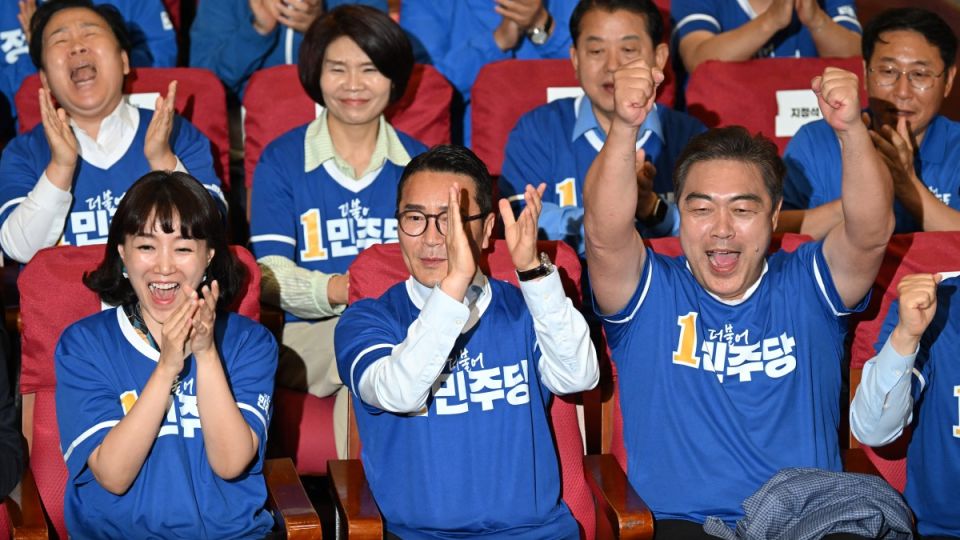
SEOUL – South Korea’s ruling Democratic Party emerged from Wednesday’s local elections with a sweeping victory that reaffirmed its dominance, but the results also exposed the limits of its reach: Seoul stayed in conservative hands, and much of the nation’s southeast remained beyond its grasp.
The Democratic Party has won 12 of the 16 mayoral and gubernatorial races, while the main opposition People Power Party has secured victories in Seoul, as well as Daegu and both North and South Gyeongsang provinces — its traditional stronghold — as of Thursday morning.
That is a dramatic reversal from the 2022 local elections, when the Democratic Party suffered a crushing defeat, winning only five of the 17 metropolitan and provincial government posts — two have merged for this year’s vote. The result, following its victory in the early presidential election in 2025, would cement the party’s return to local government dominance after four years in the wilderness.
According to the National Election Commission, the Democratic Party had won in Busan, Incheon, Daejeon, Ulsan, Sejong, Gyeonggi, Gangwon, North Chungcheong, South Chungcheong, North Jeolla, South Jeolla and the newly integrated Gwangju-South Jeolla special self-governing city.
But the ruling party’s momentum stopped short in the capital, where the race took a dramatic turn in the final stretch.
In Seoul, People Power Party candidate Oh Se-hoon clinched victory by making a late comeback to overtake Democratic Party challenger Chong Won-o, who had led in the earlier stages of the count, in a race overshadowed by voting disruptions.
Chong conceded defeat Thursday morning, saying, “I will accept the citizens’ choice with a heavy heart and humility.” With 97.7 percent of ballots counted, Oh held a razor-thin lead with 48.94 percent of the vote, compared with Chong’s 48.34 percent, a margin of 30,359 votes.
However, even after the final result is announced, the controversy is likely to linger, as the People Power Party has questioned the validity of some votes in Seoul and raised the possibility of demanding a revote.
As of Wednesday afternoon, the National Election Commission had confirmed ballot shortages at at least 14 polling stations in Seoul — 12 in Songpa-gu and one each in Gangnam-gu and Gwangjin-gu. The shortages delayed the close of voting in parts of Seoul, affecting both the vote counting process and turnout estimates.
In the closely watched battleground of Daegu, People Power Party candidate Choo Kyung-ho won the mayoral race after overtaking Democratic Party rival Kim Boo-kyum, a former prime minister, early in the count.
Conservatives also retained North Gyeongsang Province, where incumbent Gov. Lee Cheol-woo of the People Power Party secured reelection. In neighboring South Gyeongsang Province, People Power Party candidate Park Wan-soo emerged victorious over Democratic Party rival, former Gov. Kim Kyung-soo after a tightly contested race.
In Busan, one of the conservative southeast’s key strongholds, Democratic Party candidate Chun Jae-soo, a former oceans minister and three-term lawmaker, secured victory over incumbent People Power Party Mayor Park Hyeong-joon.
Chun’s win makes him Busan’s second Democratic Party mayor, after Oh Keo-don’s victory in 2018, and returns the city to Democratic Party control after eight years.
The Democratic Party also clinched Gangwon Province, another key battleground, reclaiming the provincial government from the People Power Party after four years.
Democratic Party candidate Woo Sang-ho, a former presidential secretary for political affairs under the Lee Jae Myung administration, defeated incumbent Gangwon Gov. Kim Jin-tae of the People Power Party.
In North Jeolla Province, Democratic Party candidate Lee Won-taeg defeated independent rival Kim Kwan-young, the incumbent governor who had been expelled from the Democratic Party during the nomination process.
The party also secured major victories in the Seoul metropolitan area.
The party also swept the Seoul metropolitan area. In Gyeonggi Province and Incheon, Democratic Party candidates Choo Mi-ae and Park Chan-dae defeated People Power Party rivals Yang Hyang-ja and Yoo Jeong-bok, respectively.
Democratic Party candidates Min Hyung-bae and Wi Seong-gon were elected in the Gwangju-South Jeolla integrated metropolitan government and Jeju Province, respectively.
Choo became the first woman in South Korean constitutional history to lead a metropolitan city or province, while Min became the first elected head of an integrated metropolitan government.
The People Power Party, however, performed relatively strongly in the 14 National Assembly by-elections held alongside the local elections, winning four seats despite the Democratic Party’s broader success.
The Democratic Party won nine seats, while the People Power Party took four and an independent conservative candidate won one. Thirteen of the 14 seats had previously been held by Democratic Party lawmakers.
The Democratic Party secured victories in National Assembly by-elections in Yeonsu-A and Gyeyang-B in Incheon; Gwangsan-B in Gwangju; Ansan-A and Hanam-A in Gyeonggi Province; Asan-B in South Chungcheong Province; Buan-A and Buan-B in North Jeolla Province; and Seogwipo on Jeju Island.
Two of the most closely watched contests were Busan’s Buk-A district and Pyeongtaek-B in Gyeonggi Province.
In Busan’s Buk-A, independent candidate Han Dong-hoon, a former People Power Party chair, was elected after defeating Democratic Party candidate Ha Jung-woo, who served as senior presidential secretary for artificial intelligence policy and future planning under the Lee administration.
In Pyeongtaek-B, Yu Eui-dong of the People Power Party defeated Cho Kuk, chair of the Rebuilding Korea Party. In Daegu’s Dalseong district, People Power Party candidate Lee Jin-sook, former chair of the Korea Communications Commission, secured victory.
People Power Party candidate Yoon Yong-geun also staged a late comeback in the vote count to secure victory in the Gongju-Buyeo-Cheongyang constituency.