

May 14, 2026
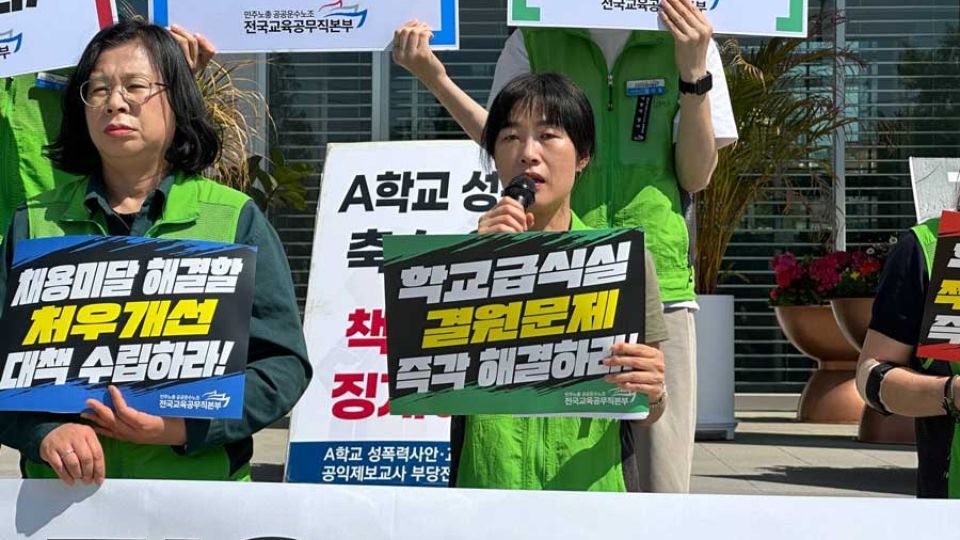
SEOUL – Unionized workers in the education sector on Wednesday urged authorities to address staffing shortages and improve working conditions for school cafeteria workers at a press conference in front of the Seoul Metropolitan Office of Education.
The National Union of Education Public Service Workers said school kitchens across 17 cities and provinces nationwide were short by as many as 1,852 workers last year. Recruitment shortfalls were found in 14 cities and provinces for which data were available, with 3,118 positions left unfilled, representing a shortfall rate of around 27 percent.
“At schools across Seoul, one kitchen worker is now doing the work that should be done by two people,” said Myung Jae-eun, a union member and school cook.
“We lift heavy rice cookers and soup pots, prepare meals for hundreds of students and keep moving in front of hot fryers and ovens without rest,” Myung added. “Even with back pain and numb wrists, we endure it because the positions that should be filled remain vacant.”
The union pointed to heavy workloads, high risks of industrial accidents and poor treatment as the main reasons people avoid school kitchen jobs.
It said the sector has fallen into a “vicious structural cycle,” in which understaffing increases workloads, which in turn worsens recruitment difficulties and drives existing workers to leave.
The union also argued that school cafeteria workers shoulder a heavier burden than cooks at other public institutions.
School cafeteria workers face heavier workloads than at other institutes
According to a study by Incheon National University that surveyed 3,128 school cafeteria workers nationwide, each worker was responsible for serving lunch to an average of 114.5 people. That figure was nearly double the average of 65.9 people per cook at other public institutions.
The same study estimated that staffing levels would need to increase by an average of 23 percent to bring workloads down to a safer level. The union added that the number of meals each worker must prepare rises further when colleagues take leave.
The union criticized a cut to the budget for improving ventilation systems in school kitchens, saying such cuts run counter to efforts to reduce heavy workloads and risks of industrial accidents.
The Korea Occupational Safety and Health Agency’s 2025 performance evaluation of ventilation systems in school cafeterias found that 54 of the 301 facilities inspected were inadequate.
However, the combined 2026 budget for improving school cafeteria ventilation systems in 16 cities and provinces, excluding Seoul, stood at approximately 297 billion won ($198 million), according to the union. This marks a decrease of 70.98 billion won from last year’s budget, finalized in 2024, and a 66.34 billion won decrease from the actual amount executed in 2025, it said.
“To break this vicious cycle, standards on the appropriate number of meals handled per worker must be established as soon as possible,” union leader Jeong In-young said during the press conference.