

November 26, 2025
JAKARTA – As a geographically fragmented nation with diverse lived experiences, Indonesia seems destined to grapple with recurring cycles of strongman rule.
Centralization, with the military as its enforcer, has long been seen as an expedient fix for elite political dysfunction and regional dissent. President Prabowo Subianto’s early embrace of centralization and military influence suggests a risk of repeating that cycle.
His direction echoes the patterns of Sukarno and Soeharto, both of whom turned to centralization in their pursuit of national unity, only to become authoritarian in the process.
When Sukarno proclaimed independence in 1945 and became Indonesia’s first president, he steered not a unified nation, but a patchwork of Dutch colonial outposts with uneven infrastructure and competing loyalties. His task was monumental: to build a functioning national government and economy that could bind these disparate regions together.
As a charismatic leader steeped in anti-colonial ideals, Sukarno did not initially envision a highly centralized state. With his socialist worldview, he adopted liberal democracy and sought to develop local administrations and councils in Java and other islands.
But the challenges overwhelmed the young republic. Weak domestic capital, limited governance capacity, and a lack of information about islands beyond Java fueled disputes over resource distribution and revenue control between Jakarta and the regions.
Without a capable central government, islands such as Sumatra and Sulawesi grew increasingly dissatisfied with Jakarta, paving the way for rebellions and separatist movements. Darul Islam uprisings in Aceh, Java, South Kalimantan and South Sulawesi and the PRRI/Permesta revolts in Sumatra and Sulawesi became defining symbols of distrust and vulnerability of the country in its early years.
By the late 1950s, the Sukarno administration was deep in a fiscal crisis. Revenue stagnated while military spending skyrocketed to quell rebellions. In 1959, he instituted “Guided Democracy”, dissolving parliament based on allegations that some political parties had been involved in the rebellions. He strengthened his alliance with the army that had helped him crush the revolts, and the Indonesian Communist Party (PKI), then the largest party in Java, that supplied him with grassroots support.
Yet Guided Democracy delivered little improvement. Sukarno increasingly leaned on hawkish foreign policy and campaigned for self-reliance. He cofounded the Non-Aligned Movement, but later grew hostile over the country’s borders and began military operations in Papua (then-West Irian) and against Malaysia.
Despite praise for Indonesia’s growing international standing as an emerging country, critics have accused these moves as manipulation to create a perpetual sense of crisis at home. Indonesia’s hardline stance culminated in its withdrawal from the United Nations.
This period was also marked by Indonesia’s most hostile stance toward foreign capital. Anti-Western sentiment translated into restrictive regulations and a wave of nationalizations of Dutch businesses. Foreign investors fled, leaving only the United States in oil and gas and foreign aid from the Communist bloc, China and the USSR, and Japan, which sought to mend relations after its brief occupation of Indonesia.
By 1965, amid Sukarno’s declining health and political polarization, inflation soared above 650 percent. Tensions between the army and PKI erupted into open conflict after the assassinations of six generals, leading to the violent purge of communists and ultimately Sukarno’s downfall.
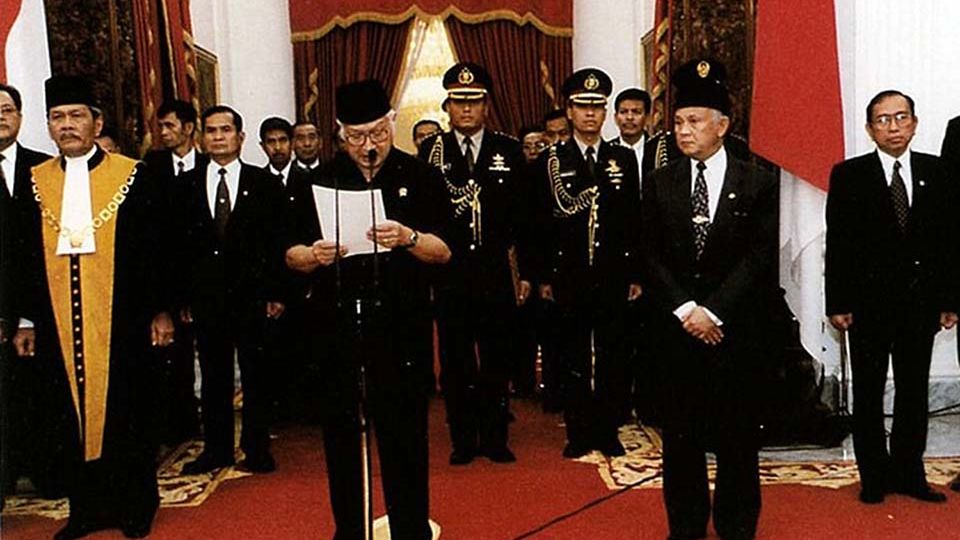
Soeharto assumed power amid the ruins of economic collapse and political chaos. Building on the authoritarian centralization begun under Guided Democracy, he restored political stability and security through increased military dominance. Under the pretext of eliminating communism, his regime persecuted anyone associated with the PKI, resulting in the deaths of hundreds of thousands.
With the support of students, academics and Muslim organizations, Soeharto established a government, prioritizing economic recovery. His early moves included reining in inflation, controlling public finances and restoring foreign investment. Between 1967 and 1981, Indonesia’s economy grew averagely at 8 percent annually, dubbed as the fastest growth trend in the country’s history.
But these achievements carried heavy costs. Soeharto expanded presidential powers, weakened political parties and curtailed civil liberties. Authoritarianism became institutionalized and enforced by the military.
In the realm of politics and security, the Operational Command for the Restoration of Security and Order (Kopkamtib) conducted surveillance, detention and repression of political activists, students and critics. Initially created to combat communism, it became a weapon to silence Soeharto’s opponents.
The military, already embedded in economic activities since they secured control over the Guided Democracy period, further consolidated its role under Soeharto. Army generals led strategic businesses through state-owned enterprises.
Ibnu Sutowo, for instance, a military doctor turned regional commander, was put in charge of oil and gas company Pertamina. Achmad Tirtosudiro, an army logistics chief, controlled food distribution through Bulog and Berdikari.
The military presence accelerated economic recovery, but also entrenched corruption and inefficiency. Corruption was rampant among the military-led businesses, notably by Ibnu, who was dismissed from Pertamina after a decade.
Poor corporate management, limited capital accumulation, and a lack of innovation left Soeharto’s regime fragile once easy money from oil, gas and mining dried up in the 1990s.
Cronyism, patronage and the concentration of wealth among Soeharto’s family and allies undermined the formation of robust economic institutions. When the 1997 Asian financial crisis struck, the economy crumbled, social unrest spread and the regime collapsed.
Under Soeharto, the centralized authoritarian model also fueled regional insurgencies in resource-rich Aceh and Papua, driven by grievances over inequitable revenue sharing and lopsided development.
The fall of the two leaders showed that centralization, especially under authoritarian rule, may be effective in crisis management and early state-building. But it cannot sustain growth in a maturing nation.
Indonesia is no longer a fledgling republic struggling to define its borders, nor a nation in economic or political crisis. It is a middle-income democracy whose thriving private sector holds large untapped potential.
Decentralization and regional autonomy have strengthened local administrations. Regional leaders, directly elected by the people, are no longer isolated from national politics. Many are now influential players in shaping the country’s direction.
The challenges of the early days of the republic no longer define Indonesia’s present. But the danger remains that leaders, confronted with contemporary pressures, may resort to old solutions unsuited to the country’s current condition.
Centralization, which is prone to authoritarianism, may serve as an emergency structure in moments of collapse, but it cannot drive innovation, productivity or global competitiveness.
Indonesia’s central task today is not survival, but advancement. And advancement requires a strong state, not a controlling one — a government that nurtures talent, fosters innovation, strengthens law enforcement and empowers its people to collectively propel the nation forward.
The writer is deputy editor-in-chief of The Jakarta Post.