

May 22, 2026
SEOUL – Starbucks Korea’s canceled “Tank Day” tumbler promotion has created a political firestorm, after far-right internet users began posting memes defending the coffee chain and mocking the country’s democratic movement.
The backlash began after Starbucks Korea unveiled a tumbler campaign Monday using the phrases “Tank Day” and “Slam on the desk!” The wording appeared on the anniversary of the May 18, 1980, Gwangju Democratic Uprising and was widely criticized for echoing two of the most painful episodes in Korea’s struggle against military rule.
Tanks were used in the military crackdown in Gwangju under Gen. Chun Doo-hwan, in which hundreds died. The latter phrase evokes the police cover-up of the 1987 torture death of student activist Park Jong-chul.
Starbucks Korea apologized and halted the promotion. Shinsegae Group Chairman Chung Yong-jin also issued a public apology, while Starbucks Korea CEO Sohn Jeong-hyun was removed from his post.
But the controversy has since spread online, where some ultraconservative users have embraced Starbucks as a way to push back against the boycott.
Far-right rallies around Starbucks
An AI-generated video posted Tuesday on X featured Chun drinking from Starbucks’ “Tank” tumbler and muttering, “Tastes good.”
Chun, South Korea’s former military dictator, seized power in a 1979 coup following the assassination of President Park Chung-hee and became president in August 1980. He is widely held responsible for the military crackdown on the Gwangju Democratic Uprising, one of the bloodiest episodes in South Korea’s modern history.
The video was posted by an account that had previously shared posts supporting former President Yoon Suk Yeol.
Another post by the same account showed an AI-generated Starbucks-style poster featuring Chun holding up a Starbucks cup. The poster read: “A good daily habit, Starbucks.”
Comments on the posts echoed far-right rhetoric. Some users wrote “crush commies,” while others said they would support Starbucks by buying its sandwiches.
In another high-profile case, the North Chungcheong Province chapter of the People Power Party posted on Threads early Tuesday, “I should stop by Starbucks before work tomorrow.”
An account belonging to Kim Seon-min, a People Power Party candidate for Geoje mayor, replied, “I should go and eat a sandwich.” The party chapter account responded, “Sandwich for breakfast tomorrow.”
Both the party chapter and Kim later issued apologies.
Other far-right internet users posted photos of themselves holding Starbucks coffee or tumblers in what appeared to be a counterreaction to the boycott movement.
Phrases such as “Coffee means Starbucks” and “right-wing beauty’s work outfit” appeared online. Some users also used the hashtag “anti-communist coffee,” while others shared images of tanks bearing the Starbucks logo.
For some users, visiting Starbucks stores appeared to become less about coffee than a way to signal their political stance.
Other doctored images mocking the boycott also circulated online, including one that showed a fabricated banner reading “No Leftist Zone” outside a Starbucks store. The image spread under the nickname “Myeolgong-bucks,” combining Starbucks with “myeolgong,” a Korean anti-communist slogan meaning “destroy communism.”
Boycott gains traction
The apparent embrace of Starbucks by some ultraconservative users came in response to a growing boycott movement against the coffee chain.
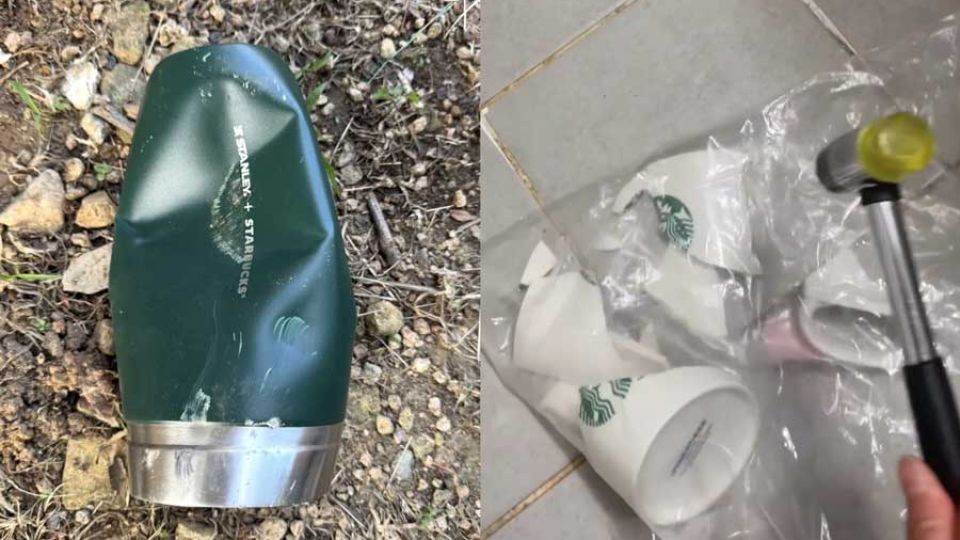
Social media users have posted photos and videos of themselves damaging Starbucks products or demanding refunds.
Posts showing people destroying Starbucks Korea mugs and tumblers have spread online, with some users tagging friends and urging them to join the boycott.
Others shared tips on how to receive refunds for prepaid Starbucks Korea cards, explaining the company’s refund policy through photos and videos documenting the process.
“Refunds are only available after more than 60 percent of the balance has been used,” one user wrote.
Photos of empty Starbucks stores in Gwangju, where the May 18 Democratic Uprising took place, also circulated online, with some users commenting, “This should be happening everywhere.”
Ruling party Chair Rep. Jung Chung-rae also urged the party’s election candidates and campaigners on Wednesday not to go to Starbucks.
The backlash also reached the government. Interior Minister Yoon Ho-jung said Thursday that his ministry would stop using products from companies that treat Korea’s democratic history lightly or use it for commercial purposes, in an apparent reference to Starbucks Korea’s “Tank Day” promotion.
In a post on X, Yoon expressed “deep regret” over what he called Starbucks Korea’s “anti-historical” conduct, saying democracy was built on the sacrifice and dedication of citizens.
Government agencies, including the Interior Ministry, have often used mobile vouchers such as coffee coupons for surveys, contests and public participation events, but the ministry will no longer provide products from companies that commercialize or trivialize democratic history, he said.
Baek Seung-jong, a history professor at Sogang University, said Starbucks Korea’s recent controversy risks weakening younger generations’ moral awareness of historical tragedies.
“Mocking a historical fact that forms the basis of Korea’s constitutional spirit and is recognized as a national commemorative day reignites wasteful ideological conflict and poses a serious risk of damaging social consensus on democratic values and the sense of community,” Baek said in a social media post.