

June 26, 2026
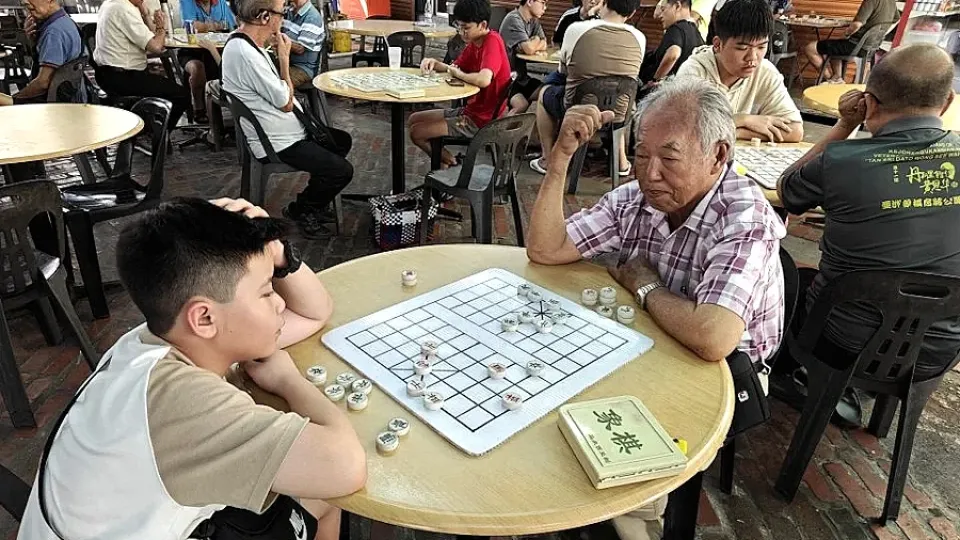
PENANG – When coffeeshop Selera SIM Food and Drink closes at 2pm, the Chinese chess matches begin in the shop.
Chess players sit down one after another to set up their boards, a rare sight of players focusing on the board game at the coffeeshop at Jalan Tengah, Bandar Bayan Baru.
No one is looking down at his phone, and there is no noisy gossip.
Instead, the air is filled with the sound of chess pieces striking the board.
The players, aged between 15 and 90, pass a leisurely afternoon together.
In an era that demands efficiency and speed, this place seems to exist in its own time zone, where time moves just a little bit slower.
Ooi Chee Keong, 42, owner of the coffeeshop, chooses to keep his doors open during break time for the chess players from all walks of life – business owners, lifeguards, school bus drivers, and hawkers – though the majority remain retired elders.
In an exclusive interview with Sin Chew Daily, Ooi shared that for over a decade, he has insisted on keeping his doors open, providing the venue, chessboards, and pieces completely free of charge.
Sometimes, he even digs into his own pocket to treat the players to chicken rice and drinks.
It all started with a chance encounter more than 10 years ago.
Back in the 1990s, this group of chess fans used to gather under a large tree nearby to test their skills, calling themselves the “Under the Big Tree Chess Club”.
Later, when Ooi took over the coffee shop from a friend, he decided to invite them into his shop to play so that the players were spared of wind, rain and the scorching sun.
What was meant to be a simple and friendly gesture unexpectedly turned a group of strangers into lifelong friends.
Over time, the coffee shop evolved into a vibrant hub for the neighbourhood to connect.
To keep the passion for Chinese chess alive, Ooi sponsors a tournament for the chess club every year, hoping to introduce more people to this traditional pastime and pass it down through generations.
A gathering of hidden masters
The chairman of the “Under the Big Tree Chess Club” Jack Lee, 47, has an enviable story about the “second half” of his life.
Once an electrical and mechanical engineer, Lee took the opportunity to retire at the age of 38 when his company offered a voluntary separation scheme.
Now fully retired, he enjoys a relaxed and carefree life, with Chinese chess being his most cherished pastime.
Lee shared that he learned to play from his father when he was in primary school.
Having defeated many of his classmates back then, he thought he was quite the master.
In his 20s, his work frequently brought him around Jalan Tengah, where he stumbled upon this group of hidden masters under the big tree.
When he finally stepped up to play, he was utterly crushed by almost every single player there.
The more he lost, the more he wanted to win.
It was this competitive spirit that kept Lee coming back to hone his skills, a routine he has maintained to this day.
However, he admits he has long outgrown the phase of blindly chasing victories.

Selera Sim Food and Drink coffeeshop owner Ooi Chee Keong (L); and Under the Tree Chess Club chairman Jack Lee. PHOTO: SIN CHEW DAILY
AI matches can’t compare with real game
Compared to staring at a cold phone screen or playing against an emotionless artificial intelligence (AI), Lee vastly prefers the genuine, face-to-face interaction between humans.
“AI has no emotions. Playing chess in a coffee shop allows me to see people who is happy, angry, or tense – that’s where the real thrill is.
“Sometimes, pushing your opponent into a corner until they get frustrated is incredibly satisfying!” Lee said.
Lee strongly believes in the saying, “The way you play chess reflects your character.”
“Watching how someone reacts when one loses a game or makes a wrong move reveals his temperament and personality.
“More often than not, a person’s chess style is a direct mirror of their character,” he said.
Years of playing in a bustling, noisy coffee shop environment have also trained Lee to focus.
“In the past, I would get distracted the moment people started talking next to me. But after being ‘tempered’ by this environment, my brain has learned to automatically filter out the noise and focus purely on my own strategy.”
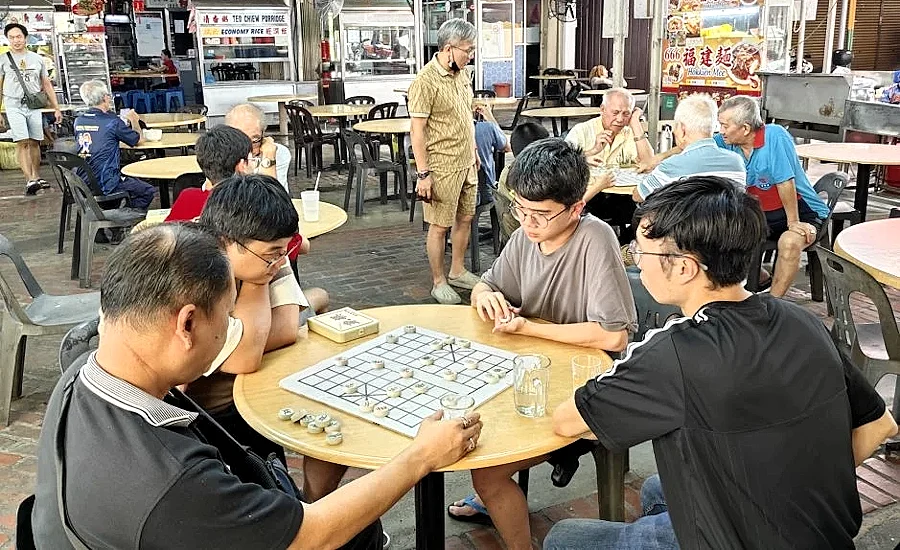
Selera Sim Food and Drink is the only place chess players gather for the game in Penang. PHOTO: SIN CHEW DAILY
Worries behind the laughter
Behind the laughter and vibrant energy of this community space, both Lee and Ooi harbour a quiet worry.
Penang Island used to boast three famous Chinese chess hubs in the past: Lebuh Presgrave, Rifle Range, and “Under the Big Tree”.
Today, the gathering at Lebuh Presgrave was permanently banned by the property owner after a dispute between players escalated and involved the police.
Meanwhile, the Rifle Range hub gradually faded away as older players passed on or scattered, and the younger generation failed to take over.
Selera SIM Food and Drink has now likely become the final “haven” for Chinese chess culture on Penang Island.
“Kids nowadays are all about e-sports and scrolling their phones.
“But playing chess doesn’t cost much money, and it trains your brainpower and fosters critical thinking,” Lee said.