


January 29, 2026
SEOUL – “You are the dancing queen, young and sweet, only seventeen,” the famous Abba song goes. But for Jun Jum-re, 78, and Jung Yoo-ok, 76, the lyric needs revision.
On stages across the world, they have offered a gentle rebuttal. With hair silvered and bodies marked by time, they became dancing queens well into their 70s — and they are having the time of their lives.
Before the COVID-19 pandemic, the two women traveled the world, performing to sold-out houses and receiving standing ovations in cities across Europe, Australia and South America. Their tours looked much like those of globe-trotting artists, stretching their European run to nearly 40 days — with one twist: neither woman had ever danced before. Both were retired elementary school teachers, and when they first stepped onto a stage, they were already past 60.
When they were young, they went to school to learn; as adults, they went to school to teach. For more than 40 years, they taught students, raised children and kept households running. Dance, let alone an international stage, belonged to an entirely different universe.
Then, about a decade ago, what they now describe as a “destined moment” arrived. The Ahn Eun Me Company, led by the celebrated Korean choreographer, began recruiting ordinary women in their 70s for “Dancing Grandmothers,” a work that would place them onstage alongside professional dancers.
“I had never danced, not once,” Jun said in an interview with The Korea Herald. “And the stage felt like a completely different world from my life. But something about it pulled me in. This was an internationally touring company, and I just wanted to see it for myself. I kept wondering, what kind of world would that be?”
By the time she was nearing 70, she said, her body ached everywhere, and people around her worried. But her desire to experience something entirely new outweighed her fears. When the prim, demure teacher announced that she was going off to dance, her family was stunned but quickly rallied behind her. Our mom is brave, they told her.
“I was the kind of person who hid in the back during talent shows for school staff,” Jun said. “I kept asking myself, why am I so shy? I think there was this boiling excitement inside me, but decorum and expectations kept holding me back. As I got older, I became braver. I felt like I had finally peeled off my shell.”
She asked her friend Jung to join her, only to discover that Jung had been a dancer all along. During her years as a teacher, Jung had quietly won awards for performances at school events. “I’ve always lived a cheerful life,” Jung recalled with a laugh.
Together, the two friends leapt onto the stage, setting aside the anxieties and fears so often associated with old age. What awaited them was not a swan song, but an overture — the beginning of a second act.
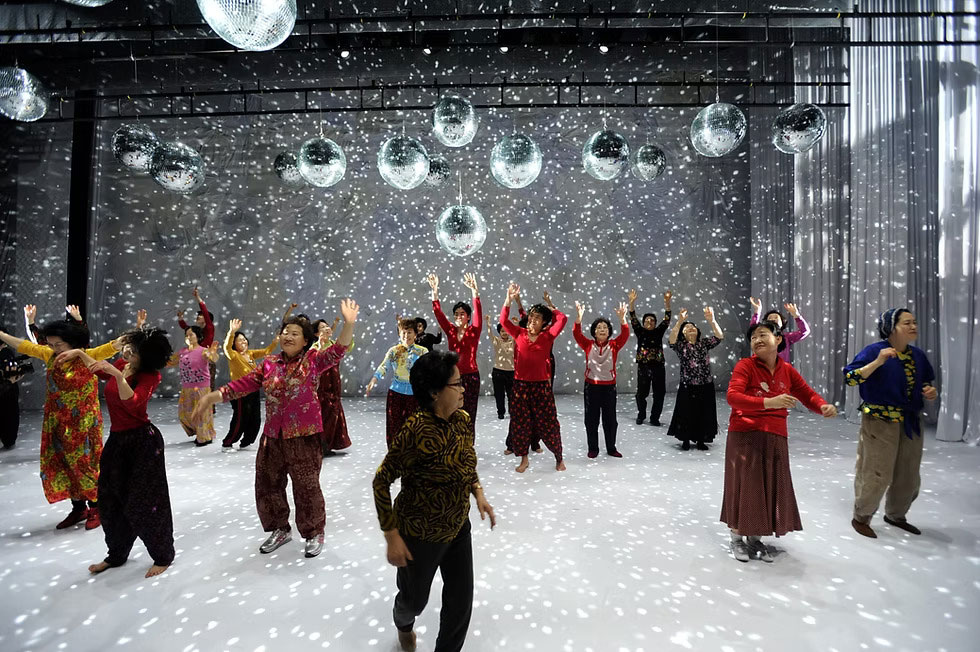
Ahn Eun Me Company’s “Dancing Grandmothers.” PHOTO: AHN EUN ME COMPANY/THE KOREA HERALD
Spontaneous joy the body remembers
Premiering in 2011, “Dancing Grandmothers” emerged from Ahn’s long-running research into Korean bodies and movement, part of an anthropological series exploring how dance is embedded in ordinary lives. The work brings together nonprofessional women in their 70s and older with professional dancers, creating performances that are playful, sweet and stirring.
Set to disco tracks, twist tunes and old Korean pop songs, the dancers perform “makchum,” a Korean term for spontaneous, untrained dancing, swaying awkwardly, wiggling their hips and swinging their arms from side to side.
The scene draws a giggle, and then, unexpectedly, hits something closer to tenderness. Their unpolished, honest rhythms radiate vitality that feels both intimate and universal.
“I couldn’t be happier dancing under the stage lights,” Jun said. “For someone so completely ordinary like me, it’s unreal and simply overwhelming.”
She had assumed makchum meant simply shaking one’s body, but once she entered it fully, the pain in her legs disappeared. So did her worries and fears. Joy rose unbidden.
“I was just moving my body, and people were cheering,” she said. “That’s when I realized there was dancing DNA passed down to us. I had only been suppressing it. It wasn’t dead.”
“Our dance doesn’t require practice,” Jung added. “We’re not showing off skill. We’re bringing out the purest movements in our bodies. That’s why there was no pressure at all. We just enjoyed every moment.”
The production toured extensively from 2016 to 2019, performing in more than 10 European countries, as well as in Brazil and Australia. It remains one of the Ahn Eun Me Dance Company’s most enduring works, often restaged with local elders in each city it visits.
Jun and Jung are among the most frequently featured performers, handpicked by Ahn as original members of the touring cast of 10. They most recently performed last year in their hometown of Jeonju, North Jeolla Province.
Abroad, they felt a particular pride representing what they fondly nicknamed “K-grandmas.”
“When we filled a 2,000-seat theater in Provence, it was electrifying,” Jun recalled. “They told us that only maestros like Chung Myung-whun usually sell it out. To receive a standing ovation there, I felt like a national team athlete.”
In effect, they were unofficial cultural ambassadors. They made gimbap to introduce Korean food as well, and Korean residents abroad came to see them perform. They were often invited to dinner afterward.
“We weren’t just dancing grandmothers,” Jung said. “We were sharing Korean joy and culture.”
Finding life in motion
For both women, the invitation arrived at a vulnerable moment. Retirement had left them adrift, submerged in a quiet sense of loss. The old age they had imagined was bleak: bent backs, canes, fading eyesight. And when they finally left the classroom at 62, they felt themselves slipping into those figures.
“I was becoming the very kind of old person I had imagined,” Jun said. “It left me feeling empty and lethargic. But dancing changed my life. I began to look forward to tomorrow.”
As they began to listen more closely to their bodies and find their rhythm, something changed. With each tentative movement, energy returned to days that had once felt inert. What they had assumed was the twilight of life, a time to endure rather than expect, began to open into possibility. Friendships formed across regions, and new, unfamiliar emotions surfaced. People around them noticed the change. They seemed brighter, more confident, less afraid.
But courage had not suddenly appeared in old age. Their lives had long been marked by grit, forged quietly in childhood and carried forward. Dance did not create bravery so much as reveal it.
Jun, the youngest daughter in her family, was not initially sent to school. At 14, she planted rice seedlings part-time to earn her own tuition. She went on to become the only female student from Gunsan to attend Jeonju National University of Education, where she first met Jung.
Jung, meanwhile, taught herself computer skills and video editing. She has since produced more than 100 videos documenting their tours. Now, she has taken up the piano as a new interest.
“We thought our lives ended at retirement,” Jun said. “If I had known the future could be this radiant, I would have worried less and lived more freely. But it’s all right. Every day is joyful now. Tomorrow makes my heart race. Even at our age, life feels just right.”