

April 21, 2026
JAKARTA – Japanese automaker Toyota and state-owned energy company Pertamina are looking to start the construction of a bioethanol plant in the second half of this year to achieve production in 2028.
Deputy Investment and Downstream Minister Todotua Pasaribu said in a press conference following a meeting with Toyota on Monday that the facility would be located in Lampung and that the construction would commence in this year’s third quarter or fourth quarter at the latest.
“Other than the [bioethanol] plant, the plan is also to grow one of the feedstocks, namely sorghum,” said Todotua, before saying that the longer-term plan was to build multi-feedstock sources that might include sugarcane and cassava.
The deputy minister said the detailed investment figure was still being calculated and that the production capacity would reach 60,000 kiloliters (kl) per annum. Indonesia is aiming for 4 million kl of bioethanol production by 2027.
Todotua said the project was initiated to support the country’s upcoming E10 policy, which seeks to make it mandatory for gasoline to have a blend of 10 percent ethanol derived from renewable biomass.
The project would be developed via a joint venture involving PT Pertamina New & Renewable Energy (NRE) and Toyota Tsusho Corporation.
Todotua mentioned that the Japanese Research Association of Biomass Innovation for Next Generation Automobile Fuels (raBIT) will be involved but did not clarify whether it would be part of the joint venture.
He went on to say that the project would receive incentives from the government, the further details of which are still being formulated.
Toyota CEO for the Asia region Masahiko Maeda, who attended Monday’s meeting, said in the press conference that Toyota would adjust its position to the government’s vision for the project when asked if the fuel would be mainly used for the automotive or industrial sector.
He said Toyota would play an “offtaker role” when needed by providing “the proper solution” in vehicles.
“We can provide any type of cars, which we already have”.
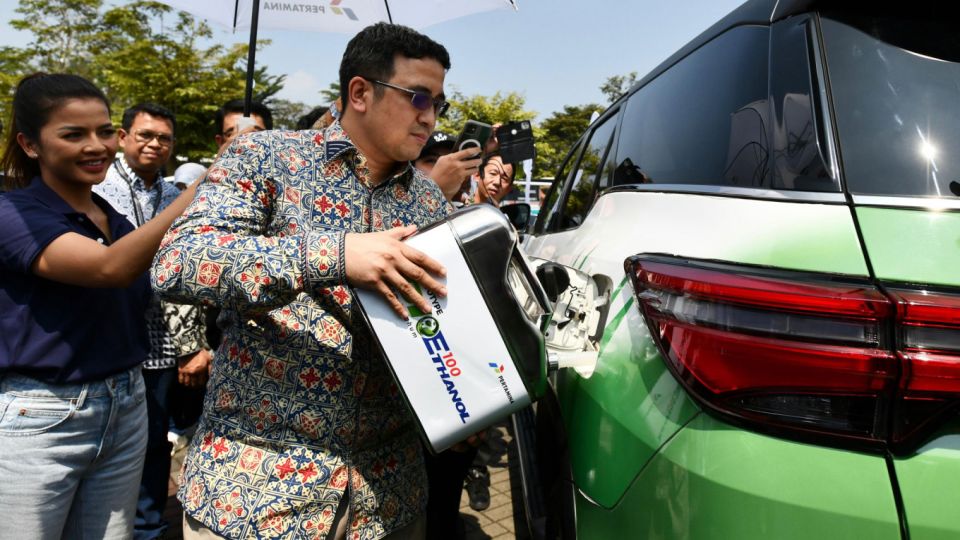
Todotua said Toyota was already in possession of the technology to run cars on E100. He said E10 and E20 would be the first stage of implementation, from which the market could choose.
Monday’s meeting was a follow-up from last year when representatives from the government visited the automaker’s biomass research facility in Fukushima, which is operated by raBIT.
The deputy minister said Toyota had developed the technology to implement the second-generation of bioethanol, which originated from the feedstock’s waste.
Implementing the second generation meant the program “will not disrupt” the country’s food priority program but the short-term plan was to implement a mix of first and second generation together.
Japanese brands accounted for almost 90 percent of wholesale car sales in Indonesia throughout 2024 and a large part of those vehicles are fueled with gasoline, which can be mixed with bioethanol.
However, most car models can currently only run on lower levels of ethanol content without immediate engine failure. Implementing higher ethanol levels, therefore, will require a type of car known as a flexible-fuel vehicle (FFV).