

June 29, 2026
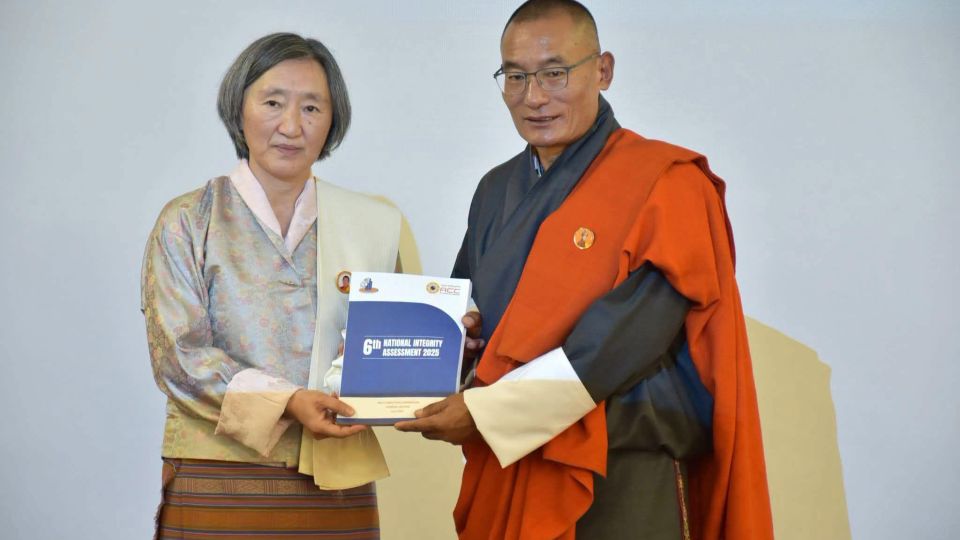
THIMPHU – Bhutan is experiencing a growing trust deficit in institutional integrity, even as direct experiences of bribery remain remarkably low, according to the Sixth National Integrity Assessment (NIA 2025) released by the Anti-Corruption Commission (ACC) yesterday.
Public perception of corruption, particularly in the form of favouritism and nepotism, is rising, the assessment finds.
The assessment covered 381 public services across 99 agencies in 13 institutional categories. It drew on responses from 17,896 participants, including service users, service providers, parliamentarians, and voters, and was further supported by 364 complaints received by the ACC during the fiscal year 2024–2025.
According to the report, Bhutan’s National Integrity Score stands at 8.16 out of 10, reflecting a “good” level of integrity and a slight improvement from previous cycles. The Public Sector Integrity Score is higher, at 8.41, categorised as “very good,” while parliamentarians scored 7.15, indicating satisfactory but comparatively weaker performance.
The assessment highlights a central paradox: while direct transactional corruption, such as bribery, remains extremely rare, scoring above 9.9 in both user and provider responses, perceived corruption is significantly lower, at 7.98 among service users and 7.41 among service providers.
This gap suggests that concerns are increasingly driven not by lived experiences of bribery, but by perceptions of favouritism, informal influence, and unequal treatment.
Internal governance indicators also reveal weaknesses.
Transparency within institutions was rated at 7.35 by service providers, lower than external users’ perception of 8.31.
Whistleblower protection emerged as the weakest area, scoring just 5.44. Ethical leadership was rated at 7.62, while fairness within organisations scored the lowest, at 7.25.
Parliamentary integrity has also declined, dropping from 8.11 in 2022 to 7.62 in 2025. Key concerns include legislative oversight and representativeness, pointing to gaps in accountability and constituency engagement.
Speaking at the launch, Prime Minister Tshering Tobgay said integrity goes beyond the absence of corruption.
“It is about doing the right thing even when no one is watching, making decisions that serve the public interest, and ensuring fairness, accountability, and professionalism in every aspect of public service,” Lyonchhen said.
He added that the National Integrity Assessment should not be seen as a scorecard but as a mirror reflecting the country’s governance realities. “It gives us an honest reflection of where we stand and a roadmap for strengthening governance and public trust,” he said.
Some agencies, Lyonchhen said, need to work harder to improve their integrity performance and strengthen systems going forward.
He also raised concerns over outward migration, warning that declining perceptions of integrity could discourage Bhutanese citizens from returning. “When integrity perception is low, even those who want to return may not come back,” he said, stressing the need to rebuild trust in institutions.
ACC Chairperson Pema Choden said the assessment serves as both a mirror and a roadmap for reform. She added that integrity is defined not only by the absence of corruption but also by whether citizens experience institutions as fair, impartial, accountable, and trustworthy.
“The next frontier of integrity is no longer limited to fighting corruption. It is about strengthening institutional culture, reinforcing ethical leadership, and closing the gap between systems and citizens’ lived experiences,” she said.
The report also stated that Bhutan’s integrity system remains externally strong but internally uneven, facing growing strain from favouritism, weak internal controls, and declining trust.