


December 18, 2025
LANG SON – Armed with solid training and a bold, enterprising spirit, many young people from ethnic minority communities in Lạng Sơn Province are building effective agricultural models, creating sustainable livelihoods and helping transform production mindsets in upland areas where opportunities have long been limited.
Ethnic minority youth are increasingly emerging as a pioneering force in economic development in mountainous regions. One such figure is Hoàng Ngọc Vũ, 32, an ethnic Tày from Lạng Sơn Province.
Living in Đình Lập Commune, Vũ chose a demanding and unconventional path: conserving and propagating the rare native tree species Hoàng đàn tuyết (Cupressus torulosa).
Born into a farming family, Vũ grew up in a community where livelihoods depend heavily on forest land. However, most of the land is managed by state forestry enterprises, leaving local people with limited space for production. This constraint became both pressure and motivation, pushing him to seek a different approach.
After graduating from high school, Vũ was admitted to the Việt Nam National University of Agriculture, one of the country’s leading institutions for agricultural science. In 2018, he earned a master’s degree in Land Management. For him, the degree was not merely a credential but the foundation of his future journey.
“What makes me most proud is having studied at the Việt Nam National University of Agriculture. It was almost a decisive factor,” Vũ said. “Without that period of systematic training, without my teachers passing on knowledge about soils, land use and plant physiology, I certainly wouldn’t have had the foundation to research and propagate Hoàng đàn tuyết, a species that is extremely demanding.”
At the end of 2022, as Hoàng đàn tuyết, a Group IA endemic species facing the risk of extinction, began drawing public attention, Vũ started researching and experimenting with seedling propagation.
With an initial capital of just VNĐ15 million (US$569), he established the Lạng Sơn Hoàng đàn tuyết Nursery, personally testing growth substrates, light conditions, irrigation regimes and seed treatments to improve germination rates. Every parameter was carefully recorded, like a scientific experiment.
Beyond his accumulated knowledge, Vũ said he was fortunate to continue receiving support from former lecturers and classmates throughout the experimentation and development process, from technical advice to moral encouragement.
“Connections forged during my student years became an important source of support,” he said.
The results exceeded expectations. In the first year, the model generated VNĐ200 million ($7,594) in revenue, sending a strong signal that encouraged further investment.
In 2024, Vũ expanded the scale, upgraded shade-house facilities and reinvested an additional VNĐ40 million from profits, raising annual revenue to VNĐ800 million ($30,377).
By 2025, the model had become more complete, featuring 5,000 square metres of nursery area, a 1,000-square-metre standard shade house, an automated mist irrigation system and 30,000 seedlings in production. The total value of the model is estimated at VNĐ5–8 billion ($189,860–303,700).
Revenue in 2025 reached approximately VNĐ2.1 billion, with estimated profits of VNĐ1.6 billion. Alongside financial returns, Vũ created stable jobs for five full-time workers and eight seasonal labourers, while supporting local youth in accessing technical knowledge and quality seedlings.
Beyond generating income for himself and the community, Vũ’s model carries significant conservation value. Successful propagation of Hoàng đàn tuyết helps reduce pressure on wild populations that are under severe threat.
He has also guided many households in adopting the model, helping them raise annual incomes to VNĐ500–800 million.
In recognition of these contributions, Vũ has received multiple awards, including Outstanding Young Entrepreneur of Lạng Sơn Province in 2024, a certificate of merit from the provincial People’s Committee for contributions to youth dialogue and a commendation from the Hồ Chí Minh Communist Youth Union Central Committee in 2025 for outstanding achievements in economic development in ethnic minority and mountainous areas.
Yet for Vũ, today’s achievements are only modest milestones. He does not describe them as a success, as he continues to harbour many ambitions.
Throughout his story, Vũ repeatedly emphasised the link between knowledge and the path he chose.
“I always want to prove that ethnic minority youth are fully capable of doing modern agriculture, of conducting scientific research, of creating new value from our own native species,” he said. “Knowledge can truly return to serve our villages.”
Aspiring to build sustainable agriculture
Hà Thị Vỹ, 34, an ethnic Tày woman, has also emerged as a standout youth figure after boldly leading crop restructuring efforts and successfully building a model to grow green chilli peppers for export to Japan in Cầu Thia Ward, Lào Cai Province.
Starting from a pilot area of 2,000 square metres, Vỹ connected, guided and formed a cooperative group of 60 members, creating stable livelihoods for dozens of households and contributing to a shift in production thinking among highland communities.
Ha Thi Vy, head of the export chili pepper cooperative group in Cau Thia Ward, Lao Cai Province. PHOTO: VNA/VIET NAM NEWS
Cầu Thia Ward, formed through the merger of five administrative units, has a population of nearly 24,000. Ethnic Thái people account for more than 66 per cent, Mường over 16 per cent, alongside Tày, Dao, Mông, Nùng and Khơ Mú communities.
With favourable conditions for agriculture and community-based tourism, the area has increasingly attracted new production models. In 2019, Hà Thị Vỹ was sent to visit a chilli-growing model in Phú Thọ Province. The trip proved to be a turning point. Recognising its economic potential, she boldly converted 2,000 square metres of rice land to grow green chilli peppers for export to Japan.
The first crop in 2020 yielded 5.5 tonnes per hectare, with an average price of VNĐ6,500 per kilogramme, significantly higher than rice cultivation. This initial success convinced Vỹ that the model offered a viable development path for local farmers.
“When you dare to do it first, people gain the confidence to follow,” Vỹ said. “If no one pioneers, the model cannot spread.”
In 2021, she persuaded 24 households to join, expanding the cultivated area to 4.5 hectares. To professionalise production and strengthen links with businesses, she proposed establishing an export chilli cooperative group, which officially began operations in January 2022.
Vỹ was elected head of the group. By 2024, it had grown to 60 members with 245 people, cultivating 10 hectares of chilli peppers. Average yields reached 5 tonnes per hectare, generating incomes of about VNĐ350 million ($13,290) per hectare each year. Most participants are from ethnic minority communities, including Mường, Thái and Tày. Members produce collectively, share experience, comply with technical processes and benefit from stable market access.
The group has signed a production and consumption linkage with GOC Food Processing Co., Ltd. The company supplies certified seeds, fertilisers and plant protection products and purchases 100 per cent of the output.
The chilli cultivation process is standardised, with sowing beginning in November and harvesting continuing until June of the following year. Products must meet Japanese standards for size, colour, freshness and pesticide residue levels. By strictly adhering to this unified process, the group’s produce is consistently purchased at stable prices.
During the model’s development, Vỹ faced debate, particularly when introducing new technical practices such as reducing pesticide use and maintaining production logs. Farmers worried about lower yields and were hesitant to adopt the changes. Vỹ organised meetings, invited technical experts to explain the methods and established pilot plots so people could see the results before reaching consensus.
The most difficult period came in the 2024 season, when unfavourable weather caused disease outbreaks and pushed up costs. At times, Vỹ considered giving up but mindful of her responsibility to the community, she persevered and sought technical support. Overcoming the crisis strengthened her belief that linking agricultural production, though challenging, is ultimately sustainable.
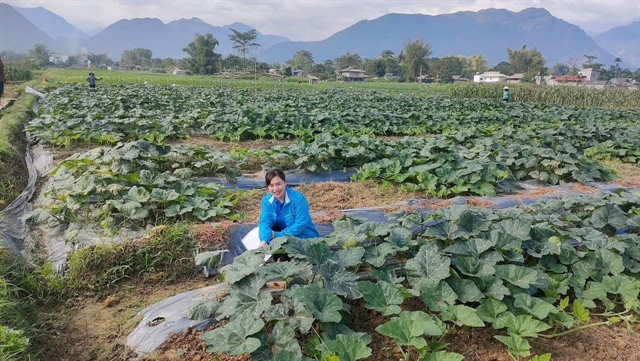
Since 2022, many group members have expanded into cucumber cultivation on 1.2 hectares, with a purchase price of VNĐ15,000 per kilogramme and incomes of VNĐ400 million ($15,188) per hectare per year. All output is fully contracted by enterprises.
Today, the group’s total annual output reaches 450–500 tonnes, with total revenue exceeding VNĐ3 billion ($113,910), creating regular employment for 60–80 rural youth. From a model in a single residential group, Vỹ has expanded it to 17 of 39 residential groups across Cầu Thia Ward, spreading a spirit of bold thinking and action among young people.