

May 22, 2026
KUALA LUMPUR – History advances not merely through wars and revolutions, but through quiet diplomatic inflections—unremarked at first, yet eventually dispositive of the global equilibrium.
Among such pivotal episodes, the convergence of two major-power summits in Beijing within a single week stands singularly unprecedented.
No capital in the annals of modern statecraft has hosted, in so compressed an interval, the supplicant heads of the world’s two most consequential rival governments.
This fleeting sequence does not merely rearrange diplomatic calendars; it recalibrates the geometry of global power, casting upon Beijing a lustre of centrality that no other city can now rival.
For seven days, the world’s familiar bipolar contest yielded to a novel truth: two strongmen who ordinarily bend international events to their will came to one capital seeking favour.
For the first time in contemporary statecraft, Beijing held the decisive vote—the authority to call the shots and the capacity to sway the destiny of competing superpowers.
Great-power diplomacy is usually a study in gradualism. It proceeds by months of bureaucratic negotiation, calibrated posturing, and incremental concession. Rival nuclear powers do not sequentially deposit their most urgent national vulnerabilities before a third nation’s capital in the span of a week. This anomaly is no accident of scheduling.
It is the tangible consequence of structural fatigue afflicting both Washington and Moscow: two states accustomed to strategic autonomy now constrained by self-generated crises and external overextension, their political trajectories increasingly contingent on the discretion of a rising third power.
The old world of binary rivalry has, for this crystalline moment, yielded to a new triangular reality.
The first summit exposed the United States’ peculiar dual fragility—geopolitical overreach paired with domestic economic attrition. The Trump administration confronted two interlocking crises, both corrosive of incumbency authority.
Inflation, a tax levied most harshly upon ordinary households, had eroded purchasing power, unsettled market expectations, and rendered the nation’s economic future uncertain.
With midterm elections looming, sustained price instability threatened to punish the ruling coalition at the polls, turning macroeconomic disorder into political jeopardy.
Abroad, America’s protracted standoff with Iran persisted as a draining liability, dispersing military assets, prolonging regional friction, and yielding no durable strategic resolution.
Faced with limits to its unilateral capacity, the American president arrived in Beijing in a posture of sober supplication. His agenda was unvarnished and pragmatic. He sought Chinese diplomatic leverage to de-escalate Iran-related tensions and reduce America’s unsustainable Middle East burdens.
He sought, equally, Chinese economic coordination to temper inflationary pressure, repair disrupted supply chains, and stabilise domestic prosperity before electoral judgment arrived.
For a nation long conditioned to set the terms of global order, this was a revealing reversal. Washington came not to dictate, but to petition; not to lead unilaterally, but to depend strategically.
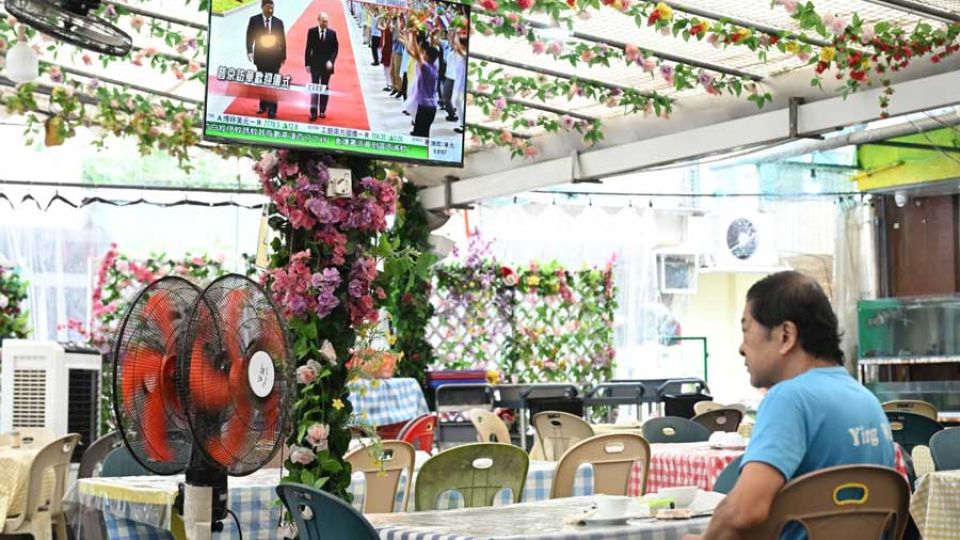
Days afterward, Beijing received President Putin with identical ceremonial dignity and unvaried state pomp—a display of diplomatic equanimity rare in a world still habituated to hierarchical great-power deference.
If America’s vulnerabilities were electoral and macroeconomic, Russia’s were structural and existential.
Since the onset of hostilities in Ukraine, Russia has endured a comprehensive Western campaign of containment: sweeping financial isolation, technological disengagement, punitive trade curbs, and layers of sanctions that have left its domestic economy enfeebled and stagnant.
Its military campaign, sustained at substantial fiscal and social cost, requires persistent external reinforcement to withstand Western-backed attrition.
Putin’s visit stemmed from necessity, not ceremony. He sought Chinese support to shore up Russia’s prolonged war effort in Ukraine, fortifying its strategic resilience against a consolidated Western bloc.
Economically, he pursued expanded trade ties, steady investment inflows, and reliable market access to resuscitate a sanction-battered economy and stabilise fraying domestic equilibrium. Isolated from the liberal international order, Russia retains few credible strategic partners.
Beijing stands as its only substantial source of durable political and economic sustenance.
The parallel arrival of these two leaders creates a power configuration without modern precedent. Two executives who preside over the world’s most formidable military machines, men accustomed to shaping global calculations, found their immediate political fortunes subjected to Beijing’s discretionary judgment.
Trump’s electoral prospects and inflation remediation depended on Chinese restraint and cooperation. Putin’s battlefield sustainability and national economic recovery hinge on Chinese continuity of support.
For this rare historical interlude, both superpowers occupied reactive, dependent postures, while China occupied the system’s immovable fulcrum.
Beijing’s statecraft throughout this episode was understated but authoritative.
It extended equal ritual grandeur and ceremonial poise to both delegations, refusing the graduated hospitality that traditionally signals great-power hierarchy. This parity of pomp was not mere protocol. It was a symbolic repudiation of old hegemonic arrangements—a quiet declaration that Beijing answers to no bloc, defers to no unilateral order, and governs its diplomacy from a position of strategic independence.
In consequence, Beijing has outgrown its national definition. It is no longer merely the capital of China.
It has become the capital of global power play: the city where superpower vulnerabilities are weighed, where rival strategic paths are calibrated, and where the political fates of the world’s dominant strongmen are subtly but definitively swayed.
The unipolar epoch’s final pretensions dissipated in this week of concentrated diplomacy.
Global order no longer orbits exclusively around Western preferences. It now pivots, in measurable ways, around Beijing’s judgments.
This brief diplomatic chapter will not alone redefine every future great-power transaction, but it marks an irreversible inflection.
It demonstrates that unilateral hegemony is functionally exhausted, that global power is irreversibly pluralised, and that one capital now possesses the centrality to shape the fortunes of superpowers. In two summits anchored in one city, history recorded a quiet revolution: the world no longer merely watches Beijing. Increasingly, the world’s greatest powers watch and wait upon Beijing’s decisions.
( L.P. Yau, (邱立本) is the Chief Editor, Yazhou Zhoukan, Asia Weekly based in Hong Kong.)