

April 13, 2026
JAKARTA – “Look again at that dot. That’s here. That’s home. That’s us. On it everyone you love, everyone you know, everyone you ever heard, every human being who ever was, lived out their lives […] every hunter and forager, every hero and coward, every creator and destroyer of civilization, every corrupt politician, every ‘supreme leader’.”
This is how renowned astronomer Carl Sagan began the opening chapter of one of his best-selling books Pale Blue Dot, referring of course to Earth being captured on a camera attached to the spacecraft Voyager 1, which was about 6.4 billion kilometers away from the planet.
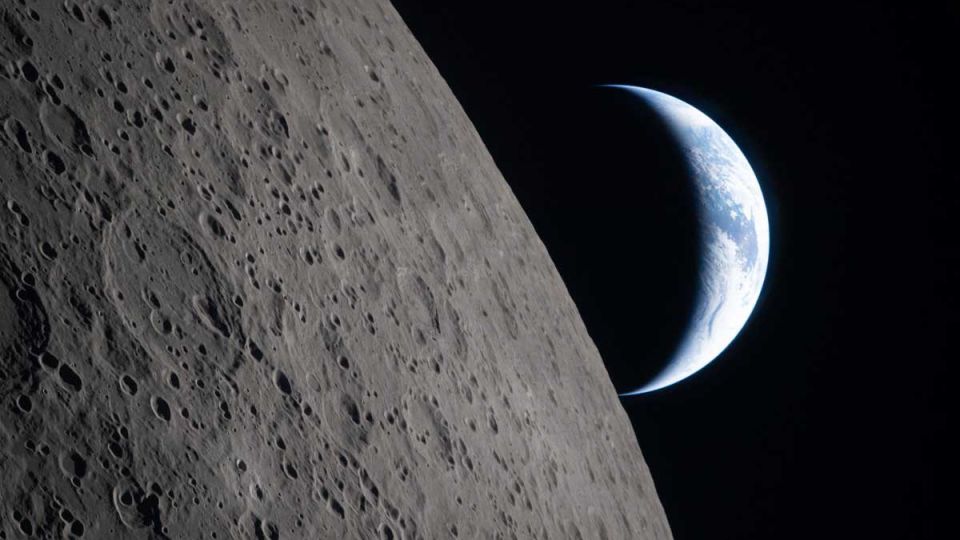
With the Artemis II crew traveling to the farthest point any human has ever reached beyond the orbit of the Earth, while also taking breathtaking photos of the planet rising behind the Moon, that quote from Carl Sagan again gains fresh urgency, especially now that for the first time in a long while, humanity stands on the precipice of a global catastrophe.
It is not lost on everyone who breathlessly keeps an eye on the Artemis II that on the day the spacecraft’s Orion module executed its perfect slingshot around dark side of the moon, the nation that launched the mission could also be on its way to destroy a civilization.
“A whole civilization will die tonight, never to be brought back again,” United States President Donald Trump posted on his Truth Social platform, referring to Iran, a nation of 90 million people and almost three millennia of culture.
A ceasefire was agreed shortly after Trump issued the threat, but the war in the Middle East has killed more than 3,500 people in Iran alone, destroyed crucial energy and transportation infrastructure in the region and could have cascading effects that result in a global economic crisis for years to come.
Humanity has been ingenious enough to accumulate skills and knowledge that eventually made it possible for us to go space and hope that someday it could build an interplanetary society.
Yet, along the way there has always been, quoting Carl Sagan, corrupt politicians, cowards and “supreme leaders” who will go the extra mile to set the clock back to the Stone Age. “We will bomb Iran back to the Stone Age,” Trump said early last week.
Despite the absolute benefit from science and technology in the form of disease eradication, general literacy rates and the overall improvements in the quality of life, on so many occasions politicians, military men and profiteers will always want to build war machines. War may have created states, but at what cost?
It was this same calculus that could have prevented Artemis II from making the trip around the Moon.
President Trump himself has consistently tried to slash overall spending on NASA. After Trump’s second presidency began in early 2025, the White House proposed a 24 percent cut to the NASA budget to US$18.8 billion, the lowest it would have been in a decade, prompting experts to warn of an “extinction level”.
On April 3, two days after Artemis II blasted off for the Moon Trump unveiled his 2027 NASA budget request with another huge cut of 23 percent, while proposing a massive $500 billion increase in the military budget to pay for the war on Iran.
Despite the intensifying militarism, once again humanity can muster the strength to achieve great things.
The Artemis II mission, with a Canadian on board and a whole range of European technology, was a collective effort to build a human base on the Moon, which in turn could become a launch pad for a future trip to Mars.
But even if the goal proves to be insurmountable for humanity today, the photo of Earth rising behind the Moon, the cloud-covered blue marble, which hosts the fragile civilization in an increasingly hostile environment, should be enough of a reminder about our own common destiny.
It is the only blue marble that we have.