

January 15, 2026
HANOI – Prime Minister Phạm Minh Chính has called for accelerating landmine clearance efforts, aiming to basically clear all land contaminated with unexploded ordnance (UXO) to a depth of 0.5 metres by 2045.
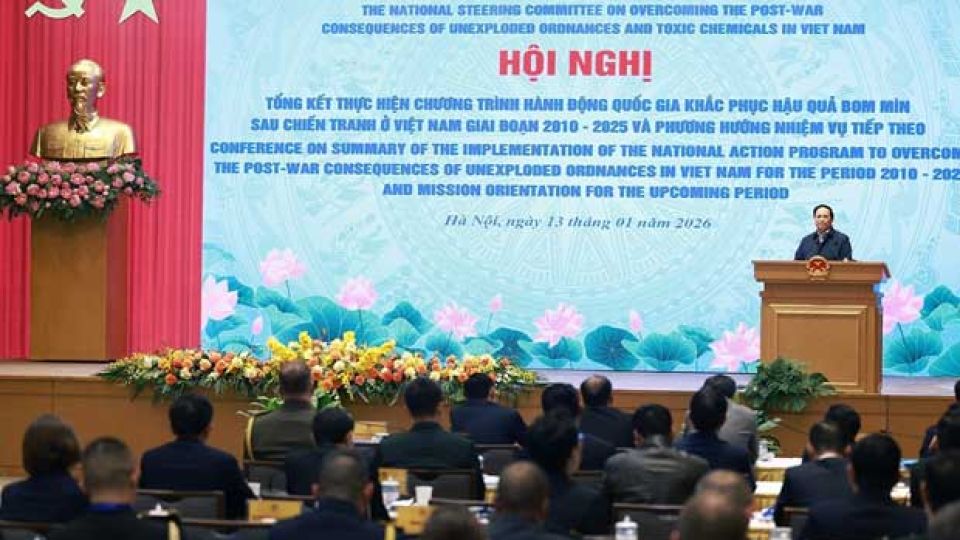
He was speaking at a conference of the National Steering Committee on the Settlement of Post-War Unexploded Ordnance and Toxic Chemical Consequences (Steering Committee 701) to review their work during the 2010-2025 period on Tuesday.
Over the past 15 years, UXO survey and clearance operations have been conducted on nearly 530,000 hectares of land across the country. Almost 35,000 hectares were cleared annually, up 35 per cent compared to the previous period.
Total funding for UXO clearance efforts during this period reached VNĐ29 trillion (US$1.1 billion), of which more than VNĐ23 trillion came from domestic resources, while direct international aid and assistance accounted for VNĐ5.6 trillion.
To date, land suspected of bomb and mine contamination has been reduced to about 5.57 million hectares, equivalent to roughly 17 per cent of Việt Nam’s total land area.
The number of landmine-related accidents has fallen sharply. From 2010 to 2016, there were 463 casualties, while after 2017, some years recorded only one to two UXO incidents, with many localities reporting no mine-related accidents for years at a time.
In addition to mine risk education and accident prevention measures, identification, classification and certification were carried out for multiple victims of UXO or chemical agents, allowing them to receive monthly allowances and livelihood support. More than 6,000 UXO victims and other affected persons have been assisted, with total funding exceeding VNĐ52 billion ($2 million).
In March 2018, a nationwide map of UXO contamination was completed and released, providing essential data for planning and implementing clearance operations. The map has helped people live more safely in areas assessed as having low risk, while also serving as a basis for effective international assistance to Việt Nam.
Mine action projects funded by non-refundable aid from foreign governments and international organisations – including those of the US, Japan, the Republic of Korea, the UK, Australia and Norway – have delivered tangible benefits to local people and made important contributions to Việt Nam’s socio-economic development.
Japanese ambassador to Việt Nam Ito Naoki noted that the consequences of war in the country remained severe, making Japan’s humanitarian assistance highly necessary. He expressed satisfaction that cooperation in mine clearance and dioxin remediation had produced effective results and was highly appreciated.
In provinces such as Tuyên Quang, Lào Cai, Lạng Sơn, Cao Bằng and Quảng Ninh, mine clearance projects aimed at land remediation and searching for the remains of fallen soldiers had demonstrated the concern and responsibility of the Party, the State and the army, as well as society’s deep gratitude to martyrs and those who made sacrifices for national defence.
Hoàng Nam, vice chairman of the People’s Committee of Quảng Trị Province, one of the localities most affected by UXO, said that addressing post-war bomb and mine consequences was a mission requiring sustained focus over decades to ensure people can truly live safely, free from the risk of mine accidents.
At the conference, PM Chính praised the efforts and achievements made in mine action over the past 15 years and expressed gratitude to foreign governments and international organisations for working with Việt Nam to address the consequences of war.
He underscored that post-war mine action should continue to be regarded as a deeply humanitarian, urgent and important task aimed at protecting public health and safety, while enabling sustainable socio-economic development in areas affected by landmines.
The PM urged further review and improvement of policies related to mine action to ensure consistency and comprehensiveness, alongside enhancing organisational structures and capacity for clearance forces.
He called for the expansion and strengthening of international cooperation, as well as mobilising and effectively using domestic and international resources, with the aim of making Việt Nam a pioneering international model in mine clearance and post-war remediation.
Other focuses include promoting the application of science and technology in the process, in addition to public education and timely treatment and livelihood support for mine accident victims.