

December 18, 2025
SEOUL – A Vietnamese woman who died following an immigration raid at a factory in South Korea has become the focus of growing calls to loosen the country’s restrictive work visa rules for international graduates.
Tu Anh, 25, was found dead in the yard of a car parts factory in Daegu on Oct. 28 after falling from the building while hiding during a workplace crackdown by immigration authorities, according to local officials.
Her death has intensified scrutiny of visa regulations that critics say leave international students with few legal options to support themselves after graduation.
Tu Anh had been staying in South Korea on a D-10 job-seeking visa after graduating from Keimyung University. The visa allows limited job-search activities but generally prohibits manual labor, including factory work.
Foreign graduates are expected to secure professional employment with an E-7 visa, a threshold that many struggle to meet.
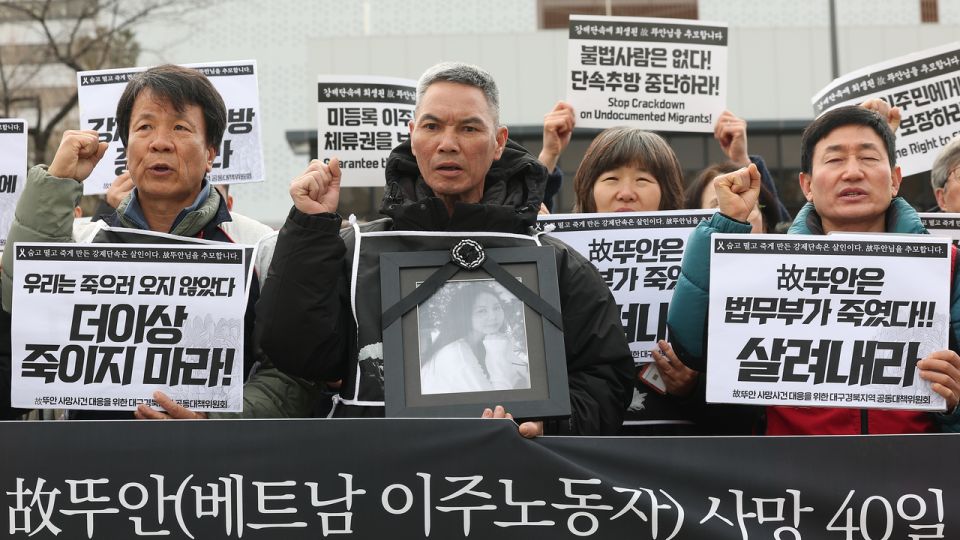
Mourning her death, labor activists and family members have launched protests, criticizing a system they say leaves international graduates with little means to earn a living legally.
“Tu Anh has died, but her death will not be in vain,” her father Vu Van Sung told The Korea Herald during a memorial ceremony Sunday. “I want the government to investigate the case thoroughly, and I hope foreign students and immigrants will not face disadvantages related to their visas.”
The Ministry of Justice, which oversees immigration policy, said it was not responsible for her death, arguing that the incident occurred after the raid had ended. Protesters, however, demand the release of surveillance footage to allow for a clearer investigation.
Labor activists have begun a sit-in protest in front of the presidential office in central Seoul, and last week filed a petition with the National Human Rights Commission of Korea, calling for a compulsory investigation into the case.
The D-10 job-seeking visa permits only limited forms of part-time work in narrowly defined professional fields, and only on an exceptional basis.
While foreign graduates of Korean universities are expected to secure employment with an E-7 professional visa to support themselves, doing so remains out of reach for many.
In 2023, only 10 percent of foreign bachelor’s degree holders and 36.3 percent of doctoral graduates from Korean universities who were working in the country had obtained an E-7 visa, according to the Korean Educational Development Institute.
A March survey by the Korea Federation of Small and Medium Business found that international students cited a shortage of E-7-eligible positions and the visa’s narrow job classifications as key reasons for low uptake.
Immigrant rights groups accuse the government of disregarding the prospects of foreign students’ employment, both during their studies and after graduation.
They point to the government’s target of attracting 300,000 international students by 2027, arguing that while intake has expanded to support universities facing demographic decline, legal employment pathways have failed to keep pace.
As a result, graduates are forced to compete for a limited pool of eligible jobs.
Many who wish to remain in Korea ultimately take factory or manual labor jobs despite the risk of visa violations or deportation, the groups said.
“She may have feared deportation or being unable to attend graduate school while preparing to continue her studies in Korea,” said Kim Hee-jeong, a labor activist based in Daegu. “Having previously experienced an immigration crackdown once, she may have felt greater fear than others.”
“A flawed visa policy that blocks people from earning a living even when they face immediate hardship contributed to this tragedy,” said Udaya Rai, chairperson of the Migrants’ Trade Union in Korea. “If her death is treated as an individual mistake, similar incidents could happen again.”
Activists say the lack of proper work authorization often exposes foreign students to wage theft and labor-rights abuses.
“Some students work beyond their permitted hours, and there are cases where employers deliberately withhold wages,” said Ryu Ji-ho, head of the Uijeongbu Foreign Worker Support Center in Gyeonggi Province.
To bridge the gap between policy and reality, experts are calling for broader pathways that allow foreign students and others in visa gray zones to earn a living without the constant threat of deportation.
“The number of foreign students is substantial, and their employment inevitably affects domestic jobs, so building public consensus will not be easy,” said Seol Dong-hoon, a sociology professor at Jeonbuk National University. “But the system can be reviewed, and more flexible work rights in foundational industries could be considered to prevent such tragedies.”