

March 24, 2026
SINGAPORE – The ongoing war in Iran has triggered an unprecedented oil and gas supply crisis with the effective closure of the Strait of Hormuz, where a fifth of the world’s oil and liquefied natural gas supplies flows through.
Neither Iran nor the US and Israel is relenting in the war that has now entered its fourth week.
A week of heavy hits on crucial energy infrastructure in the Middle East has deepened the risk of long-term economic impact.
Crude oil swung sharply, jumping 1.9 per cent, before reversing to fall nearly 1.8 per cent to US$110 a barrel, reported Bloomberg on March 23.
Global benchmark Brent has surged by more than 50 per cent since the strikes by the US and Israel on Iran in late February, threatening to unleash a wave of global inflation.
After US President Donald Trump backed down from his threats to destroy Iran’s power infrastructure, Brent fell 13 per cent to below US$100 a barrel, reported Reuters. As at 8am on March 24, Brent was around US$100 a barrel.
Here is what some countries are doing to cope with the soaring energy prices.
Short-sleeve shirts, air-conditioner limits in South-east Asia
In Thailand
Thai Prime Minister Anutin Charnvirakul ordered civil servants to conserve energy amid the energy squeeze, Reuters reported a government spokesperson as saying on March 10.
Energy-saving measures include suspending overseas trips, wearing short-sleeve shirts to work and using stairs instead of lifts.
Mr Anutin also ordered civil servants to work from home, adding that exceptions would be made for officials who must serve the public.
Government officials have also been ordered to reduce electricity use in office buildings by switching off lights and electrical equipment when not needed.
In the Philippines
Since March 9, government employees have been working four days a week to cut fuel consumption, Reuters reported.
The shorter schedule is temporary and excludes emergency and frontline services.
Government offices have also been ordered to set their air-conditioners to no lower than 24 deg C.
In Vietnam
The government has also encouraged people to work from home and reduce fuel consumption by using public transport.
In Malaysia
Work-from-home arrangements for the public sector are expected to be presented after Hari Raya, The Star reported Malaysian Minister of Communications Fahmi Fadzil saying on March 17.
To shield consumers, the government stepped up subsidies so that Malaysians do not bear the full brunt of global price increases.
But the country’s fuel subsidy bill surged in less than a week, Malaysia’s Prime Minister Anwar Ibrahim said on March 22.
The national monthly RON95 and diesel subsidies had risen from RM700 million (S$227 million) to RM3.2 billion.
In Indonesia
Civil servants are expected to have one mandatory work-from-home day.
The Jakarta Post reported Coordinating Economy Minister Airlangga Hartarto saying on March 21 that the details of WFH will be discussed and that it will be implemented after Idul Fitri, or Hari Raya Aidilfitri.
He added that public services must continue to operate without disruption.
In Myanmar
Customers in Myanmar will be allowed to buy fuel once or twice a week as the government steps up fuel rationing amid fears of shortages.
A system of barcodes and QR codes will be implemented to determine how much customers can buy. The size of their vehicle engines will also be taken into account.
Earlier in March, the government imposed driving restrictions for private vehicles to preserve petrol.
Vehicle curbs, export bans: How East Asia is conserving fuel
Neither South Korea nor Japan has significant domestic oil production, leaving them almost entirely reliant on imported crude to sustain their energy needs, even as their economies depend heavily on export-oriented manufacturing, writes South Korean correspondent Wendy Teo.
Japan imports about 95 per cent of its oil needs from the Gulf, while South Korea imports 70 per cent, to fuel key export industries, such as semiconductors, petrochemicals and automobiles.
In South Korea
To conserve fuel, Seoul has proposed restricting vehicle use based on licence plate numbers, The Korea Herald reported on March 17.
Under a five-day system, each vehicle would not be able to operate one day each week.
In Japan
Tokyo has urged citizens not to panic-buy toilet paper, as social media posts suggest that people were starting to stockpile daily necessities out of concern over the war in the Middle East.
The Ministry of Economy, Trade and Industry said in a statement that shoppers should make rational decisions about toilet paper purchases based on accurate information.
Smaller weddings, cricket at home: South Asia’s energy-saving push
In Pakistan
The Pakistan Cricket Board (PCB) is encouraging fans to stay home and watch matches on television to save fuel.
The Pakistan Super League – the nation’s biggest sporting event – takes place from March 26 to May 3.
“It was estimated that an average of 30,000 spectators and associated support staff travelling daily for more than a month would place significant strain on energy resources,” the PCB said in the statement on March 22.
Pakistan’s Sindh government also limited the number of wedding guests to 200 as part of its “austerity” drive, reported Pakistani newspaper Dawn on March 20.
In India
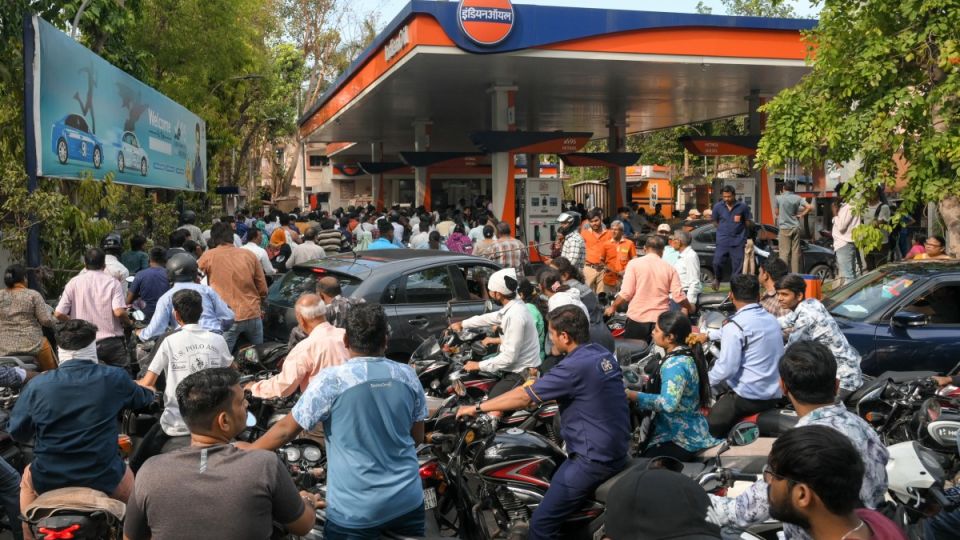
The government said members of the public should not resort to panic buying because there is enough petrol and diesel available.
However, citizens were encouraged to use piped natural gas and electric or induction cooktops instead of liquefied petroleum gas (LPG), The Statesman reported India’s Ministry of Petroleum and Natural Gas saying on March 22.
India is the world’s second-biggest importer of LPG.
In Sri Lanka
Sri Lanka announced a shorter work week to conserve its fuel reserves, AFP reported officials saying on March 16.
Commissioner-General of Essential Services Prabath Chandrakeerthi said state institutions will operate only four days a week starting from March 18. He declared every Wednesday “a holiday”.
The new austerity measures will also apply to schools and universities, and will remain in place indefinitely.
In Nepal
Half-filled cooking gas cylinders were sold in Nepal to curb hoarding and panic buying, AFP reported officials saying on March 13.
Nepal said it has sufficient gas, but has reduced cylinder volumes to stretch the available supply.