

January 26, 2026
SEOUL – Merely three months after South Korea celebrated the securing of a trade deal with the United States to lower US-imposed reciprocal tariffs from 25 per cent to 15 per cent, fresh uncertainty has set in.
At a ground-breaking ceremony for Micron Technology’s new semiconductor plant in Syracuse, New York, on Jan 16, US Commerce Secretary Howard Lutnick threatened new levies for companies exporting chips to the US.
“Everyone who wants to build memory has two choices: They can pay a 100 per cent tariff, or they can build in America,” Mr Lutnick had said, repeating comments made a day earlier in an interview with CNBC.
Mr Lutnick’s comments have sparked fresh concerns in South Korea about the possible impact of such a high tariff on its semiconductor industry, which is the backbone of the country’s export-driven growth, making up 20 per cent of total exports and earning it the moniker “rice of the electronics industry”.
South Korean chip exports to the US surged 30 per cent in 2025 to hit US$13.8 billion (S$17.6 billion), or 8 per cent of the country’s total chip exports, buoyed by demand driven by the artificial intelligence (AI) sector.
It is the country’s second-largest export to the US after automobiles.
Despite the concerns, however, analysts are suggesting prudence before action, particularly as South Korean companies dominate the global memory chip market and the US holds only a small share of global chip production, compelling it to import large quantities of the chips it needs.
Indeed, South Korea’s President Lee Jae Myung, in a New Year’s address on Jan 21, downplayed the anxiety, saying that a 100 per cent levy on semiconductor imports would only sharply raise prices of chip products in the US.
South Korean chipmakers, together with their Taiwanese counterparts, account for 80 per cent to 90 per cent of global production.
While Taiwan’s companies specialise in advanced chips used for high-performance computing and AI, South Korea’s firms specialise in memory chips which store data and are critical components in AI data centres and cloud computing infrastructure.
A US official has since said that the US administration will be seeking separate semiconductor tariff agreements for separate countries.
The newly inked US-Taiwan trade deal on Jan 15 includes a chip tariff exemption arrangement that offers a buffer from the latest tariff threats, suggesting that these threats are targeted at South Korea’s Samsung and SK Hynix, which dominate the global memory chip market with a 60 per cent share while US firm Micron holds 20 per cent of market share.
Analysts say the tariff threat is likely a high-pressure negotiating tactic aimed at drawing the world’s top chipmakers to move production to the US, with the recently sealed US-Taiwan trade deal seen as a possible benchmark for South Korea.
Non-resident fellow Troy Stangarone from the Carnegie Mellon Institute for Strategy and Technology in Pennsylvania told The Straits Times: “The Trump administration has a history of using tariffs as negotiating leverage. While this is currently just a threat, the Trump administration’s objective is to secure more investment in semiconductor production in the United States.”
South Korea has already pledged US$350 billion in mainly shipbuilding-related investments in the US, in a deal sealed by US President Donald Trump and his South Korean counterpart Mr Lee on the sidelines of the APEC meetings in Gyeongju in October 2025.
Part of the deal was that South Korean semiconductors would not receive less favourable treatment than those of economies with comparable trade volume, which implicitly refers to Taiwan.
But how the clause in the agreement is to be interpreted is unclear.
The new US-Taiwan trade deal not only sees Taiwan pledging US$250 billion in investments in the semiconductor, energy and AI sectors, but also an additional US$250 billion in credit guarantees for Taiwanese chipmakers to support “the establishment and expansion of the full semiconductor supply chain and ecosystem in the US”.
In return, reciprocal tariff rates were slashed from 20 per cent to 15 per cent.
Additionally, Taiwanese chipmakers that expand in the US will be able to import up to 2½ times their new capacity in the US of semiconductors and wafers with no extra tariffs.
Taiwan’s TSMC, the world’s largest producer of advanced AI chips, is building a gigafab cluster in the state of Arizona and has pledged a further US$56 billion investment in new facilities in the coming year.
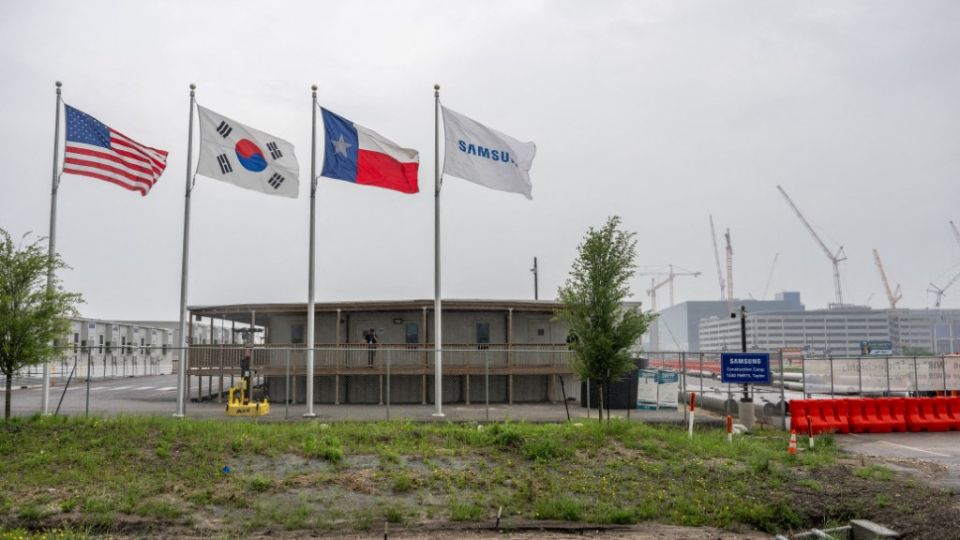
South Korea’s Samsung Electronics is currently pouring US$37 billion into building a foundry in Texas state, while SK Hynix has plans for a US$3.87 billion facility in the state of Indiana.
However, with both companies also building a massive 600 trillion won (S$528 billion) semiconductor cluster in South Korea’s Gyeonggi province, the question is whether South Korean chipmakers have the capacity to match Taiwan’s investment pledges in the US.
A Korea Times editorial on Jan 19 slammed the “aggressive and unilateral tariff push targeting Korea’s most critical industry” as deeply counterproductive, pointing out that a globally competitive South Korean semiconductor industry is not a threat to US interests but “a strategic asset in a shared effort to stabilise global supply chains and counter external risks”.
Daegu University Associate Professor of Economics and Finance Kim Yang-hee told ST that a 100 per cent semiconductor tariff is simply unrealistic.
“For US Big Tech companies already struggling with semiconductor shortages, a 100 per cent tariff would be unbearable,” she said.
Prof Kim suggested that South Korean chipmakers could leverage long-term supply contracts with their US Big Tech clients to demand tariff stability from the US government, given that the US companies would not want to suffer increased costs as well.
Noting that the US Supreme Court has yet to rule on the legality of Mr Trump’s tariff policy, enacted in 2025 under emergency powers without congressional approval, she said: “Given the current high level of uncertainty, rather than moving rashly, it would be better (for the affected companies) to watch the outcome of the court ruling and the direction of the US midterm elections in November before making decisions.”
With semiconductors used in virtually every modern product and the US holding a relatively small share of global production, Carnegie Mellon Institute’s Mr Stangarone said such tariffs would only raise input costs, at a time when the Trump administration is already grappling with domestic affordability concerns.
He believes South Korea could use its dominant market share of high-bandwidth memory chips as leverage instead.
Mr Stangarone said: “High-bandwidth memory is critical to the development of AI. SK Hynix’s capacity for this year is already sold out, giving it leverage to hold the line on a product that customers need.
“Since Korea has already negotiated a deal with the United States, it should hold firm to its position and expect the United States to honour its agreement.”