

March 6, 2026
SEOUL – While International Women’s Day is often marked with campaigns celebrating empowerment, women’s groups in South Korea are preparing to stop work.
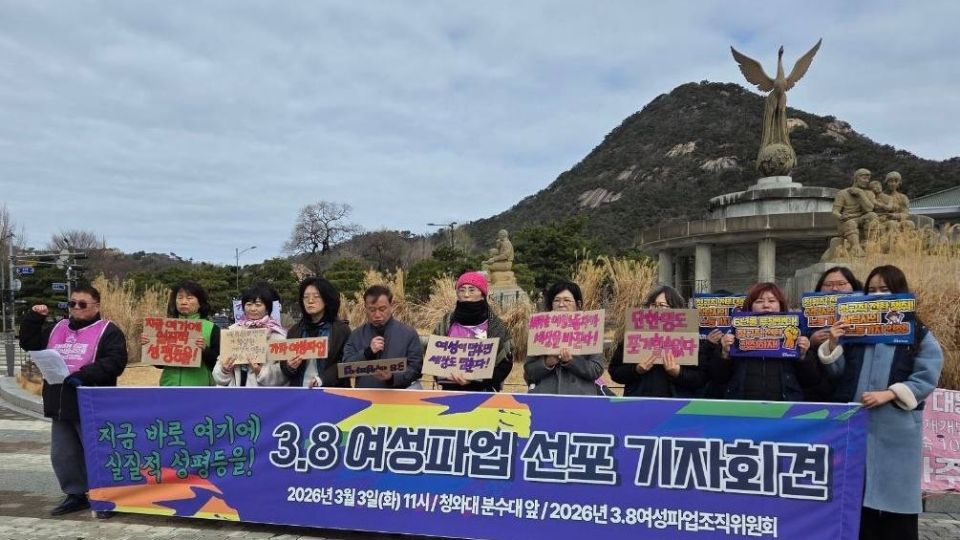
Thousands are expected to gather in central Seoul on Friday as more than 20 women’s and labor organizations stage a nationwide “women’s strike,” saying persistent gender inequality and violence have left them with little choice but to halt both paid and unpaid labor for a day.
The action, organized by the 2026 March 8 Women’s Strike Organizing Committee — a coalition of 22 women’s, labor and human rights groups — is intended to draw attention to what activists say is the invisible labor that sustains society but remains unrecognized in policy and statistics.
“Now we choose to stop. A strike is the language of cessation. It is not only an economic struggle in factories or offices. It is a declaration to halt all labor — the unpaid care, emotional labor and relational work that sustain society but remain invisible in statistics,” the committee said.
Organizers say the strike is meant to expose the scale of care work that falls disproportionately on marginalized groups.
“If the ‘invisible people’ stop for just one day, society will finally feel the weight of the intangible labor that holds it together,” the committee said. “The women’s strike is not merely a women’s issue. It concerns all who seek to live with dignity. It is time to stop, confront structural inequality and demand change.”
Organizers argue that women, LGBTQ people, people with disabilities and migrants shoulder more than 70 percent of Korea’s care work.
The coalition says the strike reflects frustration with a reality that has changed little despite repeated government pledges to address gender inequality.
“This society claims to follow the rules of meritocracy, but women and other minorities remain exceptions to those very rules,” a committee representative told The Korea Herald.
Data show the disparities remain stark.
According to the Korean Women’s Development Institute, women in South Korea earned on average 29 percent less than men in 2024 — the largest gender pay gap among OECD member states for the 29th consecutive year.
Women also accounted for 23.8 percent of low-wage workers, more than double the share for men at 11.1 percent, suggesting that wage inequality has become structurally embedded.
Labor groups say women working in nonstandard employment — including platform workers, freelancers and those in special employment categories — remain excluded from basic protections such as industrial accident insurance and maternity leave.
Conditions can be even more precarious for migrant women workers, whose working conditions remain difficult to measure due to a lack of official statistics.
Gender-based violence is another factor driving the strike.
According to figures released by the Ministry of Gender Equality and Family, stalking crimes increased 12.3 percent year-on-year in 2025.
Data from the Korea Sexual Violence Relief Center also show that roughly one in five women report experiencing physical, sexual, emotional or economic violence from an intimate partner at least once in their lifetime.
Organizers say these forms of violence intersect with women’s unequal position in the labor market, creating a cycle of insecurity that policy responses have so far failed to break.
“Despite institutional blind spots and government inaction, women have endured in every corner of society. In the streets, factories, offices, homes, and classrooms, supporting one another like light rain as they worked to change the world,” the committee said.
The coalition plans to announce seven key demands at a rally on March 6, including a ban on workplace gender discrimination, stronger protections for domestic workers, people with disabilities and migrant laborers, and the enactment of a comprehensive anti-discrimination law.
Participation in the strike will not be limited to those attending the rally. Workers unable to join in person are encouraged to take annual leave, leave work early or participate in other forms of stopping work throughout the day.
The March 8 women’s strike has historical precedents. The first nationwide action took place in Iceland on Oct. 24, 1975, when women ceased all paid and unpaid labor to demonstrate their indispensable role in society.
Similar mobilizations have since spread globally. South Korea’s organizing committee was first established in 2024 as activists began building a comparable movement.
This year’s main rally will take place Friday afternoon near Seoul Station, followed by a march through downtown.