


March 17, 2026
MANILA – For generations, Filipino fishers measured abundance by instinct: the weight of a net, the distance they had to travel, the hours it took before a boat came home full. Long before scientists put numbers to it, many already knew something was wrong.
Now, data is catching up.
A new report by international conservation group Oceana found that Philippine capture fisheries have been losing an average of 45,472 metric tons — roughly 45 million kilos — of fish each year since 2010, despite the passage of a stronger fisheries law in 2015. That amounts to more than 591,000 metric tons of fish gone — not wasted, not exported, but never allowed to exist in the first place.
This two-part series looks at how the country reached this point. The first part examines the roots of the decline: the long slide in fish stocks, the promise of the Fisheries Code and its 2015 amendments, and how gaps in implementation, rather than gaps in the law, have pushed Philippine fisheries deeper into crisis.
‘Being lost to what?’
When Oceana’s report, “The Philippine Fisheries Assessment, A Glimpse of RA 10654’s 10-Year Implementation,” said 45 million kilos of fish are lost each year, the figure did not refer to spoiled catch or illegal hauls dumped at sea.
It refers to lost potential — fish that would have grown, reproduced and sustained future harvests if stocks had been kept within sustainable limits.
The science is clear: Once breeding populations fall below critical thresholds, ecosystems lose their ability to replenish themselves. Each year of overfishing compounds the next, shrinking future catch even if effort remains the same.
Oceana Vice President Von Hernandez illustrated the scale this way:
“The annual loss of 45 million kilograms of fish isn’t just a statistic. It’s the equivalent of emptying a fully loaded jumbo jet of fish out of our waters every single day.”
For ordinary Filipinos, the result is tangible: higher fish prices, fewer affordable protein options, and fisherfolk who spend more time at sea only to come home with less.
Marine biologist Wilfredo L. Campos, one of the authors of the study, said the average annual loss of 45,472,000 kilos of fish could have fed around 93,000 Filipino families experiencing food insecurity.
Campos is a professor at the Division of Biological Sciences, College of Arts and Sciences of the University of the Philippines Visayas and head of the UPV OceanBio Lab.
In a country where fish remains the most affordable source of animal protein for millions, the disappearing catch represents not just an environmental failure, but a direct blow to nutrition and survival.
A crisis decades in the making
The decline did not begin in 2010, or even in 1998, when the Philippine Fisheries Code was enacted.
Oceana’s report traced overfishing back to the late 1970s, when per capita capture fisheries production peaked and began a steady downward slide. By the 1980s, scientific studies had already concluded that many of the country’s major fishing grounds had exceeded their maximum sustainable yield.
Simply put, the country was catching fish faster than the seas could keep up.
By the time the Fisheries Code of 1998 was passed, overfishing was no longer a looming threat — it was a documented reality. What the law sought to do was halt the slide before it became irreversible.
The Fisheries Code: Strong intentions, limited reach
Republic Act 8550, or the Fisheries Code of 1998, laid down progressive principles: food security as a national priority, preferential rights for municipal fisherfolk within the 15-kilometer municipal waters, and conservation tools such as marine protected areas and closed seasons.
But enforcement lagged behind ambition.
The Philippine Fisheries Assessment found that weak penalties, fragmented monitoring, and the persistence of illegal, unreported and unregulated (IUU) fishing allowed pressure on fish stocks to intensify.
While both municipal and commercial catches continued to rise for a time, the study said this growth concealed a long-term collapse in stock health, delaying recognition of the scale of the crisis.
Why the law was amended and what changed
By the early 2010s, the Fisheries Code’s shortcomings had become so serious that they drew international attention and pressure.
In June 2014, the European Union issued a “yellow card” warning to the Philippines for its failure to curb IUU fishing, putting at risk access to one of the country’s most important seafood export markets.
That pressure culminated in Republic Act 10654, enacted Feb. 27, 2015. The amendatory law explicitly sought to “prevent, deter and eliminate illegal, unreported and unregulated fishing” — a sharper mandate than the largely developmental framing of the 1998 Fisheries Code.
One of the most significant shifts was punitive. Under RA 10654, penalties for commercial fishing violations were raised to as high as P45 million, while fines for foreign poachers could reach $2.4 million. The law also created an Adjudication Committee within the Bureau of Fisheries and Aquatic Resources (BFAR), designed to fast-track the determination of liability and the imposition of penalties.
But the centerpiece of the reform was technological.
RA 10654 mandated a Monitoring, Control, and Surveillance (MCS) system for all Philippine-flagged fishing vessels, regardless of fishing area or destination of catch. At the time, this was seen as a potential game-changer for enforcement and transparency.
“There are so many available technologies right now that can help both government and people in monitoring the behavior of fishing vessels,” lawyer Gloria Estenzo Ramos, vice president of Oceana in the Philippines, said in a 2015 statement.
“The use of these devices can show if commercial fishing vessels are operating in the right areas. This can help our artisanal fishers regain their municipal waters from encroachment by large fishing vessels,” she said.
“These substantial amendments to the Fisheries Code give our country a better chance of rebuilding fish stocks and allow for a more rational approach for fish catch production,” she added, while also issuing a caution that would later prove prescient: “We have had good laws on paper, but sadly, we have been quite lacking in terms of enforcement.”
Even within government, there was acknowledgment that the old framework had failed.
Then-BFAR Director Asis Perez publicly conceded that the Fisheries Code had remained weak because of its implementation.
“The (previous) law was not honest enough,” Perez said during a 2015 forum at the University of the Philippines College of Law, adding that the country’s credibility would ultimately rest on “administrative capacity and political will to implement policies.”
From the EU’s perspective, reform was nonnegotiable.
Former EU Maritime and Fisheries Affairs director-general Lowri Evans said the bloc was pushing countries toward science-based policies, transparent laws and strict enforcement, warning that abundance should never be mistaken for permanence.
“Fish stocks can be renewable, but unless managed properly, they are finite,” Evans said, as she challenged the Philippine government to build a culture of compliance.
The promise of RA 10654, then, was clear in 2015: tougher penalties, faster adjudication, modern monitoring and science-based management meant to reverse decades of overfishing.
A decade later, the data examined in Oceana’s report showed that while the law changed, implementation lagged and fish stocks continued to decline.
Less fish, higher prices, and the illusion of stability
At first glance, the numbers appear reassuring.
Data from the Philippine Statistics Authority (PSA) cited by Oceana stated that from 2016 onward, total fisheries production in the Philippines hovered between 4.2 and 4.4 million metric tons a year, a plateau that could be mistaken for recovery.
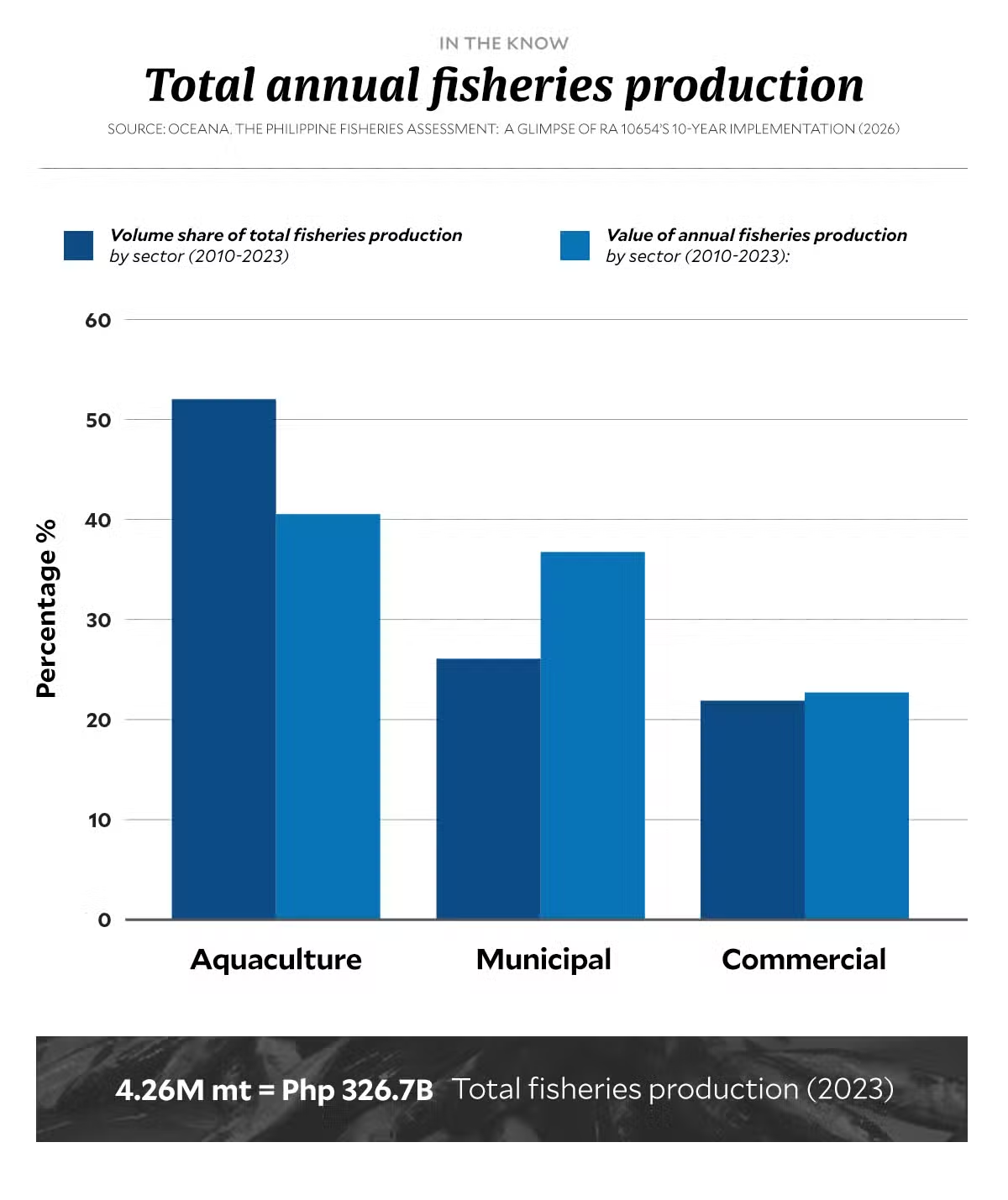
The data also showed that the apparent balance has been propped up almost entirely by aquaculture, which accounts for 52.03 percent of total fisheries production by volume between 2010 and 2023. By comparison, municipal capture fisheries contribute 26.08 percent, while commercial capture fisheries account for 21.89 percent.
In other words, more than half of the fish Filipinos consume now come from aquaculture — fish raised in managed ponds and coastal cages — rather than caught from the open sea.
This shift masks what is happening beneath the surface. While aquaculture expanded, capture fisheries steadily declined, falling from 2.6 million metric tons in 2010 to 1.9 million metric tons in 2023 — a cumulative loss of 591,136 metric tons, or an average of 45,472 metric tons annually.
The pattern becomes clearer when production is measured not by volume, but by value.
Although aquaculture accounts for the majority of output, it contributes a smaller share to the sector’s total value. From 2010 to 2023, aquaculture made up 40.54 percent of the total value of fisheries production, while municipal fisheries accounted for 36.75 percent, and commercial fisheries for 22.71 percent.
This imbalance points to a difficult reality: Filipinos are paying more, but getting less fish on their tables.
“A notable pattern emerges when examining volume versus value: production volume shows declining trends while economic value continues to increase. This suggests Filipinos are paying more for less fish, indicating both scarcity effects and inflation in the fisheries sector,” Oceana said in its report.
As wild fish populations decrease, their scarcity drives up prices. This inflation makes fish more valuable, even though there is less of it available. Municipal fisheries, which provide much of the fresh fish for local consumption, earn a large share of the market value because it has become harder to catch nearshore fish and more expensive to buy them.
The Philippine Fisheries Assessment underscored that this trend is not a sign of resilience, but of stress. Rising prices have compensated for declining catch on paper, delaying public recognition of how severely fish stocks have been depleted.
Trade figures reinforced the warning signal.
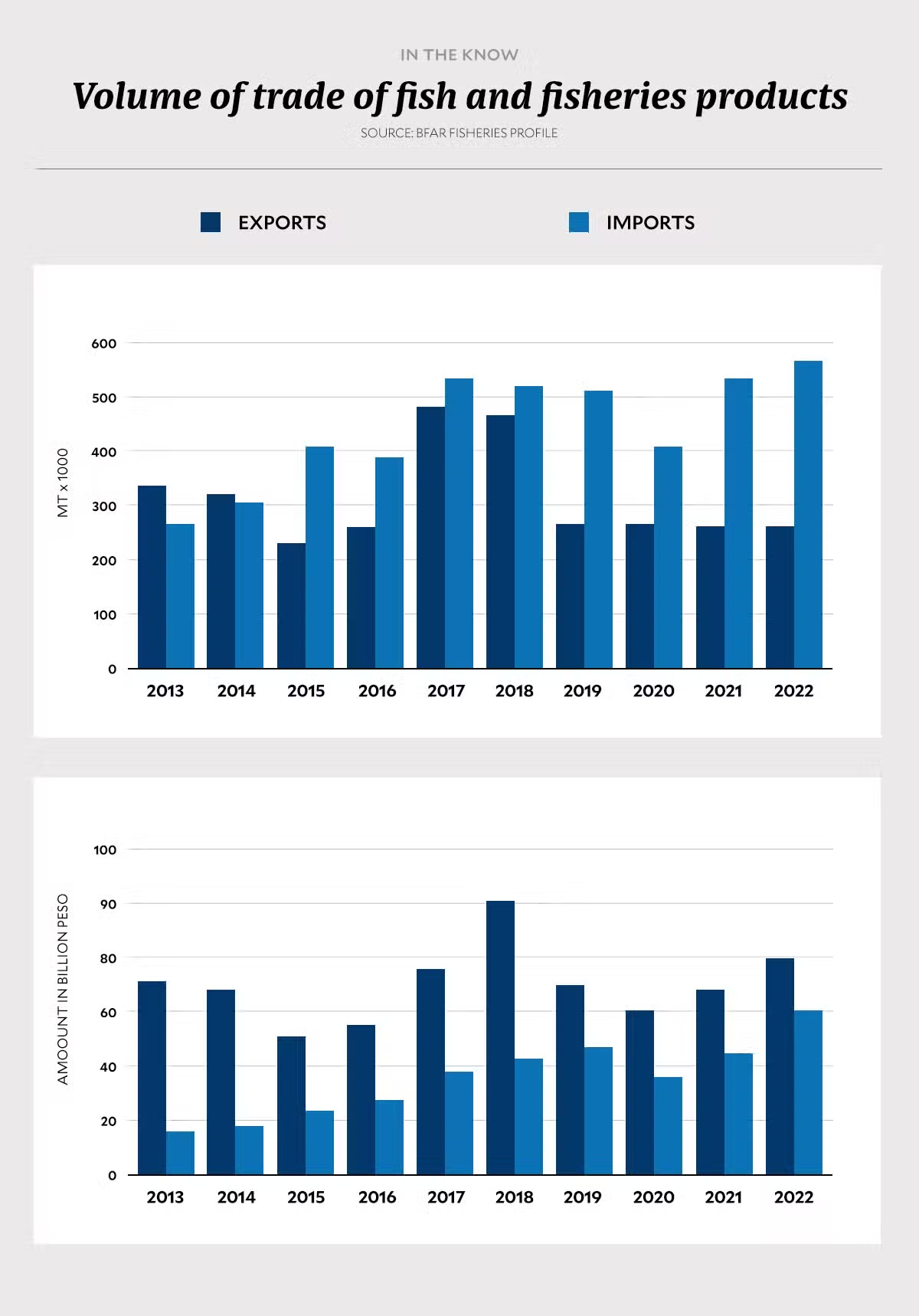
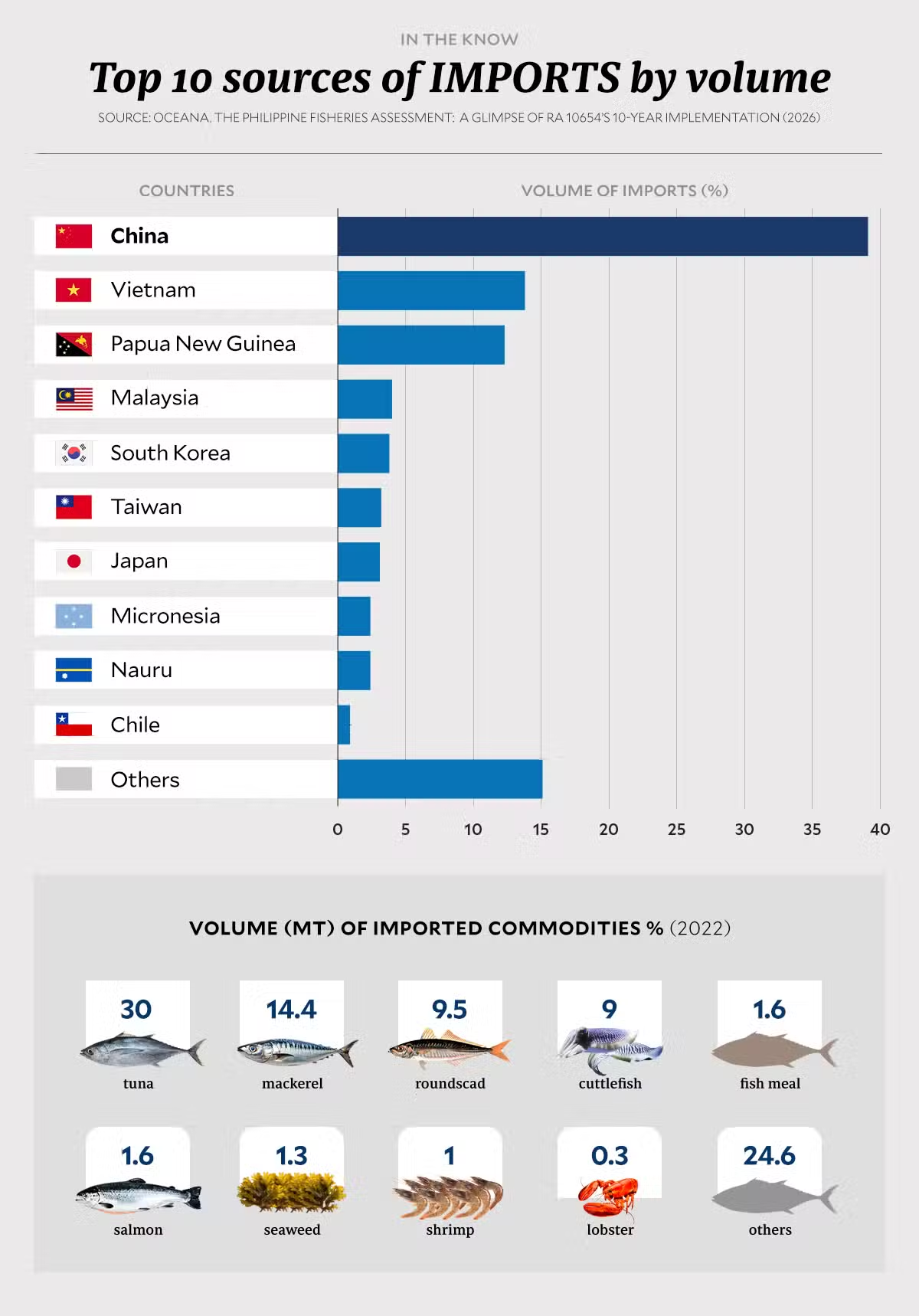
Historically, the Philippines maintained a comfortable surplus in its fisheries trade. But as domestic catch fell, imports rose steadily after 2015, while exports declined sharply after 2018. By 2022, the country’s fisheries trade surplus had narrowed to just $292,250, a fraction of previous margins and an indication of growing dependence on foreign fish supplies.
Together, these trends point to a system that looks stable only because its foundation has shifted. Aquaculture has filled the volume gap, prices have masked scarcity, and imports have buffered shortages, but none of these address the underlying decline of wild fish stocks.
Management reforms that never reached the water
The stabilizing effect of aquaculture and rising prices obscured another reality: Reforms meant to reverse the decline of wild fisheries arrived late and were unevenly carried out.
At the core of RA 10654 was a pivot toward science-based fisheries management, particularly through the creation of Fisheries Management Areas (FMAs). Instead of managing fish stocks along political lines, the law adopted an ecosystem approach, recognizing that fish populations move across bays, gulfs and seas that do not conform to provincial borders.
By 2019, Philippine waters had been divided into 12 FMAs, each with its own management body and stakeholder representation. On paper, this was a long-overdue correction. But as the Philippine Fisheries Assessment noted, the biological crisis was already decades deep by the time these mechanisms were introduced.
“It is thus critically important to recognize that most major fishing grounds around the country have been overfished for about 40 years,” the assessment stated, adding that this history “should serve as the basis for determining not only the magnitude of the problem, but also the urgency of necessary interventions to recover at the level of sustainable fisheries.”
However, the urgency did not translate into recovery.
Oceana found that while management bodies were established and plans were written, the most crucial actions for rebuilding fish stocks — specifically harvest control rules (HCRs) and harvest control measures (HCMs), which the study said are “designed to guide and limit fish extraction based on stock health indicators, fishing pressure metrics, and population trend analysis” — were rarely put into practice.
“A data transparency challenge exists: there is no updated, publicly accessible consolidated national database of stock status. Based on the most recent available publication, approximately 88 percent of assessed fish stocks are in what is characterized as the ‘red zone’ — indicating they are overfished, overexploited, or unable to replenish adequately,” the study said.
HCRs and HCMs play a key role in fisheries management. These tools set limits when fish populations decline, adjust harvest levels based on the current health of the stocks, and give fish populations a chance to recover.
Oceana said the goal is not to halt fishing altogether, but to ensure fishing can continue sustainably in the years ahead — through stricter rules, improved monitoring and more transparent reporting on the state of fish stocks.
 Across FMAs, fish stocks remain largely depleted, reflecting what the assessment described as a system still struggling to move from planning to impact.
Closed seasons, often cited as a success story, illustrate the limitation.
The assessment noted that while some fisheries saw short-term improvements, these gains were not enough to reverse the broader decline, especially where fishing effort simply shifted outside closed periods.
“Scientific data shows many fish populations remain overfished even after years of seasonal closures. Assessment of closed seasons indicates they are insufficient by themselves for stock recovery,” the report said.
Marine protected areas (MPAs) reflect similar challenges. The Fisheries Code requires that at least 15% of each municipality’s coastal area be set aside as fish sanctuaries. By 2023, there were 2,112 MPAs in the country, most established at the barangay or local government unit (LGU) level. Most of these MPAs fall within the 10- to 100-hectare range.
But as of 2007, only a small fraction — less than one in 10 — of the country’s MPAs were actually managed well, with no-take zones properly enforced. The vast majority existed only on paper, with little to no real protection for marine life.
“Research evidence shows MPAs can be effective when properly managed. Well-managed MPAs have been shown to improve coral cover, increase the diversity and density of commercially important reef fish, and generate positive spillover effects that enhance fishing productivity in adjacent areas,” Oceana said.
Oceana’s assessment also identified persistent barriers to the effectiveness of MPAs in the Philippines. These include poor enforcement capacity, limited financial and technical resources, ongoing pressure from nearby fishing activities, and management weaknesses, such as unclear zoning and insufficient surveillance. The report also noted that short-term income losses for fishers are often not addressed, and the benefits of protection are not always shared equitably among stakeholders.
What took shape, instead, was a system where the rules kept growing, but the power to enforce them on the water did not keep pace.
Oceana concluded that while BFAR has achieved structural progress — such as establishing FMAs, issuing policies and implementing seasonal closures — the agency’s effectiveness remains hampered by limited resources.
It also said performance metrics often reward process compliance, even as ecological outcomes continue to decline. According to Oceana, real progress will require reversing workforce decline, securing adequate budgets, and establishing the coordinated MCS system mandated by law.
The human limits of enforcement
The gap between design and delivery is rooted less in intent than in capacity.
The Philippine Fisheries Assessment laid out the scale of the challenge. The country is responsible for managing more than 36,000 kilometers of coastline and the livelihoods of more than 2.5 million fisherfolk, yet the burden of enforcement rests on institutions stretched thin at every level.
Local governments, the frontline managers of municipal waters, are among the most constrained. The assessment found that many coastal LGUs operate with only one fisheries technician responsible not just for enforcement, but also for registration, planning and compliance.
At the national level, the strain is also visible.
Between 2017 and 2023, BFAR’s personnel numbers declined even as its mandate expanded under RA 10654. The Oceana audit flagged this mismatch as a structural weakness, noting that enforcement responsibilities multiplied while human resources did not keep up.
“Reliable information on fishing effort is largely unavailable,” it stated, warning that without adequate data, staffing and monitoring, “annual production by itself may not truly reflect stock abundance.”
This gap is precisely where illegal fishing thrives.
Despite the legal requirement for vessel monitoring systems, coverage remains incomplete and enforcement uneven. Oceana documented continued encroachment of commercial vessels into municipal waters, as detected through nighttime light data, as evidence that violations persist even under a strengthened legal framework.
Community-based enforcement groups such as Bantay Dagat have filled some of the void, but often without stable funding, equipment or institutional backing. In many coastal areas, enforcement depends on volunteers operating at personal risk, an arrangement that the assessment implicitly recognized as unsustainable for a national crisis.
The result is a system where rules exist, but compliance varies; where monitoring is mandated, but inconsistently applied; and where the burden of protection falls on those with the least capacity to enforce it.
When the courts stepped in and fisherfolk pushed back
Even as enforcement capacity thinned and management reforms stalled, another blow landed — not from the water, but from the courts.
In December 2024, the Supreme Court upheld a lower court ruling in the Mercidar Fishing Corporation case, allowing commercial fishing vessels to operate within municipal waters — areas that, for decades, had been reserved for small-scale fishers under the Fisheries Code and its 2015 amendments.
The decision declared unconstitutional key provisions of RA 10654 that restricted commercial fishing in the 10.1- to 15-kilometer municipal waters, effectively stripping local governments of their authority as frontline managers and weakening the preferential rights of municipal fisherfolk.
Oceana described the ruling as a turning point with “serious implications for municipal fishers’ preferential rights, local governance, fish stock recovery, and the livelihoods of millions of small-scale fishing families.”
What made the ruling even more consequential was how it unfolded. BFAR’s appeal was dismissed after the Supreme Court found it had been filed beyond the deadline — a lapse the assessment described as a “sluggish defense” of the law.
For many coastal communities, the ruling felt less like an abstract legal interpretation and more like an erosion of protections they depended on to survive.
Pablo Rosales, chairperson of PANGISDA Philippines, said the effects of commercial fishing in municipal waters were already visible on the ground — long before the ruling.
“Noong pumasok yung commercial fishing sa municipal waters mas mabilis naubos ang ating mga isda. Ito ang nagdahilan ng mabilis na pagbagsak ng huli ng mga mangingisda,” Rosales said in an interview with Inquirer.
Where municipal fishers once averaged 10 to 20 kilos a day, Rosales said the catch has fallen to about 2.5 kilos on average, translating to roughly P250 a day — an income he said is increasingly difficult to stretch against rising prices.
“Ngayon, kaunti na ang nahuhuli mo, malaki pa ang gastos dahil lumalayo ka na,” he said. “Yung 100 [peso] mo, dalawang kilong bigas lang ‘yun.”
The ruling also drew concern from within parts of the commercial fishing sector itself.
Fausto Alpay, president of the Subic Commercial Fishing Association, said his group does not fish within the 15-kilometer zone and supports keeping municipal waters exclusively for small fishers.
“Suportado ako na dapat ibigay na sa maliliit na mga mangingisda yung 15 kilometers dahil sila po ay may maliliit na bangka, wala silang kakayahan na magpunta sa malayo,” Alpay said.
For Alpay, the issue is not only fairness but practicality. Nearshore waters, he noted, are where small boats can operate safely and where fishing is economically viable for municipal communities.
The backlash to the Mercidar ruling soon coalesced into the “Atin ang Kinse” campaign — a fisherfolk-led push to reclaim and protect the 15-kilometer municipal waters as a matter of survival, not ideology.
Advocacy groups behind the campaign argue that opening nearshore waters to larger vessels concentrates pressure in the most ecologically sensitive zones — areas that serve as spawning and nursery grounds for fish stocks already classified as overfished in national assessments.
Oceana’s report reinforced this concern, noting that weakening municipal water protections undermines decades-old local fisheries management systems and places additional strain on fish populations least able to withstand it.
For Rosales, the stakes go beyond catch figures.
“Ang mga maliit na mga mangingisda, hindi naman nanaisin na manatiling number one na pinakamahirap na sektor,” he said. “Kabuhayan namin ‘yun at buhay ng mga mamamayan ang nakataya dito.”
When reform outpaced capacity
In the end, the numbers, the Supreme Court’s decision, and the stories from those who work the sea all point to the same problem: reforms moved faster than the government’s ability to carry them out.
RA 10654 introduced science-based management, tougher penalties and modern monitoring tools, giving the Philippines the architecture of a strong fisheries law. By the time these reforms took shape, fish stocks had already been depleted for decades, and the institutions meant to carry them out were understaffed and overstretched.
Management bodies existed, but harvest limits were rarely enforced. Monitoring was required, but inconsistently applied. Local governments were tasked with protecting municipal waters, yet lacked the manpower and resources to do so. The Mercidar ruling weakened those protections and exposed how fragile enforcement had become.
The “Atin ang Kinse” campaign became a rallying cry for fishers forced to step in where the system had fallen short. When official protection did not hold, the people who rely on the sea found themselves fighting to protect what was left.
In the next part of this INQFocus series, the focus shifts from law to life at sea — examining how these gaps in enforcement, monitoring and accountability play out on the water, day after day. /dm