

June 25, 2026
DHAKA – A magnitude-4 earthquake was felt in Dhaka and nearby districts of the country on Monday (June 22, 2026) night, with its epicentre in Narayanganj’s Rupganj, according to Bangladesh Meteorological Department (BMD). The tremor came seven months after a magnitude-5.2 earthquake struck nearby Narsingdi in November last year, renewing concerns over seismic activity around Dhaka.
Experts say there is no cause for undue alarm over the recent earthquakes around Dhaka, as no fault lines capable of producing major tremors have been identified in the area, nor is there any record of large earthquakes originating there. However, experts warn that a major earthquake along the Dauki Fault near Sylhet or in India’s Assam region could have a significant impact on Dhaka.
“The epicentre of Monday’s earthquake was quite close to that of the earthquake felt in November last year. Tectonic plates are constantly moving. The increased seismic activity in these areas is a result of that movement. There is nothing unusual about it,” Rubaiyat Kabir, acting officer at the Earthquake Observation and Research Centre of BMD, told The Daily Star.
Asked why earthquakes are occurring within Bangladesh, particularly around Dhaka, he said the Indian Plate is exerting pressure on the Eurasian Plate beneath the Himalayas to the north of Bangladesh. “These are two major tectonic plates, which is why the region is prone to earthquakes,” he said.
“In addition, the comparatively smaller Burma Plate is also exerting pressure on Bangladesh’s landmass. That is why minor earthquakes are occurring in and around the country,” he added.
Regarding the risk of a major earthquake, he said, “If we consider an area within a 50-100 km radius of Dhaka, there is no historical record of a major earthquake originating there. Large earthquakes require large fault lines, and there is no evidence of any such major fault line in this region. Considering all these factors, there is no indication of a significant earthquake risk originating from this area.”
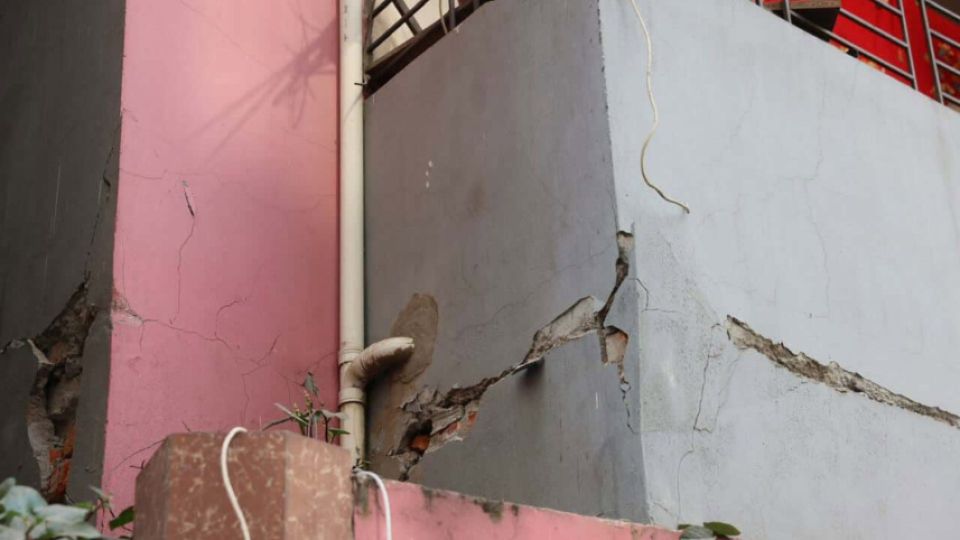
A 5.7‑magnitude earthquake jolted Dhaka and nearby districts on November 21, 2025, damaging buildings and sending panicked residents rushing into the streets. Photo: Star
“Earthquakes measuring between magnitude 4 and 5 have occurred in these areas from time to time. The tremor that occurred on Monday was quite normal,” he added.
Professor Mehedi Ahmed Ansary of the Department of Civil Engineering at Bangladesh University of Engineering and Technology (Buet) said over the past two years, around eight to 10 earthquakes have occurred with epicentres near Dhaka, including in places such as Narsingdi. However, there are no major fault lines in Dhaka itself. The tremors occurring around the capital are mainly linked to local fault lines.
He said although there are no major fault lines in and around Dhaka, there remains a risk of significant danger from major fault lines located in other parts of Bangladesh or in neighbouring countries.
He said due to its geographical location, Bangladesh lies in a region where a major earthquake could strike at any time. “Geological analyses indicate that the country has a recurrence cycle, or ‘return period’, for magnitude-8 earthquakes, which typically occurs every 300 to 350 years. Based on that estimate, a magnitude-8 earthquake may not be imminent. However, the real concern is that an earthquake measuring 7.0 to 7.5 on the Richter scale could occur at any time.”
Citing historical examples, he said major earthquakes have struck the region before, including a magnitude-7.5 quake in Assam’s Cachar in 1869, a magnitude-7.6 quake in Sreemangal in 1918, and a magnitude-7.1 quake in Assam’s Dhubri in 1930.
Star file photo
“Based on a recurrence cycle of roughly 150 to 200 years, a magnitude-7 earthquake in this region could occur at any time,” he said.
Referring to a survey conducted by the Japan International Cooperation Agency (Jica) and the Comprehensive Disaster Management Programme (CDMP), he said if a magnitude-7 earthquake strikes Dhaka, around 72,000 buildings could collapse. The city has approximately 21 lakh habitable structures. Of these, about 15 lakh structures are small buildings or tin-shed houses, where the risk of mass casualties from collapse is comparatively lower.
“The main concern lies with the remaining six lakh multi-storey buildings. Our preliminary assessment suggests that at least 40 percent of these structures are in a vulnerable condition,” he added.
He said in Bangladesh, earthquake preparedness is often understood by the government as increasing the capacity of the fire service or purchasing rescue equipment. But the real preparedness should begin with building construction.
“There is a well-known saying in engineering: earthquakes do not kill people; weak buildings do. Therefore, if we want to save lives, there is no alternative to ensuring that buildings are constructed properly and that older structures are strengthened through retrofitting,” he added.