

October 14, 2025
MEDAN – Torrential rainfall over the weekend triggered widespread flooding across three regions in North Sumatra, that inundated thousands of homes and affected tens of thousands of residents.
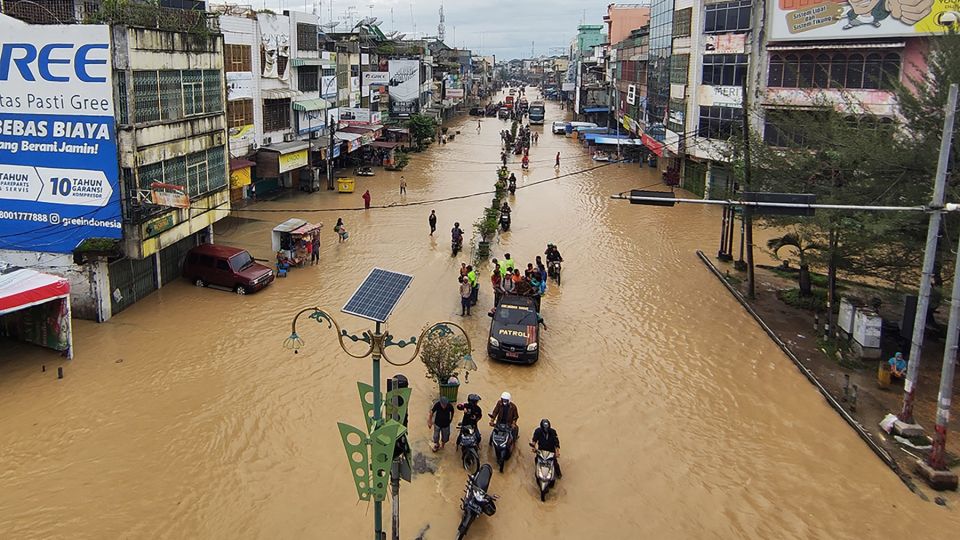
In the provincial capital of Medan, heavy rainfall which began on Saturday and continued into the early hours of Sunday caused the Deli, Babura, and Sunggal rivers to overflow. Floodwaters between 30 and 100 centimeters high submerged more than 3,300 homes across seven of the city’s 21 subdistricts.
Many major roads in Medan were also flooded, cutting off access and forcing motorists to abandon vehicles damaged by high water levels.
According to data from the Medan Disaster Mitigation Agency (BPBD Medan), the flooding affected nearly 10,400 people and forced over 400 residents to evacuate to safer locations. No casualties have been reported.
Medan Mayor Rico Waas said that local authorities have converted several mosques, schools, and government buildings into temporary shelters for residents affected by the flooding.
“We have distributed essential aid to those taking refuge in these shelters, including blankets, bedding, food, clean water and medicine,” he said on Sunday.
Rico added that emergency response teams are working around the clock to clear waterlogged areas and reduce flooding in the most vulnerable parts of the city. He also stated that the local administration will begin dredging and widening rivers and drainage channels to mitigate the risk of future flooding.
“We urge all residents to remain vigilant as the possibility of another wave of flooding remains,” he warned.
Read also: ‘Dry season’ floods nationwide highlight climate crisis
M. Simanungkalit, a Medan resident who was forced to evacuate after floodwaters rose to waist level in his home, expressed hope that the city administration would reinforce and raise the height of the Deli River embankment.
“The embankment is too low and has cracks in several sections. As a result, it fails to protect residents whenever heavy rains hit,” he said on Monday.
Beyond Medan, heavy flooding also struck parts of Tebing Tinggi, a city approximately 80 kilometers away from the provincial capital.
Continuous heavy rain on Sunday caused a sharp increase in the flow of the Bahilang River, one of the city’s main waterways. Around noon, a section of the river embankment collapsed, unleashing floodwaters into residential areas.
Water levels ranging from 30 to 70 centimeters inundated more than 640 homes across two subdistricts, affecting an estimated 2,500 residents.
Meanwhile, on Saturday night, torrential rainfall also triggered flooding in two villages in Batubara regency, located about 130 kilometers from Medan.
According to the local Disaster Mitigation Agency (BPBD), water levels between 30 and 60 centimeters submerged approximately 60 homes.
The flooding also affected infrastructure and agricultural land in the area, inundating 200 meters of local roads, 31 hectares of rice paddies, and 66 hectares of palm oil plantations.
According to the Meteorology, Climatology, and Geophysics Agency (BMKG), Indonesia is experiencing an earlier onset of the rainy season this year, with some regions having entered the wet season as early as August.
As of Sunday, approximately 42 percent of the country, particularly in the southern and eastern regions, have officially transitioned into the rainy season.
The BMKG forecasts that rainfall will peak between November and December in the western part of the country, while the southern and eastern regions are expected to experience the highest rainfall intensity in January and February.
Read also: Bali ramps up mitigation efforts after worst flooding in its history
On Sunday, the agency issued a weather warning for 27 out of Indonesia’s 38 provinces, predicting moderate to heavy rainfall through Tuesday.
BMKG Head Dwikorita Karnawati has urged regional authorities and residents to remain vigilant for potential hydrometeorological disasters, such as flooding and landslides, particularly as the rainy season intensifies from November onward.