

May 28, 2026
THIMPHU – Mist hangs low above the abandoned campus of the former Dogak Community School in Gozhi Gewog in Dagana. Bushes crawl over cracked pathways. Wild grass has swallowed the football ground. The whitewashed academic block stands silent beneath rusted roofing sheets, overlooking five acres of land that remained untouched for years after the school closed in 2017.
Established in 1977, the school shut down in 2017 after student enrolment fell to fewer than seven children — a casualty of rural depopulation that has transformed many villages across Bhutan.
Today, however, the abandoned campus is stirring back to life.
Each morning, women carrying farming tools walk across the overgrown grounds. Newly connected irrigation lines snake through cleared plots. Reserve water tanks stand beside land prepared for cultivation. Soon, aloe vera, cardamom, coffee, quinoa, soybean, fruits, and vegetables will begin growing where classrooms once stood.
What was once an abandoned institution is slowly becoming a community-led farming project built on hope, survival, and rural resilience.
Women at the centre of the transformation
The initiative is implemented under the Local Area Potential-Based Economic Development (LAPBED) programme and the Performance-Based Climate Resilient Grant component. This is supported by the European Union (EU) until 2027 with funding assistance of Nu 1.5 million.
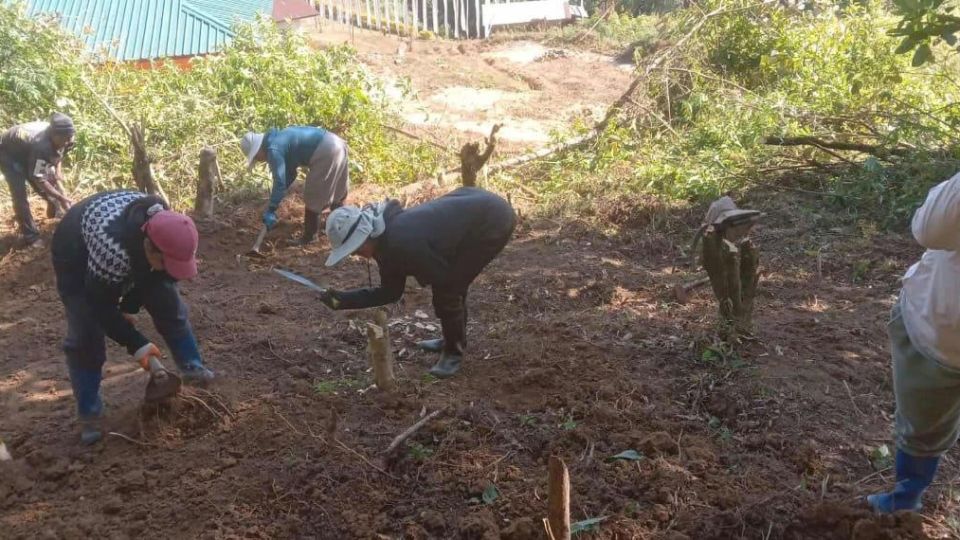
At the centre of the transformation are seven women — members of the Community Engagement Platform (CEP), many of whom come from financially vulnerable households. They now see the project as a rare opportunity to generate stable income from land left idle.
The group originally comprised 15 members, but now has seven permanent members. The group is governed by its own bylaws.
According to Sangay Wangmo, project focal person, in the past, people were working on CEP activities that did not generate income. “Now, this programme provides investment along with returns.”
Gozhi Gup Tshering D. Ghishing said the project site belongs to the Ministry of Education and Skills Development. Following approval of the proposal, the gewog administration initiated procedures to obtain land-use clearance and leasing approval.
While formal processes continue through government channels, the site has already been provisionally allocated to allow implementation to begin.
“Close co-ordination is being maintained with agriculture and livestock sector officials to provide technical guidance on aloe vera cultivation and integrated mixed cropping practices,” the Gup said.
The gewog plans to continue regular monitoring, field supervision, training programmes, and on-site technical assistance.
A project built around livelihoods and resilience
For residents of Dogak and Balleygang chiwogs, the project arrives at a time when rural communities struggle with limited economic opportunities and continued dependence on subsistence farming.

At the centre of the transformation are seven women — members of the Community Engagement Platform (CEP), many of whom come from financially vulnerable households. They now see the project as a rare opportunity to generate stable income from land left idle. PHOTO: KUENSEL
Chimi Wangmo, project focal person from the Department of Local Government and Disaster Management, said the initiative aims to strengthen rural livelihoods by increasing women’s participation in income-generating activities. “The project seeks to diversify household incomes and promote environmentally sustainable agricultural practices.”
Women make up the majority of participating CEP members, making the initiative as much about empowerment as agriculture. The project also aims to improve local economic activity through the cultivation, processing, and marketing of high-value crops.
“It builds on the success of the CEP model to promote collective ownership, inclusive decision-making, and strong community collaboration,” Chimi Wangmo said.
The economic potential of the project lies partly in its strategic location. Dogak is just five kilometres from Dagapela town, offering access to growing markets for fresh produce.
In the future, the group also hopes to supply products to the Gelephu Mindfulness City, where demand for organic and wellness-based products is expected to increase.
Existing Farmers’ Sales Outlets and aggregator networks are expected to improve market access. Nearby institutions, including agriculture and livestock offices, the Community Centre, and the Dagachu Hydropower Project, could provide future partnership opportunities.
Challenges remain despite optimism
The seven-member group has already cleared bushes across the entire five-acre site. Two rural water supply scheme reserve tanks with a combined capacity of 12,000 litres have been constructed using water drawn from a nearby stream.
Pema Dechen, the group’s representative, said the land is now being prepared for plantation. “Saplings and seeds are expected to arrive soon. Individual members have already been assigned responsibilities to oversee production activities.”
Yet uncertainty remains.
“For now, there is no trained member with knowledge in such farming practices,” Pema Dechen said. “Training in horticulture management, grafting techniques, pruning, seedling management, and farm management would be critical for the project’s long-term sustainability.”
The next phase will include fencing work to protect crops from wildlife intrusion, while the Dagana Dzongkhag Administration has agreed to provide technical support.
Members also expressed concerns over delays in accessing approved funds for immediate purchases and investments.
“This has made purchasing works difficult,” Pema Dechen said. “Without the required budget and equipment in hand, progress is slow.”
She said prolonged delays could eventually discourage members who lack the financial means to invest on their own.
A model for wider rural revival
Lekey Wangdi, Technical Assistance Expert from the EU, said the initiative forms part of a broader LAPBED governance programme supporting 13 similar projects nationwide.
At the conceptual level, the EU provides technical assistance, market analysis, networking support, governance frameworks, and product development guidance.
“This being a community-led project requires extensive soft works and technical assistance,” he said. “The project is not just based on need, but on what can be brought to the market.”
The project also explores private-sector linkages, value chains, product diversification, and value addition.
To support implementation, local government officials were trained on participatory planning, community engagement, and local economic development. Workshops on governance, business management, and gender inclusion were also organised for project co-ordinators and local officials.
Financial accountability is monitored through approved blueprints and Results-Based Management frameworks. Local governments are required to submit periodic financial and progress reports, while review meetings continue to assess implementation and address challenges.
“These 13 sites could motivate other gewogs to follow similar planning initiatives and seek support from different agencies,” Lekey Wangdi said.