


December 3, 2025
SEOUL – Giving birth to a child brings changes to a family in many ways, reshaping not only daily life but also the emotional landscape, from joy to sorrow. Birth takes center stage at the National Folk Museum of Korea and the European gallery White Cube in Seoul, embodying these ideas in different thought-provoking ways.
At the National Folk Museum of Korea, a baby’s first cry echoes through the entrance to the “Happy Birthday” exhibition, accompanied by a reimagined scene of a Joseon-era (1392-1910) childbirth. Straw rope for protecting the mother and newborn hangs from the ceiling, and a straw birthing mat, along with instruments for cutting the umbilical cord, are laid on the floor.
The exhibition traces moments surrounding newborns, showing cultural narratives not only from Korea but also other countries such as Japan, China and Europe, spanning centuries of history.
“We focused on the communal roles and environments surrounding childbirth across different cultures,” said Jang Sang-hoon, director general of the NFMK, on Tuesday. “I felt it was a topic the Folk Museum needed to address. A museum connects one generation to the next, and the declining number of children ultimately shakes the foundation of the museum itself.”
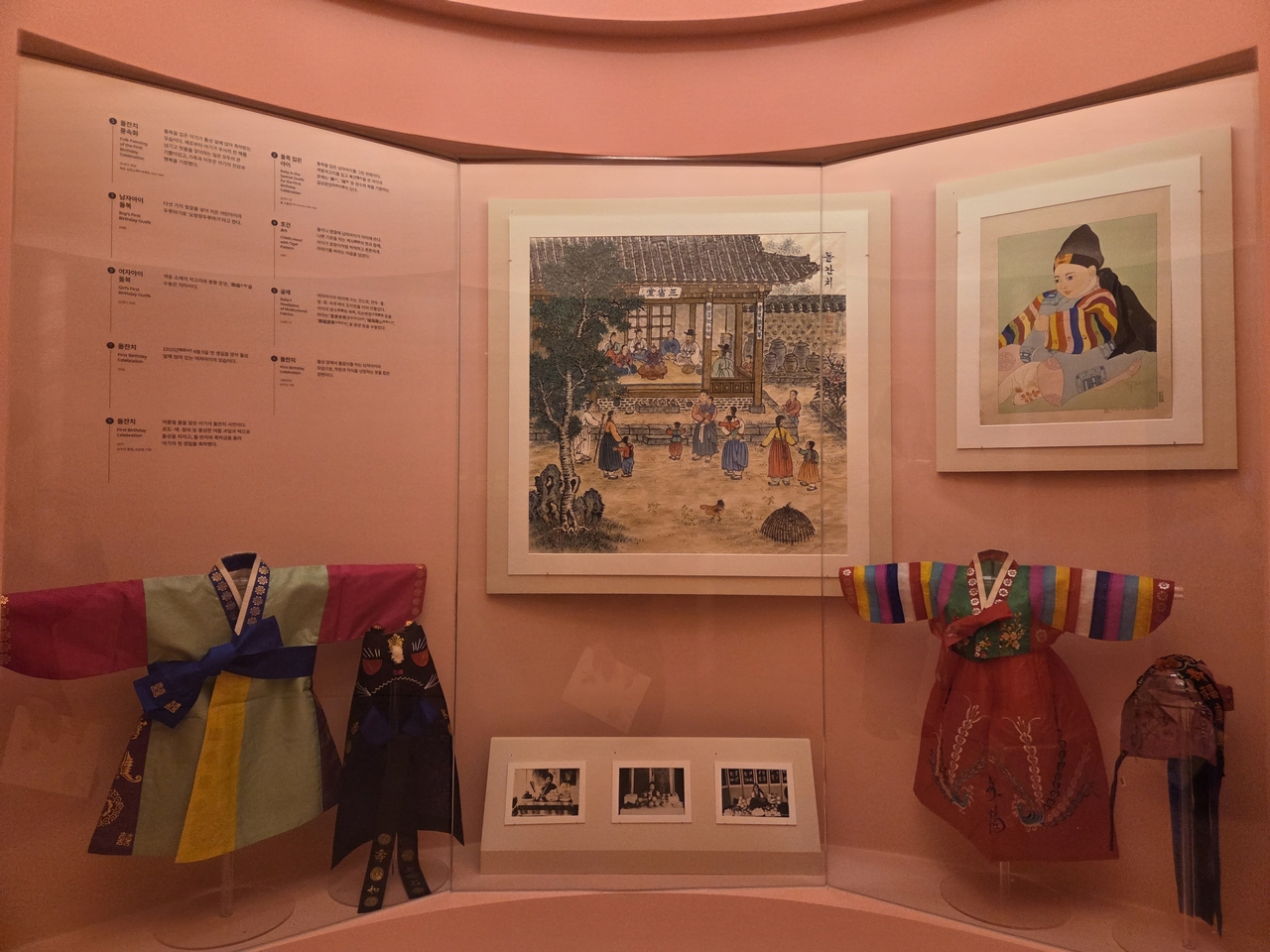
Installation view of “Happy Birthday” at National Folk Museum of Korea in Seoul. PHOTO: THE KOREA HERALD
It also shows how women have sought information across different eras — from late Joseon manuals containing childbirth-related superstitions and taboos, to early-1900s letters in which mothers offered advice to their daughters, to government-issued booklets from the 1950s, and today’s blogs and group chat rooms.
At White Cube gallery, French artist Julie Curtiss’ first solo exhibition “Maid in Feathers” explores the experiences of working women raising children, and how the burden of child-rearing still falls largely on women even today.
In the painting “Woman with Whisk,” a woman appears cooking with a whisk in one hand and her nursing bra open. The painting highlights the contrast between a woman’s identity before and after becoming a mother, according to the artist.
By tracing the blurred boundaries between care and eroticism, play and anxiety, Curtiss’ works resist idealized portrayals of motherhood, instead revealing its complexities and contradictions.
The artist recalled that during her first month after giving birth, she concentrated on making small works on paper because they were easier to handle and she had little time. Life as a new mother, she noted, blurs the boundaries between day and night.
The exhibition shows 20 new paintings from the artist and runs through Jan. 10, 2026.