

January 9, 2026
ISLAMABAD – I am an airport person — not because I travel often, but because I love their peculiar atmosphere: the sense of transition, the emotion of crossing borders. Yet I have come to recognise another dimension: airports often capture the essence of the society that built them.
Earlier in October, I booked my flight from Berlin to Karachi after completing my postgraduation in Germany. This was not my first time travelling the Berlin-Doha-Karachi route and, like every time, I looked forward to my three-hour layover at the Hamad International Airport in Doha, Qatar.
DOHA’S DOUBLE-EDGED LUXURY
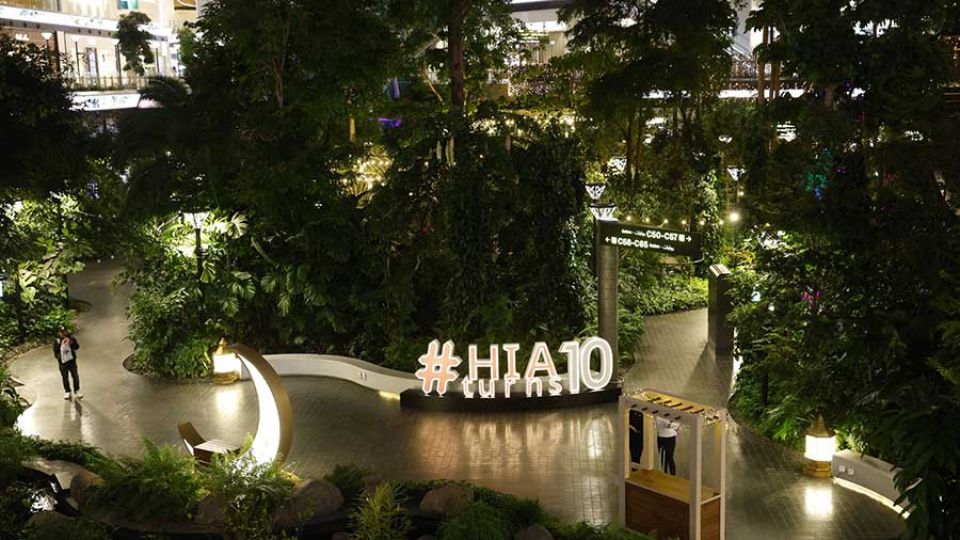
A brief stay at this airport feels like a delight for the senses; an artificial tropical garden, endless dining options and other curated attractions look like something from a fairytale.
I realise that my liking sits at odds with my sociological leanings. The Doha airport represents all that I dislike about the region’s neoliberal culture: hyper-consumerism, late-stage capitalism and an undue fixation on aesthetics.
Yet the airport’s commercial excess coexists with a highly efficient service apparatus. The wait times at immigration and baggage claim in Doha are virtually nonexistent. It is difficult not to appreciate the passenger experience, but anyone critical of the neoliberal paradigm is forced to confront certain questions: who built these terminals, who cleans the facilities, and who helps achieve such a high level of service?
What do airports reveal about the societies that build them? Comparing Doha’s opulent excess, Berlin’s democratic modesty and Karachi’s perpetual stagnation offers unexpected insights
The answer is clear: migrant workers from South Asia, Southeast Asia and Africa form the backbone of Gulf infrastructure. They work long hours constructing these expansive environments, while living under conditions marked by vulnerability, if not outright abuse.
In 2022, the kafala [sponsorship] system, which tied workers’ legal status to their employers, was officially abolished in Qatar. Nevertheless, the overall labour rights conditions are still far from adequate. The large migration of workers from other countries also speaks to a reality about where they come from: the lack of employment opportunities and survival options available to Pakistanis, Indians, Filipinos and Ethiopians compel them to migrate to the Gulf.
BERLIN’S OLD SCHOOL
In contrast to Doha airport, Berlin’s Brandenburg Airport, though modern and efficient, is considerably smaller, with fewer shops and only two or three dining options per terminal. Just like its airport, there is certainly nothing in Berlin approaching the scale of luxury found in Gulf megacities.
My two years as a student in Berlin surprised me on several fronts: remarkably few shopping malls, dated infrastructure and the metropolis seemed to be perpetually under construction, with dug-up roads and building sites scattered across neighbourhoods.
Local friends explained that this was due to long-delayed government development projects, as a result of which fibre-optic cables were only now being laid beneath the city. For me, this reflected Germany’s adherence to older systems and strict bureaucracy.
The story of Brandenburg Airport has parallels to these characteristics: the airport, which was scheduled to open in 2012, missed seven scheduled opening dates and finally opened in 2020.
Yet Berlin’s pace of modernisation isn’t just about the challenges of the scale of reconstruction. The city residents, too, have made a choice. Time and again, they have resisted the capitalist development model that prioritises profit over public access.
REFLECTION AND COMPARISON
Unlike Gulf cities, Berlin resists excessive consumerism. Leisure isn’t gatekept by wealth: museums offer free entry days, galleries and exhibitions operate on donation, making cultural participation possible.
The political systems of the two regions come into play here. As a strong democracy, the German state, which charges high taxes from its citizens, is also accountable to them. Gulf states, as described by UK-based Adam Hanieh, the author of Capitalism and Class in the Gulf States, operate as capitalist monarchies. By channelling their oil wealth into urban development, the ruling regimes have successfully built tourist economies, cultivated international investment hubs and, most recently, expanded toward knowledge economies.
Without elections or citizen-funded taxes, accountability does not operate through the public. Instead, the state strictly regulates chosen domains: food businesses face hefty fines for violations, littering incurs penalties. The resulting order and efficiency create comfortable conditions, selectively benefitting white-collar expats and wealthy natives.
HOMECOMING REALITIES
When I landed at the airport of my home city after a 12-hour journey, I was overcome with nostalgia for a few seconds, as Karachi is the city where I spent my early childhood.
But as my nostalgia faded, I felt the contrast between Karachi airport and any other international airport, including those of Doha and Berlin. The infrastructure was dated and the stores felt like relics of a bygone era. I saw my suitcase after nearly an hour of waiting, although there were only three flights at 7am on a Saturday.
Why does the transport hub of Pakistan’s largest city feel frozen in time? What has prevented its renovation or the construction of a contemporary facility? Jinnah Airport, which opened in 1992, has remained unchanged since its founding. It is, in many ways, a microcosm of Karachi itself: perpetually stuck between what it actually is and what it struggles to become.
Major governance challenges dominate Karachi’s urban landscape, where crumbling infrastructure frequently results in life-threatening accidents. Unchecked projects are often abandoned with little consequence. A clear blame rests on the shoulders of negligent authorities, but it is no less true that the general public in Karachi also suffers from an almost criminal lack of civic sense.
Yet for all its flaws, Karachi is a city whose capacity to receive, absorb and sustain people from all walks of life is remarkable. Home to at least 21 million people, Karachi has, for generations, accepted people from across Pakistan. Punjabis, Pakhtuns, Sindhis, Baloch, Mohajirs, and Bengalis have all found their way here to seek opportunity, refuge, or simply to survive, and the city has given them space to build lives, however precarious.
much said about the need for Pakistan to have an international-standard airport, there is a story to be told about the new Islamabad airport, too. When it was opened in 2018, the Islamabad International Airport, described as ‘world-class’ and ‘state-of-the-art’, was a celebration for Pakistanis. After years of unpleasant experiences at the former Benazir Bhutto International Airport, the consensus was that Islamabad deserves a transportation facility that offers, at the very least, a positive first impression of the capital city.
Admittedly, the new airport is a significant step up from its predecessor; it is much larger, better-designed and more efficient. Yet one cannot help but notice the substandard quality of construction and other characteristics that fall short of qualifying it as a truly ‘world-class’ airport. The roofs have a tendency to leak when it rains and the elevators accommodate barely four passengers.
A 2025 case study by Dr Bilal Karim, Engr Muhammad Arif and Engr Zafar Ali Khan deemed the airport a “project success” for meeting budget and schedule, but a “business failure” for missing air traffic projections. I contend it fails as a project, too. Aesthetically, the truck art offers a slight saving grace, as it shows an appreciation of the creative labour of local painters and calligraphers.
With ample to complain about on the infrastructural front, in truth, my relationship with Karachi — my birthplace — and Islamabad, where I’ve lived, is more fundamental in shaping how I feel about their respective airports. Many hellos and goodbyes have been said here, and my associations are about personal memories, and significant life moments more than anything else.
So yes, I’m still an airport person — though the term now encompasses many different meanings.
The writer is a communications professional and recently completed her postgraduation from the Free University of Berlin in Germany. She can be reached at zoyan48@zedat.fu-berlin.de