


April 10, 2026
SEOUL – A groundbreaking ancient DNA analysis has found that close-kin marriages and family-based sacrificial burials were practiced during the Silla Kingdom (57 BC-AD 935), providing the first large-scale scientific evidence of the era’s social structure and customs.
The study was led by Jeong Choong-won, a professor of biological sciences at Seoul National University, in collaboration with researchers from Yeungnam University Museum, Sejong University and the Max Planck Institute for Evolutionary Anthropology in Germany.
Researchers analyzed genome-wide data from 78 individuals whose DNA could be sequenced, drawn from 44 tombs at the Imdang-Joyeong burial complex in Gyeongsan, North Gyeongsang Province, one of the most prominent archaeological sites from the Three Kingdoms period on the Korean Peninsula.
The burial complex, first excavated in 1982 and designated a historic site in 2011, was constructed over roughly a century between the 4th and 6th centuries. It is believed to contain the graves of local ruling families descended from Abdok, a polity incorporated into Silla around the 4th century. To date, more than 1,600 tombs and the remains of at least 259 individuals have been uncovered.
According to the study, titled “Ancient genomes reveal an extensive kinship network and endogamy in a Three-Kingdoms period society in Korea,” published in the April 10, 2026 issue of Science Advances, at least 20 two-chambered tombs show evidence of “sunjang,” a burial practice in which individuals were sacrificed and interred alongside the dead. These tombs typically consist of a main chamber containing both the grave owner and sacrificed individuals, and a subsidiary chamber reserved for additional sacrifices.
Through DNA analysis, the team identified at least three cases in which closely related individuals — including parent-child pairs — were interred together in the same tomb, with one burial containing both parents and their child.
“Our genetic findings are the first to confirm the acts of sunjang of an entire household,” the researchers wrote in the paper.
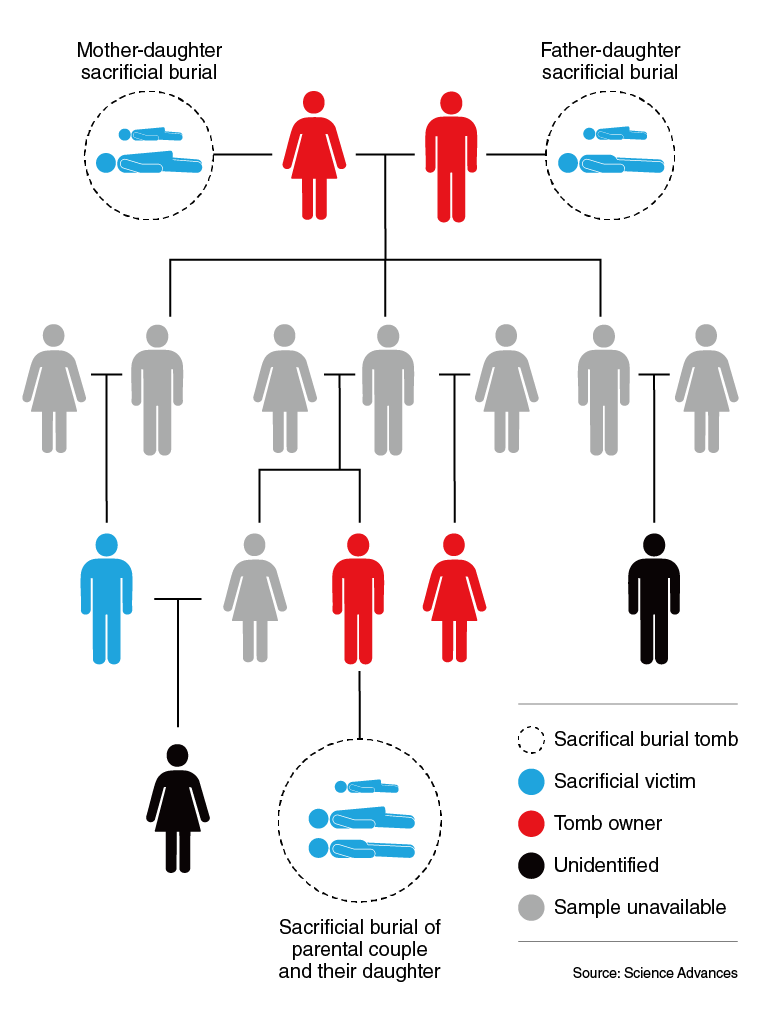
This pedigree, reconstructed from DNA analysis of individuals buried in the same grounds, reveals cases in which parent–child pairs were buried as part of sacrificial practices, including one involving both parents and their child. CHART: THE KOREA HERALD
The findings also point to the possibility that such roles were inherited. “Genetic relatedness among sacrificial individuals over generations may suggest the presence of families that served as sacrificial individuals for the grave owner class for consecutive generations,” the paper wrote.
The analysis also identified multiple cases of close-kin marriage, including five instances among relatives within six degrees of kinship. These patterns were observed among both grave owners and individuals buried as part of sacrificial rites, suggesting that endogamy was practiced broadly across social groups rather than confined to the elite class.
Sacrificial burials were practiced in several ancient societies. On the Korean Peninsula, the practice became particularly associated with Silla during the Three Kingdoms period. Individuals such as servants, retainers or dependents were buried with elites, reflecting a belief that the dead would require attendants in the afterlife. The practice was formally abolished in 502 during the reign of King Jijeung of Silla.
The study found no meaningful genetic distinction between grave owners and those sacrificed, indicating that both groups belonged to the same local population rather than representing outsiders or captives.
The findings from the DNA analysis “highlight a kinship structure distinct from those observed in ancient Europe and offer new insight into how local communities were organized during the Three Kingdoms period,” the researchers said in a press release Thursday.