

May 11, 2026
JAKARTA – As tensions in the Middle East erupted into a full-blown war, major airlines, including EgyptAir and Etihad, were forced to cancel flights. “It is because of the war. Almost every day, flights to the Middle East are canceled,” explained a representative at the Terminal 3 front office of Soekarno-Hatta International Airport in Tangerang, Banten.
Flight cancellations from Indonesia, whether for transit or final destinations in Dubai, Abu Dhabi or Doha, mostly occurred during the early days of the conflict involving the United States, Israel and Iran. Passengers often remained in limbo, not knowing until a day or two before departure whether their flights would proceed.
On March 20, just one day before Idul Fitri, the airport was buzzing with activity. Despite the Gulf conflict, Emirates managed to transport five members of the Indonesian Catholic Journalists Association (ICJA) to Leonardo da Vinci-Fiumicino Airport in Rome. “We had to take a longer route, flying over Oman and Chad to reach Europe,” said Jumar Sudiyana, a journalist from Sonora Radio.
Prior to their Emirates flight, the group held tickets for Qatar Airways, which could only guarantee travel as far as Doha. “The next available flight to Rome wasn’t until March 30, and even then, only if the situation returned to normal. So, we opted for a refund,” said Asni Ovier Dengen Paluin, the chairman of the ICJA. The group was determined to reach Rome before March 25, the date set for the official signing of the memorandum of understanding to have the Indonesian language accepted by Vatican News, the official news agency of the Holy See.
“The great vision is to create a platform where Catholic communities worldwide are fully connected, sharing the lived experiences of the Church wherever they may be,” — Paolo Rufini, prefect of the Dicastery for Communication
From Rome, a closer Indonesia
Mgr. Agustinus Tri Budi Utomo, better known as Mgr. Didik, Bishop of Surabaya in East Java who led the mission, chose a different path. Alongside Father Agung Nugroho and ICJA adviser Mayong Suryo Laksono, he flew via China Eastern. The journey took over 23 hours, significantly longer than the usual 18, but the route was safer as it crossed Eastern Asia rather than the epicenter of the Gulf tensions. They arrived just in time for the “D-Day” of March 25.
March 25 was more than just a deadline; it was the Feast of the Annunciation. “That is why the date I chose was so crucial,” Mgr. Didik explained. Putut Prabantoro, the founder of the ICJA, and Mayong had consulted with Didik in February while preparing for this historic event.
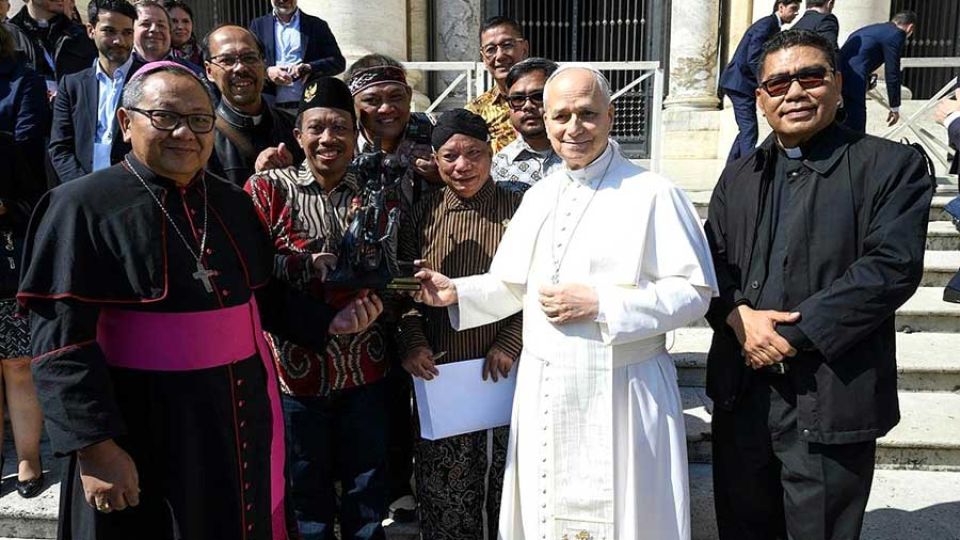
The date will forever be etched in Didik’s memory. Standing within the hallowed halls of St. Peter’s Basilica, he met face-to-face with Pope Leo XIV. “I was lucky; I sat next to His Holiness,” he recalled, describing the moment as surreal.
However, his mission was not limited to that morning’s courtesy visit. While a private audience with the Supreme Pontiff is a rare and profound honor, Didik, in his capacity as head of social communication for the Bishops’ Conference of Indonesia (KWI), was there to bring Indonesian to the heart of the Vatican.
That afternoon, following the papal meeting, the inauguration of Indonesian as an official language of Vatican News took place. “It is important both politically and ecclesiastically,” Didik said.
Ecclesiastically, the acceptance of the language means the Vatican is no longer a distant entity to Indonesians. “We, as Catholics, now feel a closer intimacy with the Vatican,” he added. The approval also symbolizes the Indonesian Church becoming more fully integrated with the universal Church.
From a political standpoint, the Vatican’s acknowledgment of Indonesian as one of its 57 official languages is significant. As the largest country in Southeast Asia and the world’s most populous Muslim-majority nation, Indonesia’s inclusion reflects its culture of respecting diversity.
The Vatican, a unique state where the Pope serves as both the head of state and government, wields immense global influence. It maintains diplomatic relations with over 180 nations, a reach second only to a few major world powers.
Paolo Rufini, the prefect of the Dicastery for Communication, praised the agreement as a vital expansion of universal kindness. Rufini noted Indonesia’s global standing as the fourth most populous nation.
Vatican News aims to deliver news in a context that is easily accessible to local communities. “The great vision is to create a platform where Catholic communities worldwide are fully connected, sharing the lived experiences of the Church wherever they may be,” Rufini said.
As a veteran communication practitioner with experience directing Rai Tre and Rai Radio, Rufini understands the weight of Vatican News across its online, print, radio and television services. The agency spreads information in dozens of languages, exerting influence not only through news but through a moral and geopolitical lens. Its core messages of peace, justice, and welfare align closely with the Preamble of Indonesia’s 1945 Constitution.
The relationship also holds profound historical value: the Vatican was the first European nation to recognize Indonesia’s independence in 1945, followed by formal diplomatic ties in 1950. While the Vatican is an apostolic, non-political state, its stances on global ethics often serve as a standard for world leaders. A notable example is how Pope Leo XIV has engaged with global figures on issues ranging from Venezuela to the current conflict with Iran.
With this milestone, Indonesia is now firmly on the Vatican’s radar as a nation whose language contributes to world peace. This vision echoes the persistent messages of successive popes, from Pius and John Paul II, who helped end the Cold War, to Benedict, Francis and now Leo XIV, all of whom have urged leaders to prioritize fairness over violence.
Mic and mission: Massimiliano Menichetti (left), Vatican Radio director and deputy editorial director of Vatican News, hosts a dialogue with secretary of the Indonesian Catholic Journalist Association Stanislaus Jumar Sudiyana at the Vatican Radio studio in Vatican City on March 25, 2026. (Sonora Radio/Stanislaus Jumar Sudiyana)
Beyond symbolism, toward substance
The spirit of interreligious dialogue was a recurring theme during the visit. Indonesia’s motto, Bhinneka Tunggal Ika (Unity in Diversity), has become well-known within the Roman Curia, especially following recent apostolic visits. “Some priests praised it during our conversations,” said Father Agung Nugroho, secretary of social communication for the KWI.
Furthermore, Indonesia has gained prominence within the Dicastery for Interreligious Dialogue due to the many Indonesian Muslim students studying in Rome and the fact that Indonesia is one of the world’s largest contributors of Catholic missionaries. Despite this, Indonesia remains underrepresented in the Vatican’s hierarchy.
Mgr. Antonius Subianto Bunjamin, chairman of the KWI, recalled that Vatican Secretary of State Cardinal Pietro Parolin has previously called for greater Indonesian participation in the dicasteries. Currently, Father Markus Solo Kewuta is the only Indonesian in the Holy See’s hierarchy, serving as the secretary of the Dicastery for Interreligious Dialogue. Father Markus accompanied Mgr. Didik and Ambassador Trias Kuncahyono during the official signing ceremony.
Mgr. Didik and Father Agung celebrated the event as a “gift from God” for Indonesia. However, amid the euphoria, they recognize that the real work has just begun. Didik’s team is now establishing a special division to implement the agreement.
“Our primary task is to translate official documents of the Church and the papacy so that the Indonesian people can access these teachings directly,” he explained. Additionally, the division will supply Vatican News with stories from Indonesia, showcasing the living practice of pluralism. “Please pray that this will be realized soon,” he concluded.