

July 3, 2026
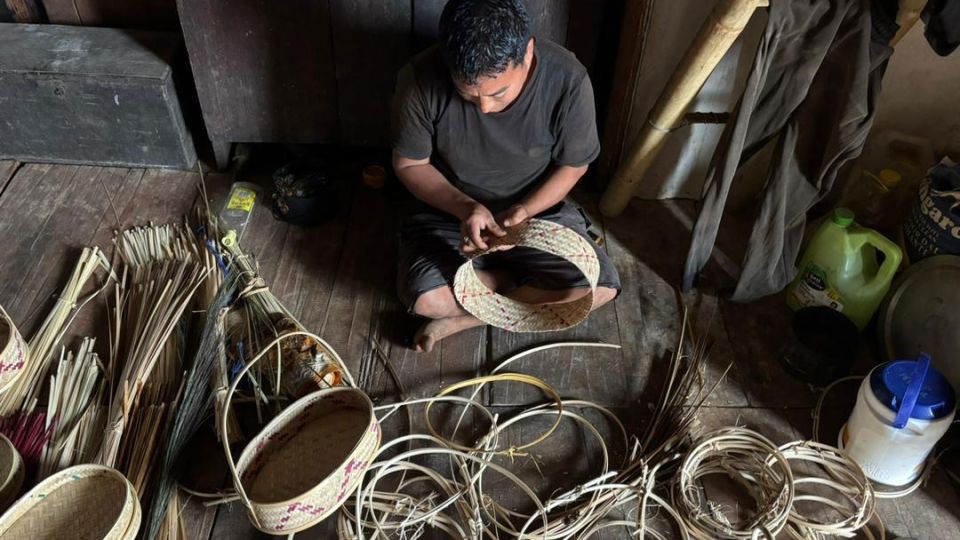
ZHEMGANG – In Bjoka, Panbang, bamboo is everywhere. Bundles lean against walls, and half-finished baskets fill living rooms as artisans weave bangchung, trays, containers, mats, and handicrafts. But Yula, the preferred bamboo, is becoming increasingly scarce, raising concerns over the region’s signature livelihood.
For generations, bamboo weaving has sustained Bjoka. During the time when rural communities paid taxes in kind, households here contributed bamboo products while lower gewogs supplied fruits and vegetables. Over time, the craft became part of daily life and identity.
Today, that tradition is under strain as the bamboo most central to it becomes harder to find.
At the centre of the concern is Neomicrocalamus andropogonifolius, locally known as Yula, the species most valued by artisans.
“The alternatives are there, but Yula is still the best,” said Rinchen Tshewang, a bamboo artisan.
Yula is preferred for its hard, shiny outer surface, its ability to split into fine strips without breaking, and its weaving flexibility. It also takes dye well, producing the coloured patterns seen on both traditional and modern products.
For artisans, these qualities directly affect durability and price.
A traditional bamboo container, bangchung sells for between Nu 600 and Nu 750, while a palang can fetch between Nu 850 and Nu 1,200. For many households, bamboo weaving remains a key source of supplementary income alongside farming and livestock.
Rinzin Tshewang works between fields, cattle, and weaving. Inside his house, stacks of bamboo strips and finished products are lined up for buyers.
“These sell more,” he said, pointing to decorative baskets and storage containers.
Next door, Kinzang Dorji and his wife share the work in a small living room turned workshop — she weaves, while he finishes and prepares the products for sale.
The process begins well before weaving. Bamboo is harvested in the dry season, when culms are stronger and less prone to insects. It is cleaned, split into strips using hand tools, then kept moist to prevent cracking. After drying in the shade, the strips are woven into baskets, mats, and containers using techniques passed down over generations.
Demand for these products has increased sharply in recent years.
Orders now arrive through TikTok, WhatsApp, and Telegram. Trade fairs and festivals have added new buyers, and the Bjoka Tsharzo Tshogpa also collects and markets products beyond the village.
What was once a problem of finding buyers has become a problem of supply.
Pressure on Yula has increased in nearby forests.
Yula is not difficult to propagate, and forestry studies recommend its cultivation. It can be grown through rhizome and stem offsets, but it requires warm, fertile sites with good rainfall and overhead tree cover to thrive. While locally abundant in some forest pockets, its distribution is limited to specific ecological zones, making supply sensitive to harvesting pressure rather than to cultivation constraints alone.
A Non-Wood Forest Products Management Plan regulates harvesting, allowing collection only between January and March and setting limits on extraction, such as twice a month, with only two members of each household allowed to collect. But enforcement is difficult.
“It is hard to monitor bamboo collection deep inside the forest,” said Pema Wangdi, Chairman of the Bjoka Tsharzo Tshogpa. “The harvesting areas are scattered and far away.”
He described what often happens in practice. “If there are seven culms in a clump, one person takes a few and leaves some behind. The next person takes more. By the time others come, almost everything is gone.”
It is a pattern that reflects the difficulty of managing shared natural resources where monitoring is challenging.
To cope with the shortage, weavers have begun planting bamboo on private land. But Yula takes about six to seven years to mature into usable size. It also grows best in fertile soil and under partial tree cover, making cultivation slow.
Some artisans are turning to alternatives. Jasui (Bambusa alamii) is already used for baskets and mats, while Demcher (Dendrocalamus sikkimensis) is used for larger containers and household items. Both grow faster, usually maturing within three years.
But artisans say they are not the same. They work, but they do not split as finely. They do not bend as easily. And they do not take dye in the same way. Yula remains the preferred material.
The Tsharzo Tshogpa has begun encouraging new designs using alternative species, hoping to reduce pressure on forests while keeping production going.
“We need more research on other bamboo species,” Pema Wangdi said. “If we can identify suitable alternatives, we won’t have to depend so much on one species of bamboo.”
He said studies on growth, fibre strength, flexibility, and dye absorption could help guide future planting and use.
For now, Bjoka’s weaving continues as it always has. Nearly every household is involved in some form, and around 180 members belong to the Bjoka Tsharzo Tshogpa.
But the question of supply is becoming harder to ignore. The craft remains steady, the material behind it does not.
In Bjoka, bamboo still shapes daily life. But the bamboo that built it is becoming harder to hold on to.