

July 17, 2026
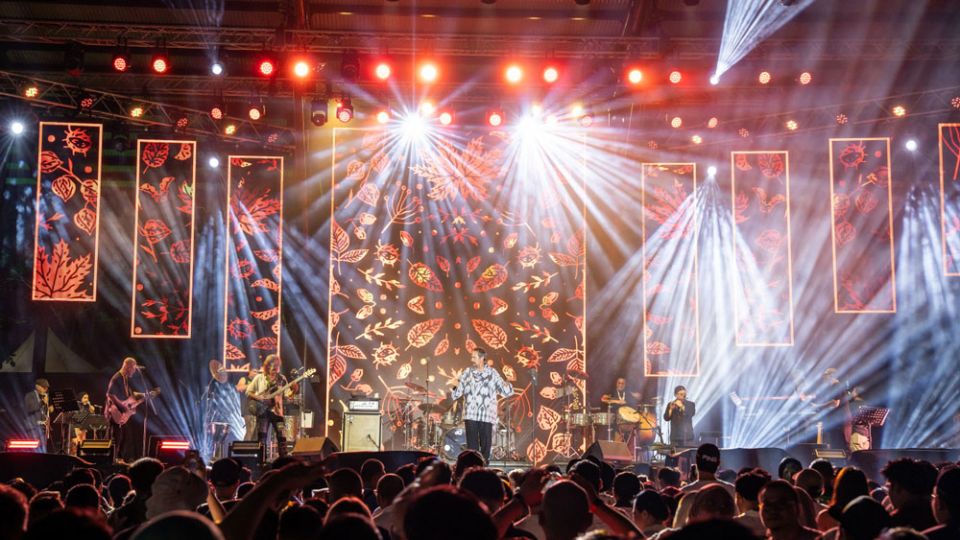
SARAWAK – As dusk settled over the foothills of Mount Santubong in Sarawak, Malaysia, the sounds of drums, bamboo instruments and electric guitars drifted through the rainforest, mingling with waves rolling in from nearby Damai Beach.
At the Rainforest World Music Festival (RWMF) in late June, musicians from Southeast Asia and beyond blurred the boundaries between tradition and modernity, blending indigenous melodies with jazz, rock, funk and electronic music while demonstrating how cultural heritage continues to evolve without losing its roots.
Among the performers was Indonesian ensemble Sambasunda, returning to the festival more than two decades after its first appearance in 2004.
“The greatest challenge is not choosing between tradition and modernity, but finding a balance between the two.” — Ismet Ruchimat, founder and composer, Sambasunda
Founder and composer Ismet Ruchimat said the group had presented a more traditional repertoire during its debut. This year, however, Sambasunda embraced contemporary influences while remaining firmly grounded in Sundanese musical traditions, with renowned sinden (singer) Rita Tila continuing to perform entirely in Sundanese.
“The greatest challenge is not choosing between tradition and modernity, but finding a balance between the two,” Ismet told reporters before taking the stage.
That balance extended beyond the music itself. This year’s lineup included younger musicians, among them Ismet’s own son, whose creative ideas often challenged his father’s artistic vision.
“He wanted to destroy my idea,” Ismet said with a laugh. “But we had to make a deal between his perspective and my perspective.”
When Sambasunda finally took the stage on the festival’s second night, they opened with the resonant sounds of gamelan before moving seamlessly into compositions blending Sundanese scales with rock, jazz and world music. Several pieces incorporated bajidoran, a contemporary Sundanese style that combines traditional instruments with modern arrangements and has gained popularity among younger audiences.
The performance reflected a broader theme running throughout the festival: tradition not as a museum piece but as a living art form continually reshaped by new generations.
Tradition in transition
Sarawakian duo Ta’Dan offered another example, introducing audiences to the kulit bungkau, a traditional mouth harp associated with the Kadazandusun community in neighboring Sabah.
For member Prostasindra Agatho, preserving traditional music depends less on institutions than on people continuing to play and appreciate it.
“Preserving traditional music ultimately depends on people’s willingness to continue practicing and loving it,” he said.
Elsewhere on the lineup, musicians from Thailand, Spain and Benin fused folk instruments with jazz, hip-hop, rock and electronic music, demonstrating how local traditions can speak a global musical language without sacrificing their cultural identity.
For nearly three decades, the Rainforest World Music Festival has transformed the Sarawak Cultural Village, nestled between Mount Santubong and the South China Sea about 35 kilometers north of Kuching, into a meeting point for musicians exploring those connections.
The festival was originally established to help preserve the sape, the boat-shaped lute of Borneo’s Orang Ulu communities, including the Kenyah, Kayan and Kelabit peoples. Since then, it has grown into one of Asia’s leading world music festivals while maintaining its commitment to indigenous traditions.
“We keep the momentum and the interest, especially in indigenous music that you cannot find anywhere else in the world. We showcase it here,” Sarawak Tourism Board chairman Dennis Ngau told reporters.
Its 29th edition featured Malaysian music icon M. Nasir, British acid-jazz band Incognito and American funk veterans The Commodores featuring Thomas McClary, alongside 12 other acts exploring the intersection of traditional and contemporary music.
New audiences
For festivalgoers, the event offered opportunities to discover unfamiliar musical traditions alongside celebrated performers.
Michael Capel, a 39-year-old visitor from Kuala Lumpur attending the festival for the second time after a decade, came primarily to watch M. Nasir perform but found himself equally captivated by artists he had never encountered before.
“I naturally gravitate toward traditional music,” Capel said, adding that Sarawakian duo Ta’Dan became one of his favorite discoveries this year.
On opening night, thousands sang along as M. Nasir performed classics including Gerhana Dalam Jiwa and Satu Hari di Hari Raya, before closing with Raikan Cinta, whose lyrics about rain, oceans and love echoed through the rainforest.
The festival concluded on Sunday with British acid-jazz band Incognito, whose energetic performance of Stevie Wonder’s “Don’t You Worry ‘Bout a Thing”, alongside songs from its latest album music.magic.ironic, kept thousands dancing until midnight.
“We kept the energy until the last performance, so you came home and will continue to talk about it,” bandleader Jean-Paul “Bluey” Maunick said before taking the stage.
As the final notes faded beneath the rainforest canopy, the festival’s message lingered beyond the performances themselves. Across Southeast Asia, traditional music is not fading into history but continuing to evolve, carried by artists willing to experiment while remaining rooted in their heritage, and by audiences eager to discover the sounds that connect the region’s diverse cultures.