

December 24, 2025
JAKARTA – On a humid afternoon in Bekasi, West Java, two chefs from distant corners of Oceania, Kia Kanuta of New Zealand and Charles Toto of Papua, worked side by side, using kindred techniques that turned the ground beneath their feet into a living stove.
One pit followed the careful steps of a Maori hangi, a centuries-old cooking method from New Zealand. The other drew on bubigi, or masak bakar batu, a communal stone-cooking tradition rooted in Papuan life.
At the Javara Culture Garden Store on Dec. 10, the two chefs lined the base of their separate pits with heated stones, layered with food, and covered with foliage before leaving it to cook underground for three hours.
Though similar in principle, the two techniques eventually produced different flavors.
Kanuta wrapped chicken, potatoes and sweet potatoes in one big sheet of aluminum foil, then layered them with banana leaves before stacking the wrapped food inside the pit. He covered the pit with a wet cloth and sealed it with soil to trap the heat.
Kanuta said that hangi, traditionally prepared for large gatherings, carries a deeply personal meaning.
“Without words, I can show my love through food,” he said. “It’s actually a love language for all of us. Even if you don’t have much, you can still show people that you care by giving them food.”
Across the garden, Toto was preparing bubigi, an underground cooking technique widely practiced in Intan Jaya, Central Papua.
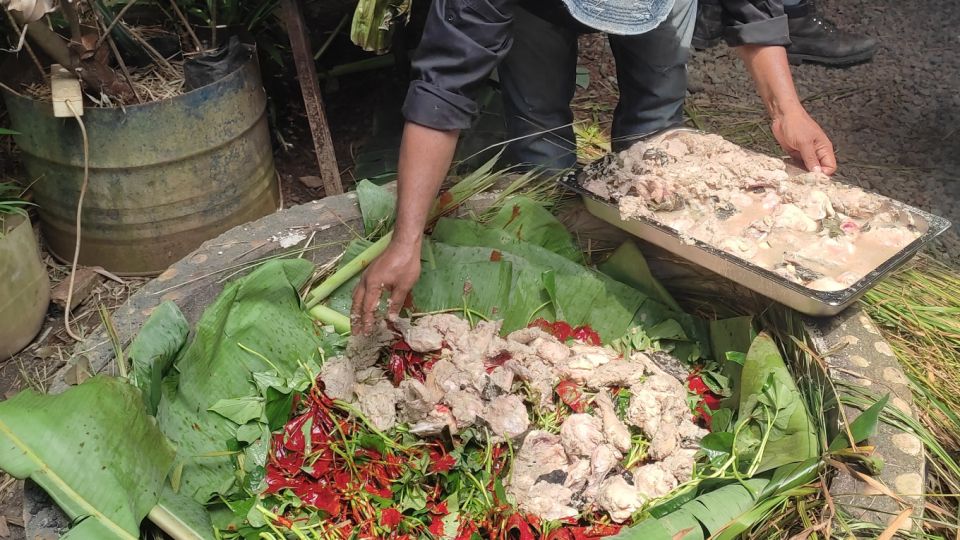
Toto layered stones, leaves and spread the food before covering it with another layer of leaves and stones.
The chicken was placed at the very top so that its juices would drip downward, seasoning the vegetables beneath. The flavor of the dish relies neither on oil nor on spices, but comes from the ingredients and aromatics from the leaves.
On that day, Toto improvised by mixing buah merah, a deep-red Papuan fruit, to create a sauce for vegetables.
“We create flavor from the ingredients. The meat gives richness, and the plants from the forest add aroma,” Toto said
Collective ritual
Requiring a multi-step process and large quantities of food, both dishes are typically prepared for special occasions that bring people to work hand in hand.
“Both methods are expressions of the same idea. Cooking together, using what the earth provides,” Toto said, while letting the stones slowly cook the food.
He added that Papuan stone cooking traditionally relies on leaves and tree bark. But in the collaboration, both chefs combined the techniques of using Papuan leaves and sealing it with soil, following the hangi method.
Toto carried on that the technique he demonstrated was only one of many stone-cooking methods practiced across Papua.
In southern Papua, particularly around Merauke, stone cooking is done above ground and stretches up to 8 meters in length. Kangaroo meat, locally known as saham, is traditionally used as the main protein, scented with eucalyptus leaves and covered with eucalyptus bark to trap the heat.
Along the north coast, people use a technique known as baraben, which stacks stones into a pyramid. Fish, as a staple food, is wrapped in areca palm sheaths, placed into the gaps between the stones, and layered with breadfruit leaves.
“Papua is almost three times the size of Java, with landscapes ranging from the coast to the highlands,” Toto said. “That diversity creates different ways of masak bakar batu.”
After three hours, the stones had worked their heat into the chicken and vegetables, resulting in tender food with a gentle, earthy smokiness.
One of the lunch attendees, Adriel M. Simorangkir, managing and culinary director at private club The Bimasena said that although the two dishes were cooked using similar methods, the outcomes were in contrast.
The hangi, he said, was moist, soft and delicate in flavor. The bubigi, on the other hand, was heavier, with a deeper roasted character.
“The difference was fascinating. The choices of small ingredients, wrapping and layering techniques can result in completely different outcomes,” Simorangkir said.
He added that the event offered both a spectacle and new ideas for bringing stone-cooking techniques into his kitchen.
Across borders
The event was organized by the New Zealand Embassy in Jakarta in partnership with Javara, marking 50 years of New Zealand and ASEAN dialogue.
New Zealand Ambassador to Indonesia Phillip Taula said that the similarity of communal cooking traditions provided a simple way of strengthening ties between Indonesia and New Zealand.
“We need to keep sharing and building shared knowledge between our countries,” Taula said.
Helianti Hilman, founder of Javara and Sekolah Seniman Pangan, said the event was part of a social gastronomy program, which trains rural communities to ethically monetize food biodiversity and food culture.
“Our training is action-based. We use gastronomy to create opportunities for rural communities,” Helianti said.
As the last stones cooled and the plates were lifted, the event left a memory of shared culinary heritage.