

July 13, 2026
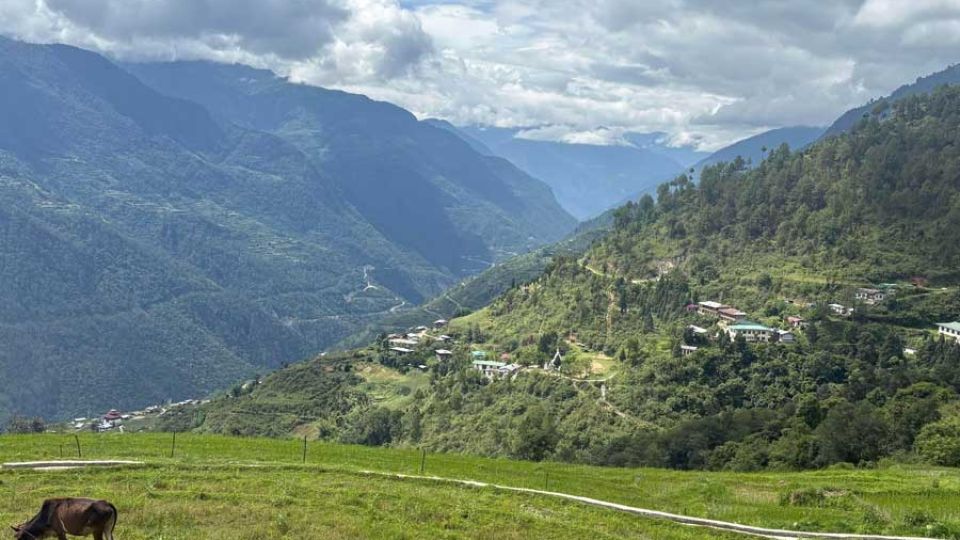
THIMPHU – A monk walks into a shop in Chhaling Gewog, Mongar, and asks, “Teru gak-pa?”, pointing toward a juice bottle on the shelf. His question, meaning “how much does it cost?”, is spoken in Chhaling Kha, an indigenous local dialect that is quietly fighting for its survival.
A 2004 study by the Himalayan Language Project reported that, similar to Gongdue Kha, Chhaling Kha was among 15 dialects in Bhutan on the verge of extinction due to rapid socio-economic change and demographic pressure.
Chhaling Kha is slowly disappearing as locals increasingly favour Tshangla and Dzongkha, and younger generations leave the gewog in search of better opportunities.
To the untrained ear, the dialect is a fascinating linguistic puzzle. Everyday phrases like “Gang-Hee-To” (Where are you going?) and “Ga-Se-Na-Ga” (How are you?) form the core of the local tongue.
According to Sonam, a 60-year-old villager, local folklore says that when languages were being distributed across the world, the language meant for Chhaling was left inside a bag. As a result, it supposedly formed by blending elements of various existing tongues, including Tshangla, Lhotsham, and English among others.
However, the continuity of this linguistic blend is fracturing under demographic pressure. Chhaling Gewog currently has a resident population of just 920 people out of 2,455 registered citizens. The gewog also recorded 29 goongtongs (empty households) in 2024.
Kinley Tenzin, 17, who helps his father run their shop during school vacations, said that while older residents still communicate fluently in Chhaling Kha, outsiders working in the gewog rely entirely on Dzongkha and Tshangla.
For students like 14-year-old Karma Tobten, the decline represents a loss of cultural identity. While she still speaks the dialect at home with her friends, she worries it is fading.
“As Chhaling Kha speakers become fewer, we are slowly losing our gewog’s culture,” she said, stressing that consistent communication at home is the only way to save it.
The linguistic shift is further accelerated by the expanding global Bhutanese diaspora.
Ugyen Lhamo, 55, shares a reality mirrored in many households today.
“I have two daughters in Australia. When I talk to them, we speak in Chhaling Kha,” she said. “However, when my five children talk among themselves here, they prefer speaking in Tshangla. They only use Chhaling Kha with me.”
Similarly, Sonam from Pangthang village said that his eldest sister, also based in Australia, is one of his primary conversational partners in the dialect, as fewer people speak it fluently back home.
Tshewang Pemo, 52, from Goenpa village, attributes the decline to a mix of youth migration and the influence of social media, where young people mimic dominant languages.
“The preference to speak in another language is becoming stronger than our own,” she said, sharing her worries that the dialect might vanish entirely once the older generation passes away. “The most effective remedy is for young parents to consciously pass the language down to their children.”
Chhaling Gup Tashi Dendup acknowledged these challenges, sharing that many younger children struggle to construct full sentences or remember specific vocabulary.
“Preserving and promoting the language is a major hurdle when the older generation is left behind, and the youth are heavily exposed to external influences,” the Gup said.
The gewog is promoting the language by speaking in Chhaling Kha during meetings and gatherings. Furthermore, the gewog has introduced targeted interventions in the 13th Five-Year Plan.
“We plan to create nursery rhymes in Chhaling Kha for ECCD students,” Gup Tashi Dendup said. “Another initiative is to establish a local museum to display ancient artifacts, with their names and descriptions explained entirely in Chhaling Kha.”