

April 1, 2026
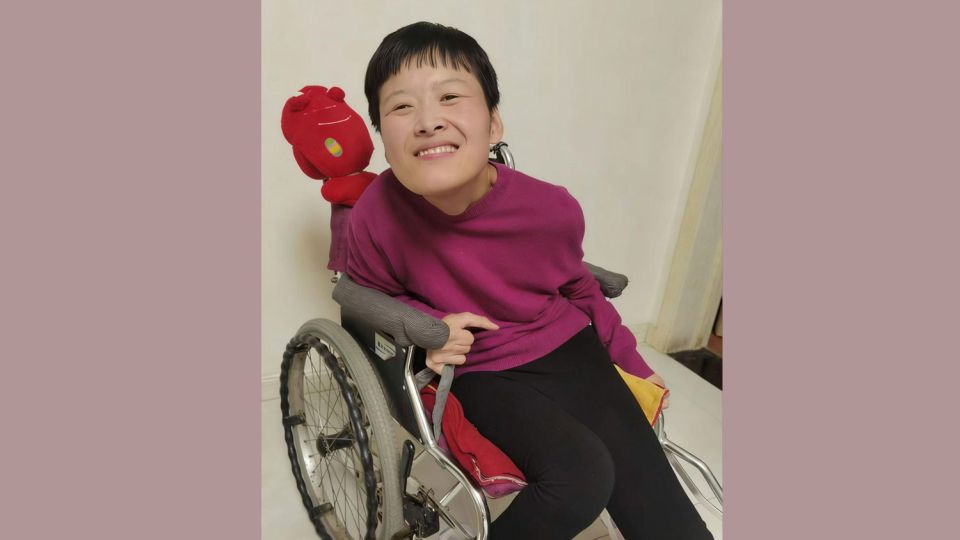
ZHENGZHOU – Zhao Dian, a 38-year-old with cerebral palsy from Anyang, Henan province, concentrates as she taps on a mobile phone screen, while the rest of her body stays completely still.
Books are stacked in piles around her. Zhao’s mother, Zhao Li, 66, keeps a few books set aside, making them easy for her to reach whenever she needs them.
Though Zhao Dian has never spent a day in a classroom, she has taught herself to read, write, and type using the Wubi input method — a keyboard system that builds characters from strokes, no pinyin required.
Zhao is a writer. She can often be found typing away into the late hours of the night.
Since publishing her first novel at 18 years old, she has written more than 1 million words.
“I’m an ordinary person who longs for freedom but can’t take care of herself,” Zhao wrote. Though her life is full of obstacles, she stays positive by insisting on doing what she loves.
Recently, history has become one of the topics. She has a particular fondness for Anyang’s Yinxu Museum, which opened in February 2024. Yinxu is the first documented historical site of a capital city from late in the Shang Dynasty (c. 16th century-11th century BC). Oracle bone inscriptions uncovered during excavations have helped flesh out the area’s history.
After visiting the museum in March last year, Zhao wrote a 6,000-word essay titled Yinxu Ruins, Enough to Make Us Anyang People Proud. The essay found an online audience of people fascinated by Yinxu culture.
“I love the Shang Dynasty, a civilization that flourished more than 3,000 years ago,” she remarked on her phone. “I listened to the guides in the museum, then I went home and began researching. I kept studying until I understood everything.”
When asked what draws her to Yinxu culture, Zhao Dian responded quickly: “Love, duty, and ingenuity.” She was captivated by the romantic story of Lady Fu Hao, a legendary female figure from 3,000 years ago who served as a military general and a high priestess.
Zhao described her writing as a mix of “introduction, reflection, and imagination” that intertwines history with emotion.
Readers online found it difficult to imagine how someone confined to a wheelchair could forge such a deep connection with Yinxu. In her writing, Zhao provides her own explanation: “I fell in love with Yinxu at first sight, and the love became deeper with the second visit, which finally led to a lifetime promise for the third visit.”
“I’m not worried about being criticized for bad writing,” she states. “I’m more afraid of misleading people with false information.” She spent two weeks critiquing, checking, and revising her essay before publishing it.
“In fact, my purpose in writing is not only to teach people about the Yinxu Ruins, but to understand Anyang, and to appreciate the power and historical significance behind them,” Zhao writes.
Zhao’s mother has spent decades supporting her writing pursuits. “Writing isn’t just a hobby for her,” she said. “It’s how she talks to the world.”