April 22, 2026
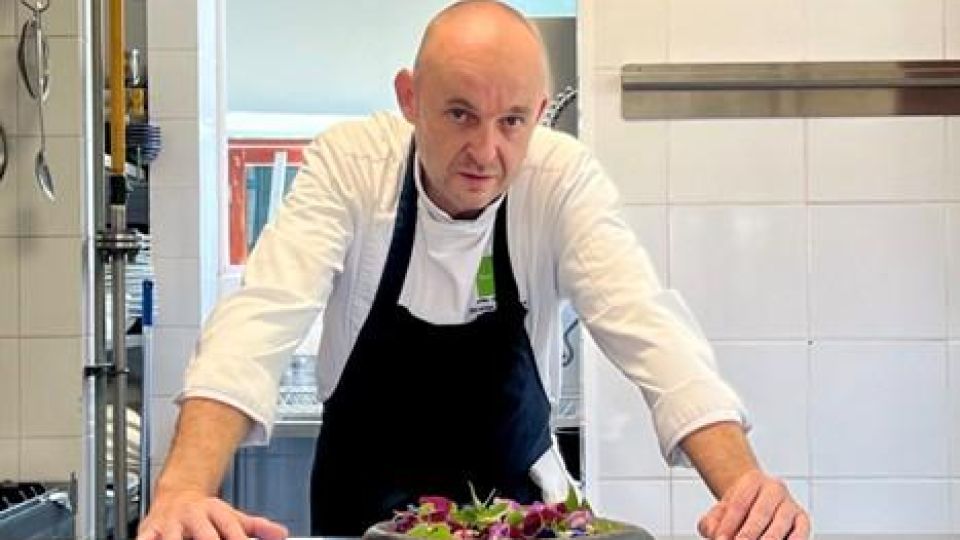
PHNOM PENH – Chef Nicolas Malherbe came to Cambodia in 2007 with a contract in Siem Reap and a plan to stay one year. He was twenty-six, trained in France, with time in Michelin-starred kitchens in Europe and the US behind him. Eighteen years later he is still here, tending his garden after midnight and arriving at work every morning, by his own account, happy. Not just content or settled, but genuinely happy.
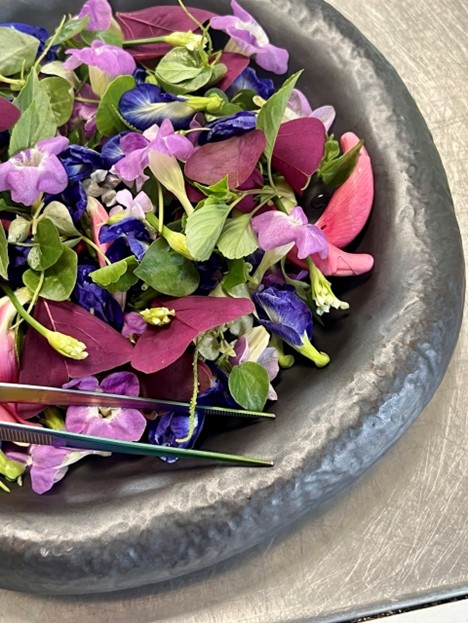
Every evening after service he goes home and spends two hours among his plants before sleeping: chillies of several varieties, tomatoes, eggplant and the edible flowers that end up on the plates at La Pergola, the restaurant at Phnom Penh’s award-winning Plantation Resort & Spa where he has been chef for several years. He grows seven types of botanicals for presentation at the resort just behind the Royal Palace, among them hummingbird blossom, oxalis, butterfly pea and Chinese violet.
“All the flowers on the plate are from my garden,” he says.
On the edge of the dish before him sits a small crimson shape, delicate as the leaf of a sensitive plant. Asked if it came from the garden, he smiles the way a man smiles when he knows the answer will surprise you.
“No. This one actually I make myself. Eggs, flour, water, then a mold, then the oven. For colour I use natural things: turmeric for yellow, spinach for green. This one, I use a small seed, roucou. When you add water, it turns red.”
The simple life
His first memory of Cambodia is the roads, or rather the absence of them. He had been working in the US before the Siem Reap contract came through.
“When you come from a very big city, you arrive here, and you say: where am I now? It was a bit strange, that first feeling.” Then he started to explore. Angkor Wat, the streets of the town, the markets. “Every place I went, I said wow. It was all very nice.”
He stayed a year and a half in Siem Reap, then moved to Phnom Penh for a position at Van’s Restaurant, where he would spend many years building a reputation for classical French cooking – the kind that would eventually bring Plantation, repeatedly recognised among the finest resorts in the city, to his door.
When you ask him to identify the moment he decided to stop thinking of all this as temporary, he considers it carefully and says there was not really a moment.
“I just stayed longer and longer, and finally after eighteen years, now it is my home.”
What Cambodia gave him, he says, is freedom. He means it in ways both practical and harder to name.
“The simple life, the simple people, the freedom. This is what I was looking for. That is the most important thing.” But underneath it is something less easy to articulate, and it has less to do with the place than with the people.
“If I go away from France,” he says, “it is not to go to another country and stay only with French people.” From the very beginning, his friends were Cambodian. Former sous chefs, store managers and kitchen colleagues who have since gone on to run kitchens of their own around the city. He has spent holidays in their home provinces, attended ceremonies, eaten in their homes.
“They invite me to the province. I spend time in their home. I really live like them. I learn where they live, the culture, the tradition. I have been part of that with them.”
In May, he is getting married to his Cambodian fiancée. His three groomsmen are former members of his kitchen staff. “We all stayed friends,” he says simply.
The kitchen as classroom
Nicolas has been running kitchens in Cambodia long enough to watch an entire generation of cooks come of age inside them. Five of his former sous chefs are now head chefs at other restaurants around Phnom Penh. When their own staff want to move on, some of them still send people his way. “They know who I am,” he says. “They always say, Nicolas, you want staff? I have staff for you!”
He did not always make it easy. He arrived carrying the full weight of the French culinary mindset: precise, hierarchical, uncompromising about sequence and method. Cambodia softened that, gradually, and not without resistance on his part. There is a quote from an interview he gave in 2011, in which he described the role of a chef here as requiring you to be, all at once, a teacher, a policeman, a friend and a father. He remembers it well and does not disown it. But the feeling behind it has changed completely.
“Before, I did it by obligation,” he says. “I said: I am a chef, I am not your papa, I am not a teacher. Everything now is the same, but I do it with pleasure. When they have a problem with family, they come and talk to me, and I try to help them to resolve it. Before I really did not like to do this. Now, even me, I come to them when I see something happen. I am so happy to help them.”
The cooks themselves have changed too, and this he talks about with something close to endearment. When he first arrived, his Cambodian kitchen staff were reluctant to taste the food they were preparing. Western ingredients were unfamiliar, slightly foreign, not quite real to them.
“They would always say, ‘oh I don’t like, I don’t like’. But if you don’t taste what you cook, you cannot cook.”
Now, he says, they are curious in a way they simply were not before. They eat out, sample food from other countries, try cuisines they had never encountered. They understand why a dough needs two hours to prove.
“Before they didn’t understand why we have to do it like this, like this, like this. Sometimes before they would start from step one, then go to step five directly, because for them there was no sense to make it ‘like this’. Now they really understand. The result is completely different. And now, for them, eating is also a pleasure. They enjoy food more.”
French technique, Khmer soul
For most of his career in Cambodia the menu was entirely French. At Van’s, people came specifically for that. La Pergola asked something different of him: take traditional Khmer recipes and bring them into a Western kitchen, keeping the soul of the dish while transforming everything around it.
It was, he says, genuinely new territory. So he asked his team. They told him what the dish should taste like, what the real version was, what their mothers had made. He brought the technique. Together they found something in between.
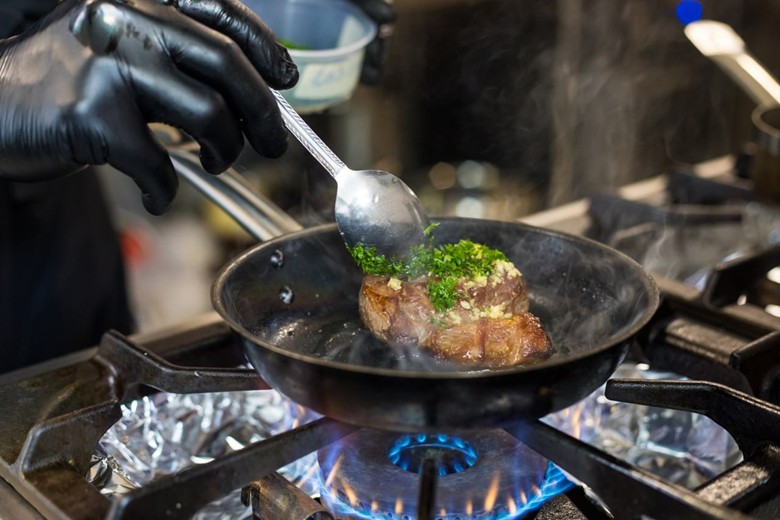
The method is the point of difference. Where a Cambodian cook might use prawn, he uses Canadian lobster. Where the original calls for squid, he will slow-cook octopus and preserve the essential flavour in the sauce.
“I use a lot of sous vide, a lot of slow cook, in a way that Cambodian cuisine doesn’t use. But I introduce this method on a local recipe. The product is different, the technique is different. But I keep the original taste Cambodian.”
He gives another example: chicken krung, the Cambodian dish built around a fragrant spiced paste, made with grain-fed French farm chicken, the meat more tender than anything the original recipe would have called for. The krung stays. The flavour stays. The bird is something else entirely.
Standing back from French cuisine for as long as he has gives him a particular vantage point on where it has been and where it seems to be going. He watched the molecular gastronomy years from a distance with something approaching suspicion.
“For me, that is not really cooking. It doesn’t feel like real cuisine. There was too much focus on the molecular elements. The food may look impressive, but in the end you are not even sure what it is.”
What nobody is talking about
Ask Chef Nicolas about Cambodian ingredients and he will not reach first for Kampot pepper. He uses it, his foie gras terrine sits on a bed of it, but that is not where his mind is right now. Lately he has been working with prahok powder, a relatively new product that takes the fermented fish paste foundational to Khmer cooking and gives it a form a Western kitchen can work with.
He is honest about his history with the paste. “The smell of prahok is a bit strong, so before I was a little bit scared.”
The powder changes that. When he works with it he adjusts the intensity himself, building up or pulling back according to the dish. He is making mayonnaise with it now, blending it with coconut. He has made an espuma.
“I don’t know why people don’t talk about this,” he says, with what sounds like genuine puzzlement. “Maybe because it is a new product?”
He suspects the powder was developed partly because Cambodians living abroad wanted to bring prahok home to their families in Europe or the US, where the real thing is not always permitted through customs. The powder travels. It is one of those practical solutions that also happens to open a door for a curious chef.
He talks about other ingredients that he has found along the way. Longan wild honey from Ratanakiri, from the flowers of the longan tree. The mangoes worth seeking out from certain provinces. And then there are the herbs: things he finds when he travels around Cambodia on holiday, walking through markets in towns he is visiting for the first time.
“Some I even don’t know what it is. They sell by the Khmer name, but they cannot find me the name in English. There is no way to translate.”
He brings things home, experiments, asks his girlfriend what she thinks, what the story behind this or that plant might be. Some of it makes it to the menu. Some stays in the kitchen.
“I am not sure some of these herbs can ever be exported,” he says. “They will stay local.” He does not sound disappointed by this. If anything, a little protective of it.
Eighteen years, very fast
When you push him on what he is most proud of from all these years, he resists the question a little. Pride does not sit easily on him.
“I am always saying, no, can be better, should be better. Can always be better.”
What he will say is that what comes closest to pride is when guests remember. Customers who ate at his table ten years ago and still talk about a specific dish. Visitors who come back to Cambodia and seek him out at La Pergola just to eat his food.
“This makes me proud, yes. It means people can remember my food even from 10 years ago,” he admits.
It is, in the end, a very French quality, that refusal to be satisfied, that standard which keeps moving further away every time you reach it. Eighteen years in Cambodia and that part has not softened at all. Everything else, more or less, has.
By the time his garden is tended to it is past midnight. He eats, sleeps and in the morning he gets up and goes back to work.
“I always feel I am on vacation, you know. Even I work hard, I have this feeling inside myself. The sky is so beautiful. I am happy to wake up, I am happy to see my staff, I am happy to see the owner. Every day I go to work with a good mood.”
“As long as I am so happy like this,” he says, pushing back his chair to return to his kitchen, “I will stay here in Cambodia. And I hope for a long time. Eighteen years goes by so fast, that I can say. Very fast.”