


May 6, 2026
TOKYO – When walking through Aizuwakamatsu City in Fukushima Prefecture, it becomes quickly apparent the city is proud of its local history, whether scientist or samurai, castle or village. However, the monthlong siege of the local castle during the Boshin War (1868-69) casts the largest shadow.
About three hours by trains from central Tokyo, just past the beautiful Lake Inawashiro, Aizuwakamatsu stands in a wide valley. Surrounded by snow-capped mountains, its calming atmosphere made it hard to imagine fighting ever having happened there.
It can often feel like one can’t walk for five minutes in the city without seeing a sign with information about local historical figures or sites. These include Toyohisa Matsue (1872-1956), known for his kindness toward prisoners of war during World War I, and his brother Haruji Matsue (1876-1954), a pioneer in Japanese sugar cube production.
Bacteriologist Dr. Hideyo Noguchi (1876-1928) has an entire street dedicated to him.
Because Aizuwakamatsu is known as “Samurai City,” it may come as no surprise that many of its sites are dedicated to samurai.
Chief among these locations is Tsurugajo Castle. With the Aizu domain fighting as a firm shogunal loyalist, the main keep was damaged beyond repair when it was besieged by pro-Imperial forces during the Boshin War, requiring it to be torn down. However, it has been reconstructed as a museum and many of the stone walls remain standing.
The castle’s main keep is filled with information on the site’s history and important figures from the region. This location was controlled by some of the most famous households in medieval Japan including the Uesugi and Date, but much of the space is dedicated to men and women who served the Aizu domain in its final years.

View of Aizuwakamatsu City from Tsurugajo Castle. PHOTO: THE JAPAN NEWS
Visitors can enjoy a beautiful view of both the town and the surrounding mountains from the main keep’s top floor. Even though Tsurugajo Castle is in an urban area, surrounded by the city instead of on top of a hill or mountain, the sight from the veranda in its early days must have been stunning.
A yagura tower and a hallway leading to it from the main keep were traditionally built. Walking through them feels like entering a completely different world.
The castle grounds also include the Rinkaku teahouse, which is thought to have been built in the 1590s for tea ceremony master Sen no Shoan (1546-1614). The structure had been moved elsewhere to avoid demolition in the aftermath of the Boshin War, but was later restored to its original spot.
Not far from the castle, one can take a calming stroll through Oyakuen Matsudaira Garden, which served as both a daimyo feudal lord’s garden and a medicinal herb garden that was the starting point of ginseng production in the area.
The garden also served as the pro-Imperial forces’ location for tending to their wounded during the siege of the castle.
Trail of monuments
Just east of the garden is the Aizu Bukeyashiki samurai residence. While the original buildings were mostly destroyed, drawings of the residence of Aizu chief retainer Saigo Tanomo (1830-1903) were used to recreate the site.
Exploring the halls, visitors can learn details about life and architecture during the Edo period (1603-1867) as well as tragic scenes from the Boshin War.
Many of the rooms have explanations for who used them and why, as well as specific events that happened in them.
One standout is how the ceiling over a toilet was constructed to prevent assassins from striking at an inopportune moment.
Along the mountains to the north, there are memorial markers related to notable figures including a cenotaph for Kondo Isami (1834-1868), head of the Shinsengumi, a group of swordsmen who fought alongside shogunal loyalists during the Boshin War.
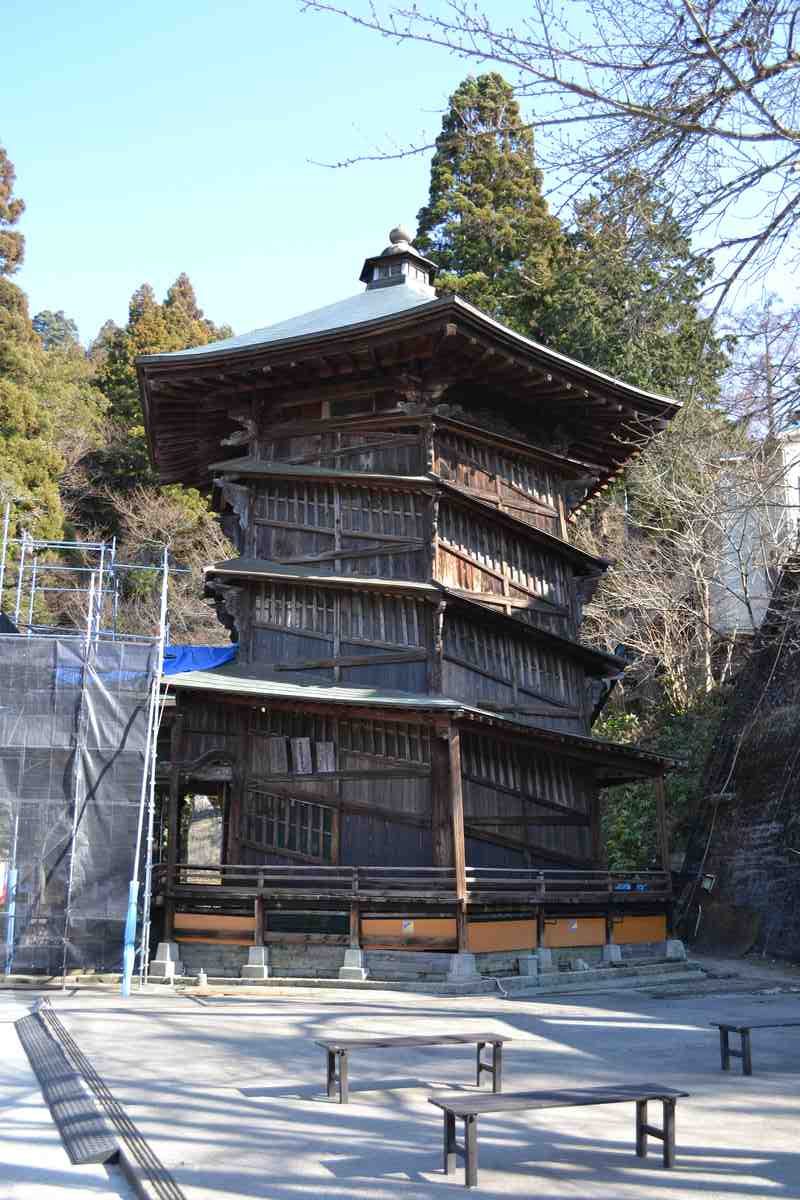
The exterior of Sazaedo. PHOTO: THE JAPAN NEWS
One of the largest memorials is in an area on Mt. Iimoriyama set aside for the Byakkotai white tiger corps, a group of teenagers who fought for Aizu during the war.
The area where many Byakkotai members ended their lives after believing the castle was engulfed in flames has numerous markers, including a statue of a young man looking off into the distance.
The statue truly grasps the expression of someone who, after engaging in fierce fighting, seems to be witnessing the utter defeat of his side.
These memorials on the mountain are just above Sazaedo, a distinct piece of Buddhist architecture with a spiraling tower design. Even though the tower is not large, visitors going up are separated from those going down due to its double-helix structure.
The tower has 33 statues of Kannon, the bodhisattva of mercy, and there are ofuda paper slips all over the walls and ceiling, giving the location an intensely mysterious feeling.
Relaxing in tradition
About an hour away from the center of the city by a combination of train and bus, is Ouchi-juku. The spot includes a collection of Edo period houses that are still being maintained.
Visitors can walk between the houses, imagine the early-modern lifestyle and stop by a restaurant for a local traditional dish. The most famous is a bowl of soba with a whole negi leek.
The local history museum details the structure of thatched roofs and how they are made. It also shows many common items from the Edo period, including pots and farm equipment. You can sit by the irori sunken hearth to get nice and toasty near a fire in the colder months.
Snowfall, even in March, can give visitors a sense of peacefulness, with Ouchi-juku being in the mountains, quite removed from everyday life.
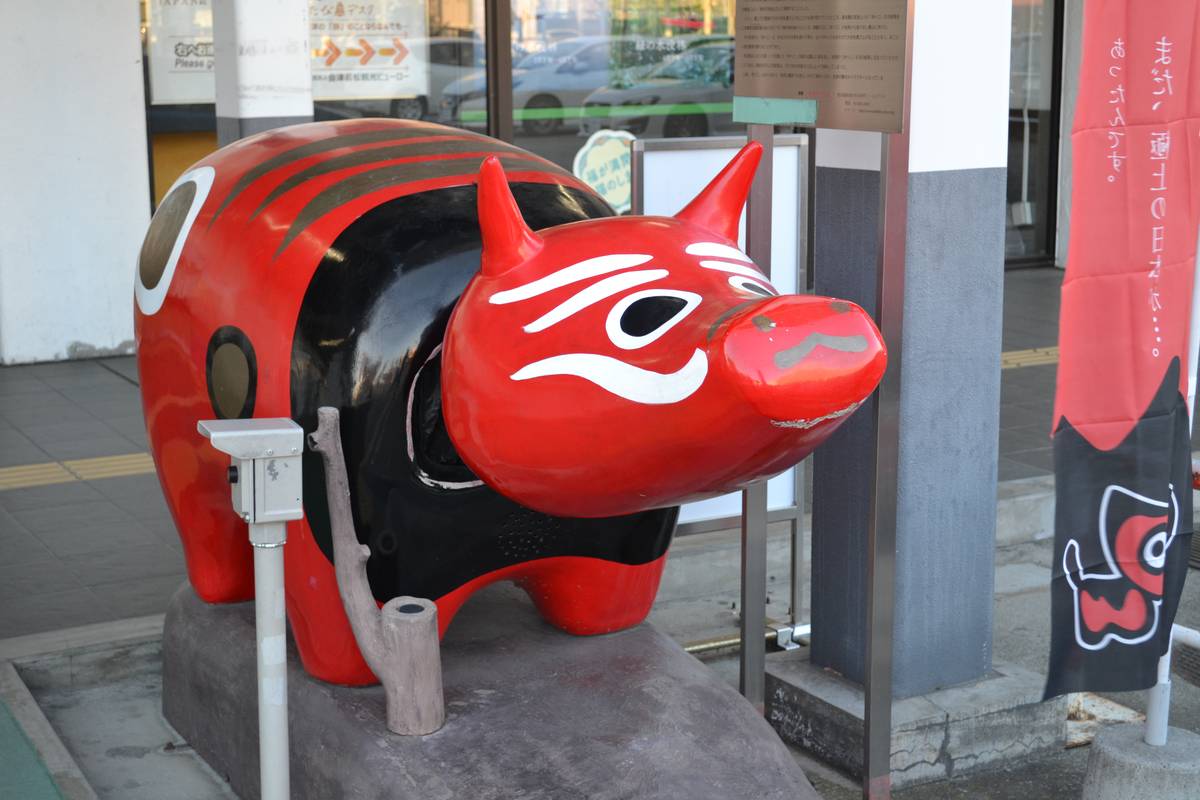
This adorable akabeko stands just outside Aizuwakamatsu Station. PHOTO: THE JAPAN NEWS
The city is just as proud of its traditional crafts as it is of other historical aspects.
Candles, ceramics and lacquerware can be found in numerous shops in Aizuwakamatsu. For those interested, opportunities to paint their own akabeko bobblehead cow and Okiagari Koboshi roly-poly toy abound.
Aizuwakamatsu may not be a massive city like Tokyo, but even three days of constant exploration of its museums and historical sites can leave one feeling like they’re just scratching the surface.