

June 4, 2026
SEOUL – Dating in South Korea once followed a familiar playbook: a friend or colleague arranged a blind date, profiles and photos were exchanged over KakaoTalk, a few polite messages followed and two strangers met over coffee or dinner to decide whether there was chemistry.
Now, some young Koreans are trying a different route: watching short clips of each other’s daily lives before deciding whether to meet at all.
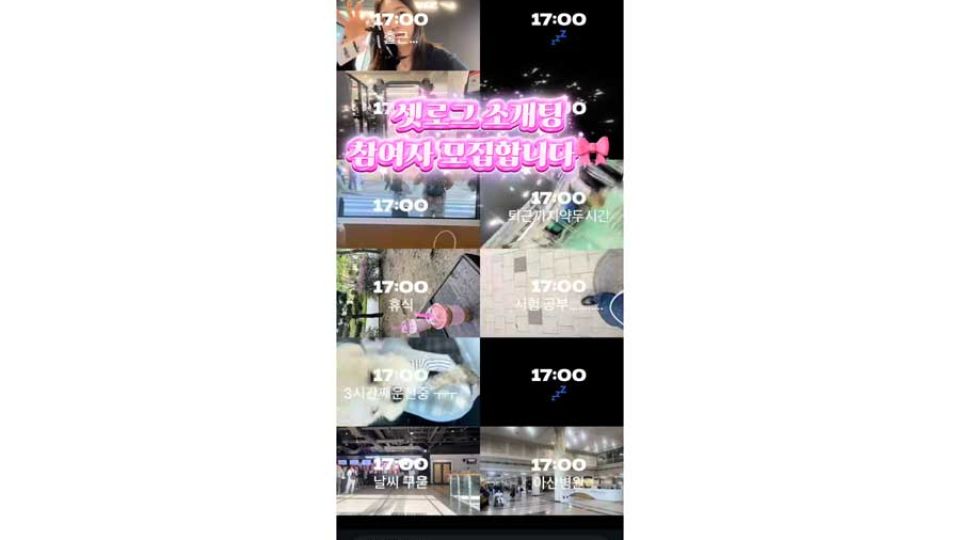
The trend is known as “Setlog blind dating,” a matchmaking format built around Setlog, a social app where users upload short real-time video clips throughout the day. Rather than relying on polished profile photos or carefully written self-introductions, participants spend several days observing one another’s routines, habits and personalities before choosing whether to meet offline.
For young people tired of formal blind dates and curated social media profiles, the appeal lies in what they describe as a more natural way of getting to know someone: seeing what the person eats, how they spend breaks at work, where they go after class and what they do when they are alone.
“It feels less like a blind date and more like slowly getting to know someone,” said Kim Ji-eun, a 33-year-old office worker in Seoul who recently joined a Setlog group blind date arranged by friends.
“In regular blind dates, you sit across from a stranger and feel pressured to decide within two hours whether you like them. With Setlog, you already know what kind of person they are before meeting.”
Originally launched as a casual social recording app, Setlog has found an unexpected use among people in their 20s and early 30s looking for a less formal way to meet potential partners. University community platforms and social media channels for office workers have seen an uptick in posts recruiting participants for “Setlog group dates.”
The format usually involves six men and six women joining the same room anonymously for several days. Participants share snippets of their daily lives before expressing interest in someone they want to meet in person.
“People are tired of overly edited Instagram culture,” said Choi Seung-yeon, a 24-year-old university student who uses the app daily with friends. “You don’t really have time to stage things because the notification comes randomly. You end up showing your real life instead of your best moments.”
Others say the format reduces the emotional burden often associated with traditional dating culture in Korea.
“I prefer natural encounters rather than formal blind dates, but in reality, it’s hard to meet new people,” said Kim Ji-min, a 26-year-old graduate student. “Setlog makes conversations easier because you already share context about each other’s lives. When you finally meet, it doesn’t feel like meeting a complete stranger.”
The trend also reflects broader shifts in how younger generations approach relationships. According to a 2025 survey by Korea Research, 72 percent of respondents said they preferred forming relationships with people who shared similar lifestyles, interests or values. Another report by digital market research firm Incross found that more than 90 percent of people in their 20s and 30s considered shared interests important in romantic relationships.
“With Setlog, I can see someone’s daily life and tell whether we might click,” said Lee, a user in her 20s. “For instance, I saw one person reading books, staying home and cleaning during his free time. I instantly felt he might make a good boyfriend.”
Experts say Setlog blind dates combine these preferences with a growing desire for efficiency and emotional safety in dating.
“Young people today tend to avoid uncertainty and emotional risk in relationships,” said Kwak Geum-joo, a psychology professor at Seoul National University. “Traditional blind dates often come with pressure because mutual acquaintances are involved, and rejecting someone can feel socially uncomfortable. Platforms like Setlog lower that burden by allowing people to gradually build familiarity before meeting.”
Others view the phenomenon as part of a broader reaction against performative social media culture.
“Generation Z became accustomed to maintaining relationships through videos and online interaction during and after the pandemic,” said Kim Si-wol, a consumer studies professor at Konkuk University. “Rather than presenting an idealized version of themselves, many now prefer lighter forms of communication that focus on sharing everyday moments.”
Some users have begun organizing Setlog-based matchmaking events as side projects or small businesses.
Yun Su-yeong, a 21-year-old college student who organized several Setlog blind dates among university students, said the idea came naturally after seeing how people reacted to one another’s routines on the app.
“I realized people could already tell whether their lifestyles matched just by watching each other’s daily clips,” Yun said. “So I thought: wouldn’t matching be more successful if people could see each other’s real lives first?”
Still, experts caution that the trend could bring new forms of fatigue and privacy risks. Because users share real-time moments throughout the day, critics warn the format could create pressure to constantly document ordinary life. Others point to the risks of oversharing personal routines, locations and private spaces with strangers.
“There is always the possibility that casual sharing evolves into another form of social pressure,” Kwak said. “What begins as relaxed communication can gradually become an obligation to constantly show what you are doing.”
Even so, for a generation wary of both polished profiles and high-pressure blind dates, romance may increasingly begin not with a staged introduction, but with a few seconds of ordinary life.