

June 5, 2026
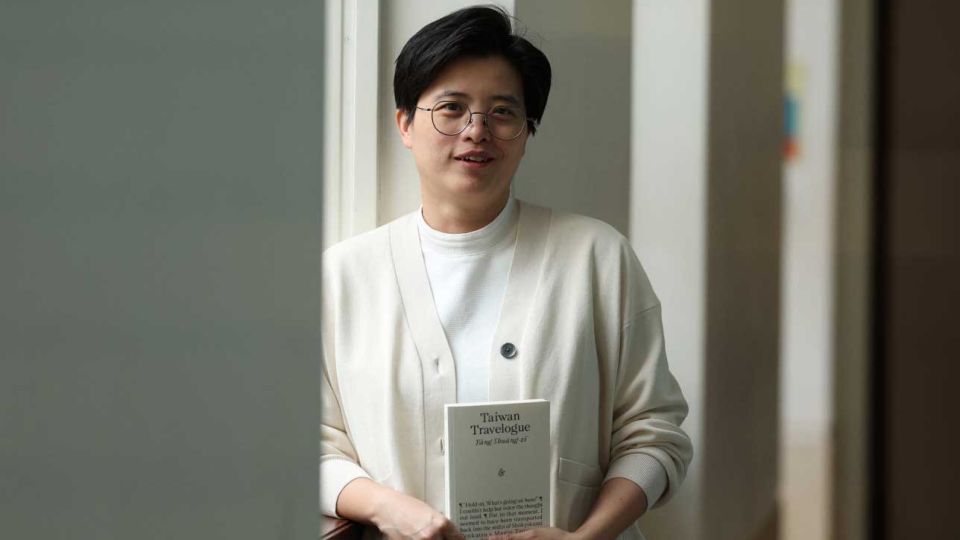
SEOUL – This year’s International Booker Prize winner, Yang Shuang-zi, fresh from her historic win just two weeks ago, said she wanted to win the award for Taiwan.
“In the current international situation, Taiwan is under immense pressure. Through literature, I wanted to show Taiwan in its many different facets, and to tell stories that only Taiwan can tell,” Yang said during a press conference in Seoul on Monday.
After becoming the first Taiwanese writer to win the prestigious award, the 41-year-old has, in her acceptance speech and subsequent interviews, focused much of her attention on her homeland and its circumstances at home and abroad.
Yang is in Seoul on a visit scheduled before her win, in line with the Korean publication of “Taiwan Travelogue,” which has since become the first novel originally written in Mandarin to receive the award. The book has not been published in China.
Yang said she participates in social activities and protests but often feels anxious, wondering why the world cannot change more quickly. But, she added, “we all know that society does not change overnight.”
“I believe in literature and its power to change society,” she said. “But unlike medicine its effects are not immediate. Instead, it carries on as a long conversation that may last longer than a human life.”
That is why she leans on literature — on its long endurance, which outlives any single life and is passed down from one generation to the next.
“I hope that it will continue and endure across generations,” Yang said. “So I’m very happy that this award has given me a chance to speak about what I want to share with readers.”
Yang, who began her career as a literary researcher, said she has also reflected on her Booker Prize win from an academic perspective.
“As a literary critic, I did not find the award surprising,” she said. “I think the world is looking in the same direction, much like when Han Kang won the Nobel Prize. We are addressing similar subjects — women, how state power has historically enacted violence, the wounds left by history and how these voices emerge from the margins of society.”
The book has already won a string of international awards, including the National Book Award for translated literature in 2024. It has been published or is forthcoming in numerous languages, including Japanese, German, Italian, Dutch, Norwegian, Danish and Greek.
The novel is set in 1930s Taiwan under Japanese colonial rule and takes the form of a fictional rediscovered travel memoir from 1938. It follows a Japanese writer, Aoyama Chizuko, traveling across the island with the help of an enigmatic Taiwanese interpreter, Chizuru, on a culinary and scenic journey, with whom she becomes infatuated.
The Booker Prize jury described it as a “bittersweet story of love” that “unearths lost colonial histories and deftly reveals how power dynamics inflect our most intimate relationships.”
Yang reflected on the shared colonial histories of East Asia in an interview with the Booker Prize Foundation, and she pointed to Korea when speaking about the inspirations behind the book.
“Both Korea and Taiwan were once colonies of the Japanese Empire, but Koreans seem to feel uniformly resentful of that history, whereas Taiwanese people regard it with a much more conflicted mix of distaste and nostalgia.”
She noted during the press conference in Seoul that Korea and Taiwan’s postwar histories diverged. While Korea went on to achieve liberation in 1945, Taiwan underwent 38 years of martial law before holding its first direct election in 1996.
“It has been nearly 30 years since then, but the shadow of colonial rule still lingers.”
She added that many people still feel unable to speak freely, out of fear of being targeted for opposing authority. Taiwan’s circumstances have become even more complicated amid China’s rise.
“I wanted to ask: Isn’t this not so different from colonial conditions? Could this be another form of colonialism? We went through this kind of history 100 years ago, and it was so painful and devastating. Are we going to be colonized again? Has nothing really changed in all this time?”
A few days before the press event, Yang attended a book talk with Korean readers and said she found the response significantly different from that in other countries, attributing it to the shared history of Japanese colonialism.
“I intended the novel to be read from the perspective of the colonizer, using a first-person narrative to guide that literary experience,” she said. “But that strategy completely failed with Korean readers. They immediately read it from the perspective of the colonized instead. It felt like my magic trick didn’t work at all.”
Speaking about her choice to feature a Taiwanese interpreter as a key figure, Yang said she wanted to highlight the gap between languages across time.
“Even though we use Taiwanese Mandarin today, it is not our mother tongue,” she said. “There is still a process of translation within our own language. I wanted to think about what has been lost in that process.”
She hoped readers would approach her work as a gateway to a more diverse Taiwan, and be encouraged to learn about its many different sides.
“Taiwan is a very complex country, and an extremely diverse one,” Yang said. “Its ethnic makeup, indigenous communities and the many languages and cultures all have many different facets. Some people may read my book and say it represents Taiwan, but Taiwan is far too diverse to be captured in a single work. I hope people can see that it opens up a vast space for exploration.”