

February 20, 2026
JAKARTA – Companies from Indonesia and the United States have inked deals worth US$38.4 billion ahead of President Prabowo Subianto’s meeting with US President Donald Trump to seal a bilateral trade pact, in a move analysts say could smooth negotiations for lower tariffs.
The 11 memorandums of understanding (MoUs), signed during a business summit hosted on Wednesday by the US Chamber of Commerce in Washington, DC, include agreements on manufacturing and agriculture as well as on semiconductors and strategic industrial materials.
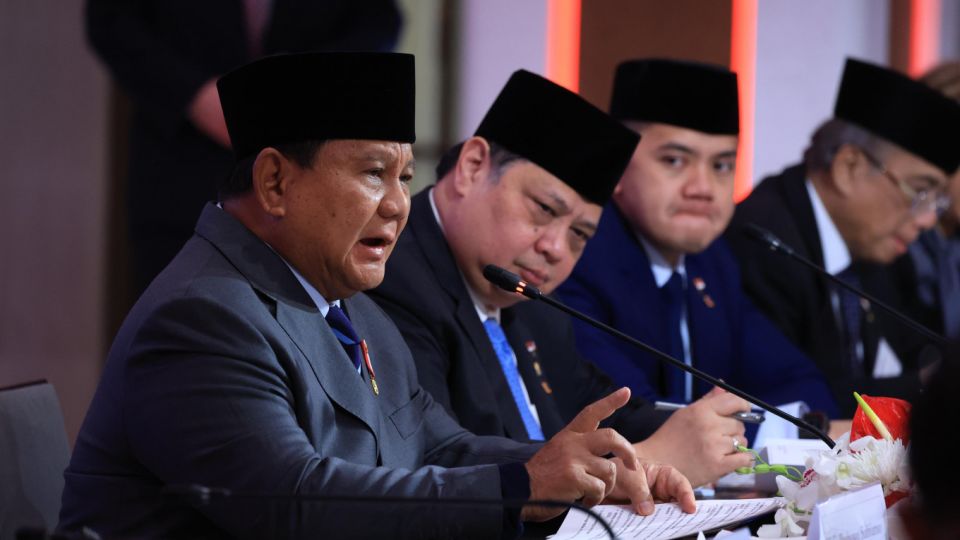
“I’m here to conclude a major trade agreement between our two countries. […] It sends a clear signal that Indonesia and the United States are committed to deepening economic ties and market access and providing greater certainty for business,” Prabowo told the summit.
Prabowo arrived in Washington on Wednesday for the inaugural meeting of Trump’s Board of Peace initiative and to sign the Agreement on Reciprocal Trade (ART) scheduled for Thursday.
He said the business deals formed part of the trade pact’s implementation and would help narrow Indonesia’s trade surplus with the US.
Trump has long demanded that other countries import more goods and services from the US to reduce America’s trade deficit.
Among the key deals is a preliminary agreement between US mining group Freeport-McMoRan and Indonesia’s Investment and Downstream Ministry to extend the operating rights for PT Freeport Indonesia’s (PTFI) Grasberg mining site, currently valid until 2031, beyond 2041.
Grasberg, located in Central Papua, is one of the world’s largest gold mines and the second-largest copper mine, accounting for about 3 percent of global copper output.
Under the agreement, Freeport would retain its 48.76 percent stake through 2041, before transferring 12 percent to the government, cutting its stake to about 37 percent, subject to approval, the company said.
Indonesian state-owned oil and gas firm Pertamina, meanwhile, signed an oilfield recovery cooperation agreement with US oil services company Halliburton.
The summit also produced two semiconductor joint ventures involving Indonesian industrial estate operator PT Galang Bumi Industri, one worth $4.89 billion with Essence Global Group and the other with Tynergy Technology Group.
Separately, Galang Bumi Industri signed a Transnational Free Trade Zone Friendship Pact with Solanna Group LLC.
In agriculture, Indonesian firms committed to purchasing 1 million tonnes of US soybeans, 1.6 million tonnes of corn and 93,000 tonnes of cotton over unspecified periods, according to the US-ASEAN Business Council (US-ABC), as cited by Reuters.
The US-ABC valued the soybean purchases at $685 million, wheat at $1.25 billion and cotton at $122 million. Indonesia is slated to import 1 million tonnes of wheat this year and up to 5 million tonnes by 2030.
The corn deal was signed between Cargill and its local unit PT Sorini Agro Asia Corporindo, while the cotton agreements involve the US National Cotton Council supplying Indonesia’s Busana Apparel Group as well as PT Daehan Global.
An additional $200 million worth of shredded worn clothing is to be shipped from the US to Indonesia for recycling under an agreement between garment maker PT Pan Brothers and US-based textile recycler Ravel.
Not all agreements disclosed financial values, including Indonesian purchases of US lumber and furniture products under an MoU signed by the Indonesian Furniture Entrepreneurs Association (Asmindo) and Bingaman & Son Lumber, as well as a similar agreement between the Indonesian Furniture and Craft Association (HIMKI) and the American Hardwood Export Council.
“This MoU has no direct transaction value as it is a framework cooperation agreement between associations,” HIMKI chairman Abdul Sobur told The Jakarta Post on Thursday.
The agreement was aimed at expanding access to American hardwood and facilitating knowledge transfer, he said, with expected gains stemming from higher hardwood imports and increased Indonesian furniture exports.
Indonesia announced $34 billion in US business deals in July last year as part of its tariff negotiations, including wheat and soybean import commitments similar to those signed on Wednesday, according to the Indonesian Flour Mills Association (Aptindo).
Paramadina University economist Wijayanto Samirin told the Post on Thursday that the series of deals reflected demands long sought by Trump and had been under ministerial discussions for months, “which hopefully will secure deeper tariff cuts or even exemptions for [some of] our goods.”
“Viewed purely from an Indonesia-versus-the-US [perspective], we may lose, but in a broader exporters-versus-the-US context, it could benefit Indonesia,” he said, adding that Jakarta might gain from trade diversion as US imports shifted from other countries.
State Secretary Prasetyo Hadi said on Wednesday that Indonesia hoped to secure a lower tariff rate under the trade talk, adding that “it is possible that the good relationship between the two leaders may lead to policy changes.”
Under a handshake agreement clinched in July last year, which is to be finalized with the signatures of Prabowo and Trump on Thursday, Washington would impose a 19 percent duty on most imports from Indonesia, down from the initially threatened 32 percent “reciprocal tariff”.
A general 19 percent tariff would place Indonesian exporters on par with Southeast Asian peers based on ARTs signed by Malaysia and Cambodia with the US, while an 18 percent rate would align Indonesia with India.
Mohammad Faisal, executive director of the Center of Reform on Economics (CORE) think tank, called the import commitments “manageable”, if they were limited to goods not produced domestically, such as cotton and wheat, which feed industrial processing.
However, he cautioned against commitments on critical minerals and mining products, arguing that would compromise Indonesia’s downstream processing policy, which prioritizes processing raw materials at home and restricts ore exports since 2020.
“The government must remain consistent. Reverting to raw material exports would set a bad precedent for our investment climate,” Faisal told the Post on Thursday, noting that the US was simultaneously seeking to secure its own critical mineral supply chains.