

May 12, 2026
JAKARTA – On a drizzling afternoon, a taxi pulled up in front of a quaint restaurant in Central Jakarta. A medium-built man stepped out, dressed in a gray hoodie and blue jeans, a bulky laptop bag slung over one shoulder. He moved with a steady confidence, his stride wide, his gaze fixed ahead.
Inside, a group of reporters was already waiting. One of the organizers glanced toward the entrance, then announced, “There he is. Our author, Eka Kurniawan.”
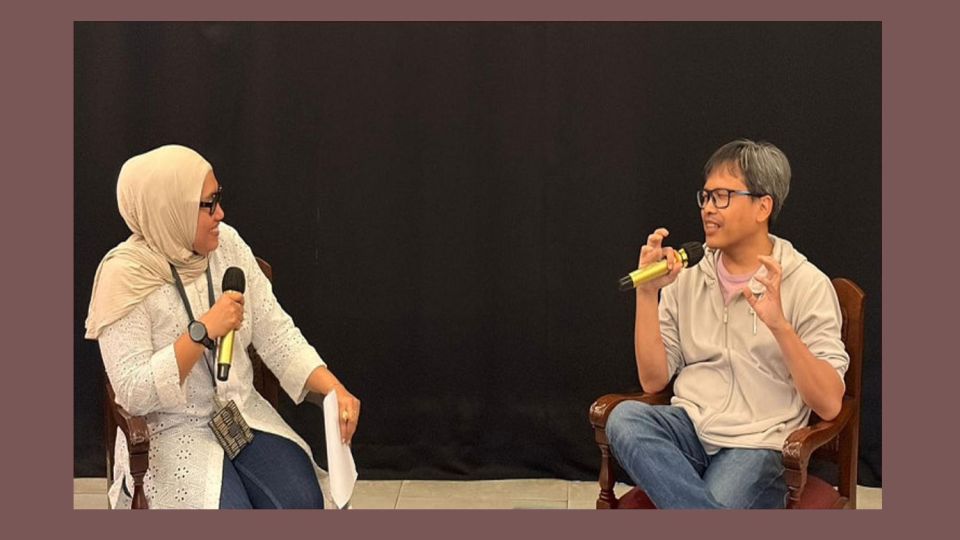
That afternoon on March 10, publisher Gramedia Pustaka Utama hosted an intimate iftar gathering at Tjikini Lima, bringing together the writer and a small circle of journalists. After the session, Eka reflected on his childhood, literary career and upcoming projects.
Imagination taking roots
Eka writes playful yet unsettling novels and short stories, often drawing on Indonesia’s social and political history. He tells them through unexpected voices, from a ghost in Cantik Itu Luka (Beauty is a Wound), released in 2002, to a monkey in O, which was published in 2016.
“The ideas come from everywhere,” he said. “From books, stories from friends, historical records, even folklore.”
Born in a remote village among the mountains in Tasikmalaya, West Java, he grew up listening to radio plays that fed his imagination with stories from the Mahabharata and local folklore.
“Every afternoon, I would sit in front of the radio and listen to the plays, sometimes running for hundreds of episodes,” Eka said.
When he was 10, his family moved to the nearby coastal town of Pangandaran. There, his father started a small-scale garment business, while his mother opened a clothing stall at the local market.
“It was a pasar segala ada,” he said. “It was always busy, from dawn until late in the evening. In many ways, that’s where I grew up.”
After school, he would head to his mother’s stall, have lunch with her, then spend the rest of the day roaming the market with other children who gathered there. The market became their playground and meeting point, a world of its own.
The friendships he formed there, among boys wandering between stalls and alleys, would later inspire his forthcoming novel, Coreng Hitam (Black Streak).
“Basically, it’s about a group of kids who hang out in the market and form their own little society,” he divulged. “They develop certain ideas that, in some way, end up shaping Indonesian history.”
The book will soon be published by Gramedia Pustaka Utama.
Writing without map
It took Eka nearly a decade to complete his upcoming novel.
“That doesn’t mean I was working on it the whole time,” he explained.
Alongside his fiction, Eka writes columns for local and international publications, and occasionally scripts for television films, as he puts it, to “make ends meet.”
Curiosity is what drives his writing. Each project often begins with a deep exploration of a theme that catches his attention. From there, he lets the story unfold without a fixed plan or rigid framework, allowing his imagination to take the lead.
“It’s enjoyable, yes, but it can also become a problem,” he said. “It’s like driving without a map or a clear destination. Once you get stuck, you don’t know where else to go.”
When that happens, he simply turns to another manuscript. Over time, this habit has left him with a growing stack of unfinished drafts.
“Some of them might just stay drafts forever,” he added with a chuckle.
Eka usually writes in the morning, after getting his only child, Kidung, ready for school. Once he has finished his household chores as “a stay-at-home dad,” he sits down at his desktop computer and begins to work. To avoid distractions, he often turns off the Wi-Fi, keeping social media and the day’s news at a distance.
Although he does not set strict deadlines, he admits to having an approximate timeframe in mind for finishing a new work.
“But since it’s only a rough target, it’s almost certain it won’t be met,” he said with a laugh.
Eka keeps his manuscripts to himself. He does not share them with anyone, not even his wife, Ratih Kumala, herself a novelist and the author of Gadis Kretek (Cigarette Girl).
“Talking about a work in progress can be distracting,” he said.
Stories that keep expanding
Beyond novels, newspaper columns and television scripts, Eka also enjoys writing for the big screen. Sleep No More (official Indonesian title: Monster Pabrik Rambut), which he co-wrote with director Edwin and Japanese filmmaker Daishi Matsunaga, premiered at the Berlin International Film Festival in February. The film drew attention for its portrayal of factory workers caught in the machinery of capitalism. It is slated for release in Indonesian cinemas in July.
Eka said the idea grew out of his concern over how people today tend to push themselves to work more just to keep up with rising living costs, a situation that is often exploited by those in charge.
The setting was inspired by a real-life wig factory that he and the film’s team visited during their research in Bali.
In the film, workers are pushed beyond their limits, struggling to meet both their own needs and the demands of their supervisors.
“Labor activists might take to the streets over this issue,” he said. “But as a writer, I try to break it down at its roots and understand it from different points of view as I write.”
For Eka, concern is often the starting point. It allows him to approach a story with empathy, even when working in fiction.
He offers simple advice to aspiring writers: “read, read and read.”
“If you want to write a book, you have to read as many books as you can,” he said. “I don’t see any other way.”
Among the writers he returns to most often is Russian novelist Nikolai Gogol (1809-1852).
“He’s adept at capturing the absurdities of real life and shaping them into his stories,” Eka said.
But it was Hunger by Knut Hamsun, which he read while studying philosophy at Gadjah Mada University, that set him on the path to becoming a writer. The novel, loosely based on Hamsun’s own struggles, tells of a writer pushed into poverty and hunger.
Illustrious career
Today, as one of Indonesia’s most widely acclaimed authors, that fear seems far behind him.
Eka became the first Indonesian writer to be nominated for the Man Booker International Prize in 2016, when Lelaki Harimau (Man Tiger) was longlisted. He later received the Prince Claus Award in 2018. His debut novel, Cantik Itu Luka (Beauty Is a Wound), was also named among The New York Times’ 100 Notable Books.
This year, from April 21 to 27, he is set to appear at the Granada Book Fair, where he will speak about his works, particularly those translated into Spanish, such as Cantik Itu Luka (2002) and Lelaki Harimau (2004).
Looking back, Eka credits his parents for giving him the freedom to choose his path.
“To this day, I’m very grateful for how relaxed they were when I decided to study philosophy and later become a writer,” he said.