


July 13, 2026
THIMPHU – Flooding triggered by last month’s heavy rainfall has intensified Phuentsholing’s already acute housing shortage, forcing about 87 families from their homes and exposing the town’s limited capacity to accommodate displaced residents.
Of the affected families, 46 lived at the Amochhu Temporary Settlement (ATS) and 41 at the National Housing Development Corporation Limited (NHDCL) housing colony, where five residential buildings were severely impacted. While residents of the NHDCL colony were evacuated after floodwaters entered their buildings, those at the ATS were displaced by prolonged water stagnation following days of continuous rainfall.
The temporary settlement occupies about 17 acres of land designated for the Phuentsholing Township Development Project (PTDP), which Druk Holding and Investments is developing.
About 400 households continue to live at the ATS, despite officials warning that the structures are no longer suitable for continued habitation.

Built as temporary shelters with an intended lifespan of just two years, the houses have deteriorated significantly after repeated exposure to standing water, leaving them increasingly vulnerable to structural damage. If heavy rainfall continues in the coming months, more households may be forced to leave the settlement, as prolonged waterlogging remains a recurring problem.
Relocating hundreds of additional families would strain Phuentsholing’s affordable housing market further, where demand already far outstrips supply.
In addition, because construction cannot proceed until the site is cleared, the ongoing occupation of the temporary settlement has delayed development on Zone A of the PTDP.
The housing shortage is already evident among the displaced families. Many are currently staying with relatives or friends, while others have moved across the border to Jaigaon after failing to find affordable accommodation in Phuentsholing.
Residents said that skyrocketing rents have left them with very few options.
“I am currently staying with my relatives and have been looking for a house, but most of the available apartments are beyond what I can afford,” said Namgay Tshering, who recently left the temporary settlement.
Other displaced residents said they have begun searching for accommodation in Pasakha and nearby areas, where rents are lower than in the main town.
Some admitted they may have to return to Jaigaon because housing there remains far more affordable, despite prevailing concerns over safety and living conditions.
As one of Bhutan’s largest commercial and industrial centres, Phuentsholing is home to a substantial low-income workforce, making affordable housing a long-standing challenge.
Several ATS residents stated that the shortage of affordable housing is the primary reason many families have stayed, despite repeated reminders from authorities and their own awareness of the deteriorating structures.
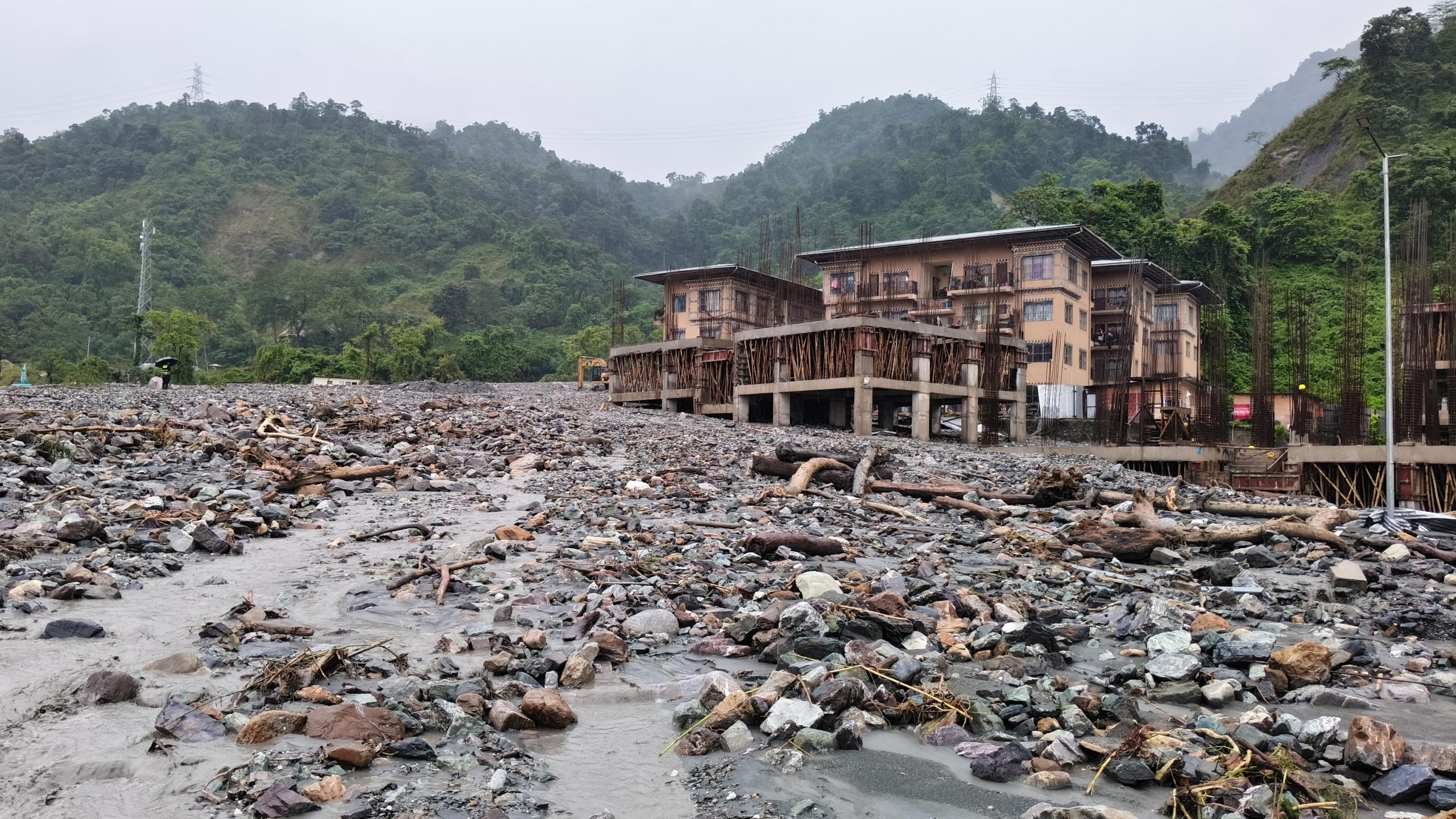
Finding alternative accommodation for residents displaced from the NHDCL colony is also expected to take time. Vacant units in other NHDCL housing complexes will become available only when existing tenants move out, as all current units remain fully occupied.
NHDCL currently manages 689 housing units across 91 buildings, including the affected colony at Amochhu. Another 392 units are under construction, including a new housing project at Amochhu that was also affected by the recent floods.
Although some residents hope the affected housing colony can reopen soon, others say the site will require a comprehensive risk assessment and extensive mitigation measures before it can be declared safe for residential use. This rehabilitation work is expected to involve several government agencies.
Exacerbating the danger, the slope above the NHDCL colony has been destabilised by recent rainfall, increasing the risk of further landslides into the built-up area if the wet weather continues.
The longer-term challenge extends far beyond this single flood event.
A source said that while NHDCL has the financial and technical capacity to build more affordable housing, recent geological assessments have found much of the Phuentsholing area unsuitable for large-scale residential development.
Although stable state land does exist in a few locations, those sites lack essential infrastructure such as schools, hospitals, and public services, severely limiting their immediate potential for housing construction.