

June 29, 2026
TAUNGGYI – The Shan State-wide Vinaya Dinugaha Festival, which was suspended due to COVID-19, was held again this year, according to the Central Committee of the Shan State-wide Vinaya Dinugaha Festival.
The Shan State-wide Vinaya Dinugaha Festival, which was suspended for 6 years due to the COVID-19 pandemic in 2020, was held again in 2026 with great fanfare.
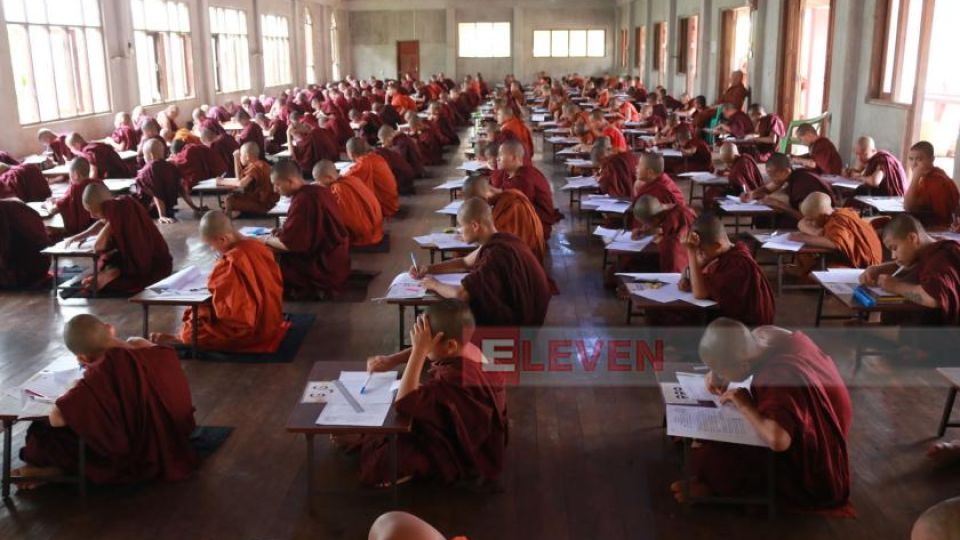
The Shan State-wide Vinaya Dinugaha Festival Examination Center is being held at Yangon Monastery in Nyaung Shwe Township, southern Shan State. The exams are being taken in five main halls, divided into rooms.
There are eight (8) grades taking the exams: primary level, first grade, second grade, third grade, fourth grade, fifth grade, sixth grade, seventh grade, and religious education. There are no candidates for the honors level this year.
The festival will be held for nine days from June 26 to July 4, 2026. There will be seven days of exams from June 26 to July 2, and Saturday, July 4, will be the day of the award ceremony and sermon.
There are 3,200 monks registered for the Shan State-wide Vinaya Dinugaha Festival, and if you include more than 400 responsible monks, the total number is (3,700).
This is a great festival of writing and questioning. When it was first held, it was called a rewriting festival. There was also a written and oral examination. The rewriting festival was organized by the Nyaung Shwe Maharaja Sawbwa Kyi Sao Shwe Thaik, the President of the Union of Myanmar, U Saw Shwe Thaik, and the great monks of the Inle region and Nyaung Shwe city. They met and said that the Vinaya is the life of the religion. The Vinaya is called Vinaya Dinugaha to establish the Vinaya. The festival was first held in 1294. At the beginning, there were less than one hundred monks. Now it has been 95 years.
The retired president, Sao Shwe Thaik, and his family, monks, and elders who led the event, believe that the three precepts of the Dhamma, the Dhamma, and the Dhamma Veda are the most important, so they have made it possible for everyone from young monks to U Zin level to participate in the exam, which is the main task of preserving the Dhamma. When taking the exam, they have coordinated with other Pali exams in Myanmar and have been systematically organizing the exam for many years, following the method of answering the questions asked at the exams.
There is also a special feature in the event that the monks are not allowed to go out once they have taken their seats in the Dhamma Hall, they are not allowed to communicate with the outside world, they are not allowed to use their phones, and they are only allowed to answer the questions. They are only allowed to go out after the students have finished answering.
The answer sheets that have been answered are also systematically pasted with codes. The answer sheets are systematically destroyed. The score list is published on the same day with the answer sheet. After the question and answer session, the exact score list is published before the day of the sermon, and the award ceremony is held systematically during the sermon on the 5th day after the full moon.
U Tin Aung Kyaw, vice chairman of the central committee for the Shan State-wide Vinaya Dinugaha Festival, said.
It was held annually from its original inception in 1932 to 2019. It was not held for more than 6 years due to the COVID-19 pandemic in 2020, record-breaking floods in August 2024, and earthquakes in March 2025. U Tin Aung Kyaw said that the event was held again in 2026 without breaking the tradition.
Until 2019, monks from various monasteries in cities such as Lashio in northern Shan State, monasteries in Kengtung in eastern Shan State, and monasteries in Loikaw in Kayah State also came to answer the questions, but this year, 2026, they were unable to come, and instead came from various townships in southern Shan State.
“The first president of Myanmar, Sao Shwe Thaik, led and initiated the Nyaung Shwe Festival. There are some unique features of this Nyaung Shwe Festival. This festival is not organized by the government. The relevant townships, state administrative organizations, and authorities provide the necessary administrative assistance for the festival. The main event is organized by the central leadership of the Sangha, under the guidance of the monks and monks in the township. This is the first and most important thing. This festival is not organized by any political party. It is a festival organized by the residents and the villagers. The third thing is that the Nyaung Shwe Festival has a very long history. From 1932 to 2026, it has been 94 years. With a 6-year break in between, the 89th Nyaung Shwe Festival and the 86th Nyaung Shwe Festival have been held for 94 years. The third unique feature is that this festival is based on the collective efforts of the residents, and the festival fund is The money from the city’s residents, donations from all over the country. The fund for this festival increases every year. There are nearly 4,000 monks and nuns in total. There are so many monks, so many years, and the festival lasts for 9 days. The city’s residents are responsible for all the monks’ alms, health, and living and traveling expenses. This is unprecedented. We dare to say that there is no other festival in Burma with this kind of characteristics. There are large festivals organized by the government. This time, the people are responsible for organizing and organizing the festival with their strength,” said U Kyaw Win, a retired director of Nyaung Shwe.