


February 11, 2026
BUSAN – When Ms Li, a school teacher from Shanghai, booked a cruise holiday for herself in August 2025, the itinerary had included ports of call at the Japanese cities of Hiroshima and Nagasaki, and South Korea’s Jeju island.
But by the time she embarked on her trip on the Chinese cruise ship Adora Magic City on Feb 4, the itinerary had been changed twice and no longer featured port calls in Japan.
“At first they changed from Nagasaki to Fukuoka, but later on they changed it further to skip Japan altogether, and to Jeju and Busan (instead),” said Ms Li, who declined to reveal her full name.
She was among at least 2,500 passengers who had disembarked at the Busan International Cruise Terminal on Feb 6.
“It can’t be helped,” said Ms Li, about the itinerary changes, before lowering her voice. “We are not allowed to go (to Japan) now anyway.”
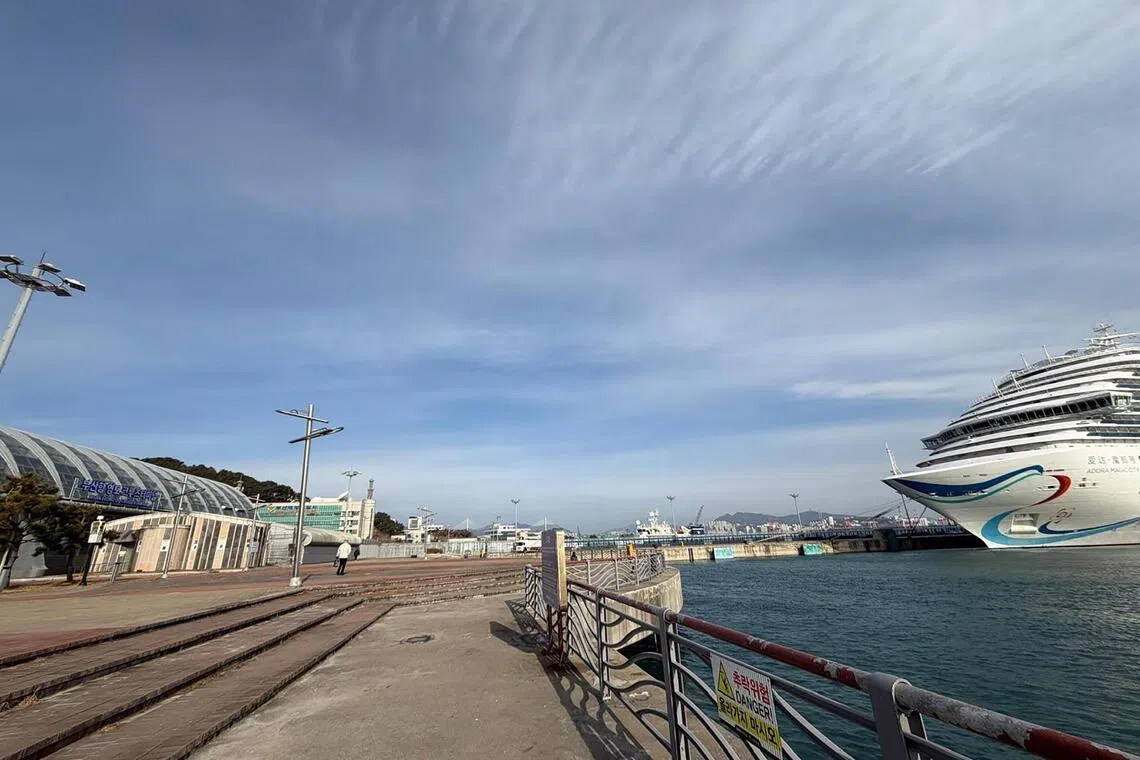
The Adora Magic City cruise ship, which has its homeport in Shanghai, sailed to Busan for the first time in 2026 and is scheduled to make 63 more visits to Busan in 2026. PHOTO: THE STRAITS TIMES
China reiterated a warning to its citizens on Jan 26 against travel to Japan during the upcoming nine-day Chinese New Year break from Feb 15 to 23.
China first issued a travel advisory to its citizens against visiting Japan in November 2025, sparked by a diplomatic row that erupted over Japanese Prime Minister Sanae Takaichi’s remarks on Taiwan.
Speaking to the Japanese Diet on November 7, 2025, Ms Takaichi had incurred China’s wrath when she said that that any use of force by Beijing against Taiwan, which China claims as its own, would “constitute a situation that could threaten Japan’s survival” and therefore justify a military response by Japan.
All scheduled flights between China and Japan have also been cancelled for the month of February, with Chinese airlines extending special ticket change and refund policies for Japan-related travel.
In the Feb 8 Japanese snap legislative elections, however, Ms Takaichi won a strong mandate, with her Liberal Democratic Party (LDP) sweeping a historic two-thirds supermajority in the House of Representatives.
The landslide victory was an indication of her popularity and an implicit rebuke to Beijing for the diplomatic spat.
And with the freeze in Japan-China relations not likely to thaw any time soon, Chinese tourists have been redirecting their attention to South Korea, as well as other destinations in South-east Asia.
In particular, the south-eastern port city of Busan is expecting an unprecedented number of Chinese visitors in 2026 on Chinese cruise ships.
From having just eight Chinese-origin cruise ships in 2025, Busan is now gearing up for 173 Chinese-origin cruise ships slated to dock there.
Jeju, traditionally the most popular port of call in South Korea for Chinese-origin cruise ships, is expected to welcome more than 300 vessels in 2026.
The port of Incheon, which is nearest to Seoul, received 40 urgent bookings from Chinese cruise ships in December 2025, and is expecting at least 44 arrivals from China.
An official from Incheon Port Authority was quoted by Yonhap News Agency as saying that cruise call reservations are usually made one year in advance, so the last-minute bookings were highly likely to have been driven by political reasons.
Adding to the appeal is South Korea’s temporary visa-free entry scheme for Chinese tourists, which began in September 2025 and runs until June 2026. Under the programme to spur tourism, groups of three or more travellers booked through accredited agencies can stay for up to 15 days, with visa fees waived.
China has also extended visa-free travel for South Korean tourists through the end of 2026, as part of efforts by Seoul and Beijing to build warmer ties, which reached a nadir in 2017 following South Korea’s deployment of the American THAAD missile-defence system. Angered by the deployment, which it saw as a security threat, China suspended group tours to South Korea.
Flights between South Korea and China are also on the increase.
Despite February being a low travel season, the number of flights between Jeju and Chinese cities such as Shanghai and Beijing increased by 22 to 125 flights per week.
Casinos and hotels located in Incheon and Jeju are reporting full occupancy rates over the Chinese New Year holiday.
According to data by research firm China Trading Desk, around 250,000 Chinese tourists are expected to visit South Korea over the nine-day festive holiday, a 52 per cent increase from last year.
Mr Piao Zhe was among the dozens of tour guides milling outside the Busan International Cruise Terminal, waiting for the Adora Magic City’s passengers to disembark for a day tour of Busan city.
He was dispatched from Seoul as “there are not enough tour guides in Busan to handle the crowd”, Mr Piao tells The Straits Times.
The 50-year-old, who has been a tour guide in South Korea for Chinese tourists for 18 years, says that his company has told him to expect to be very busy this year.
“No one knows what exactly to expect, but I think perhaps I will be needed more in Seoul as that is usually the main hub for Chinese tourists,” said Mr Piao.

More than 50 tour buses were parked at Busan’s Yeong-do Cruise Terminal on Feb 6, waiting for passengers to disembark from the Adora Magic City cruise ship for a day tour of Busan city. PHOTO: THE STRAITS TIMES
At the cruise terminal’s carpark, more than 50 tour buses were waiting to ferry passengers to the popular Busan tourist spots of Haeundae beach, Jagalchi seafood market and Gamcheon Culture Village.
One of the bus drivers told ST that while he usually drives a cruise tour group once every three days, his company has told him that the frequency will soon increase to daily runs.
Busan Port Authority manager Lee Ji-young was on-site to ensure cruise passengers disembarked smoothly. She told ST her agency is set to hire more staff in anticipation of the surge in visitors, but that it will take time.
Local media reports said Busan Port Authority President Song Sang-geun had flagged the issue of insufficient personnel to handle the surge in traffic.
“With the current manpower situation, it will be difficult to assign berths starting in the second quarter,” he had said.
In response, South Korea’s Ministry of Oceans and Fisheries has said it is working with related institutions to devise measures to expedite immigration processing and boost manpower. Busan has three cruise terminals with five berths.
Mr Lee Won-suk, 68, who runs a stall selling dried fruit and seafood near Jalgalchi market, is delighted about the anticipated surge in Chinese visitors.
“Taiwanese visitors are currently my top customers, but the Chinese tourists are different, they come with rolls of cash! I once had two Chinese ladies who bought up 900,000 won (S$780) in one go,” he told ST.

Mr Lee Won-suk, 68, has been selling dried seafood and fruits at the open-air market at Busan’s Nampo Port area for more than 11 years. PHOTO: THE STRAITS TIMES
The irony is that some of his dried seafood and nuts are sourced from China “because the prices are cheaper”, but he processes them into distinctly Korean flavours such as butter-seasoned dried squid.
“I think it is because we have similar palates with the Chinese, so the Chinese tourists seem to enjoy our dried green tangerine peels, and all the dried seasoned seafood,” said Mr Lee.