

June 8, 2026
PHNOM PENH – A newly released report by an international NGO into allegations of wildlife trafficking in Cambodia has raised serious questions regarding the relationships between large-scale criminal enterprises in the Kingdom.
Earth League International (ELI) describes itself as “the only NGO in the world dedicated exclusively to investigating and addressing Environmental Crime Convergence”.
It was established more than a decade ago by Italian Andrea Crosta.
In a 2023 New Yorker profile, the late Jane Goodall shared her support for his work.
“Andrea is one of my favourite people,” she was quoted as saying. “He’s passionate, he’s courageous — what he’s doing is very dangerous— he loves dogs, and he won’t ever, ever give up.”
Crosta explained the scale of the operations his organisation undertook.
“Our investigators spent over a year inside some of the most significant wildlife trafficking networks in Southeast Asia, recruiting sources and documenting a criminal ecosystem where endangered species are slaughtered on demand, traffickers boast about their political protectors and the illegal wildlife trade is intertwined with drugs, scams, and human exploitation,” he told The Post.
This report brings that world into the open,” he added.
ELI aims to identify the intersection of natural resource crimes with other transnational crimes, including money laundering, human trafficking, corruption and drug trafficking.
Operation Sandokan was a more-than-one-year undercover investigation that examined wildlife trafficking networks operating across the Lower Mekong Region, including in Cambodia.
Released earlier this month, the organisation claims the report was based on covert intelligence gathering inside active trafficking organisations, making it one of the most extensive investigations of the illegal wildlife trade ever conducted in Cambodia.
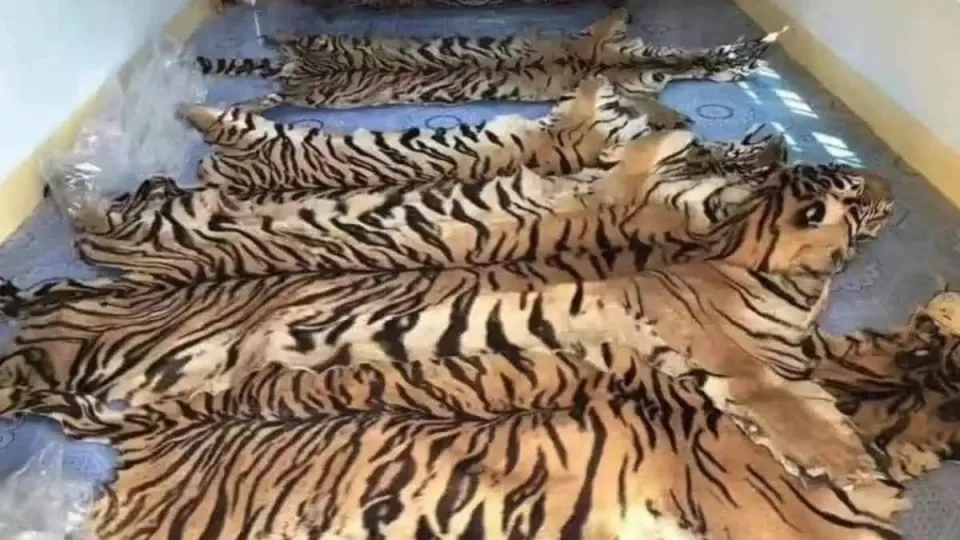
It contains several shocking allegations, with investigators reporting evidence suggesting that at least one tiger is slaughtered to order each week by one of the trafficking groups under investigation.
The report asserts that one large trafficking network alone supplies exclusive restaurants and private clubs, including in Phnom Penh, that serve endangered species.
An illegal smorgasbord
According to ELI, the network sells “skeletons, meat, live cubs (generally as pets but sometimes as a culinary delicacy), and makes and sells tiger bone, tiger penis and even tiger cub wine”.
Investigators compiled a “menu” of what was on offer, complete with prices in both the Chinese RMB and US dollar.
Alleged illegal wildlife product prices in Cambodia as of March 2026
Tiger bone 10000-13500 RMB/kg ($1463 – $1975)
Tiger penis 15000-18000 RMB/each ($2194 – $2633)
Pangolin scales 1200-1400 RMB/kg ($175 – $205)
Bear bile 3500-4000 RMB/100 gram ($512 – $585)
Rhinoceros horn 130-180 RMB/gram ($19 – $26)
Source: ELI
One supplier reported that he was earning up to $500,000 per month from just one customer, the operator of a large-scale scam operation.
Transnational farm-to-table trading
According to ELI, investigators infiltrated networks involved in the trafficking of endangered species and documented how wildlife products move through ports, airports, border crossings, retail outlets, restaurants and online platforms.
The report alleges that some of the region’s most significant traffickers operate extensive international supply chains reaching Africa, Europe, Russia and South Asia. ELI claims that these networks are involved in the trade of tigers, elephant products, rhino horn, pangolins and numerous other protected species.
A central theme of the report is “crime convergence” – the overlap between wildlife trafficking and other forms of organised crime. ELI argues that individuals involved in the wildlife trade are often simultaneously engaged in online scam operations, drug trafficking, timber trafficking, prostitution and other illicit activities.
It also alleges “significant corruption and collusion” between trafficking networks and influential political and business elites, with traffickers reportedly speaking openly about their protection and connections. None of the individuals in question were named in the report.
Scam busts drive reduced demand
There was some positive news, however, with the organisation highlighting that wildlife crimes appear to have fallen significantly since the onset of the Cambodian government’s current campaign to quash online crimes.
ELI claims that, prior to government crackdowns in late 2025, operators of scam centres were major consumers of illegal wildlife products and spent large sums supporting the trade. According to the report, the decline of the scam industry reduced demand for wildlife products, illustrating how disrupting one criminal sector can weaken others that are financially connected.
ELI also warned that some criminal groups appear to be relocating operations to neighbouring countries, particularly Laos and Myanmar.
The report warned however, that Cambodia remains an important transit hub for international wildlife trafficking and that stronger enforcement, international cooperation and anti-corruption measures are needed to combat the trade effectively.
The hunt continues
ELI states that intelligence gathered during Operation Sandokan has been shared with US law enforcement agencies and other partners to support ongoing investigations.
Some findings have been withheld from the public version of the report because authorities requested that sensitive information not be disclosed while investigations continue.
The organisation was quick to highlight that some claims have not been tested in court, and parts of the underlying intelligence remain subject to ongoing law-enforcement investigations.
While many of the allegations seem far-fetched, it may be worth considering that early warnings about the scale of the region’s well-documented online scam syndicates were also met with doubt and disbelief from many quarters.
“The video that accompanies the report shows what our teams witnessed firsthand — and why this work is essential,” noted ELI founder Crosta.
Ministry of Environment spokesperson Khvay Atitya was approached for comment. He initially told The Post that he was “looking into it” but was unavailable for further comment at the time of publication.