

February 3, 2026
LAHORE – FOR nearly two decades, Lahore has been deprived of the colours of Basant. An entire generation has grown up only learning about the festival through faded photos and family stories. But this week, it is set to make a roaring comeback — albeit with unprecedented regulations and lingering questions about safety and fairness.
Young people in their teens and 20s will get experience the legendary spring festival for the first time, while older Lahoris, recalling the glory days when world celebrities visited havelis and millions gathered on rooftops for night festivities, will be able to re-live those memories.
But the revival comes with strict conditions: QR-coded kites, heavy fines, and massive safety measures. Rooftop rentals now command premium prices, hotels are fully booked, and the walled city is abuzz.
Yet as Lahore celebrates, other parts of Punjab are left out. Illegal manufacturing and kite flying continues in other cities, raising uncomfortable questions: what happens after Basant, and where will the thousands of leftover kites go?
The generation that forgot to fly
A GENERATION has grown up in Lahore without ever knowing the joy of beholding a Basant sky: filled with kites of all colours and echoing with the sounds of gleeful kite-manship.
For many young people aged between 18 and 25, the festival of Basant exists only in secondhand memories.
But now that the Punjab government has now allowed highly regulated Basant celebrations in Lahore for a three-day period, Gen Z may finally get a chance to turn those inherited memories into lived experience for the first time.
For Tuaha Zahid, 26, Basant has always been “something talked about more than lived, a festival frozen in memories and videos rather than personal experience.”
“This will be my very first Basant,” says Aayat-i-Noor, 25. “Experienced not through words or screens but with my own eyes, and that makes it feel incredibly special.”
Many believe that Basant is inseparable from Lahore itself. Abu Bakr Masood, who grew up in the 1990s, terms the festival “Lahore’s only genuine product.”
Speaking to Dawn, he remembers rooftops filling up after 9am, music blasting through loudspeakers across neighbourhoods, and people chanting “bo kata” with every victory.
For those now in their 40s and 50s, Basant is more than just a memory.
Hassan Ejaz Wyne, 47, fondly recalls: “From the age of 5 to 22, I flew kites almost every other day, and not just on Basant.”
“My top financier was my naani,” he laughs, recalling how children prepared days in advance, capturing “around 50 to 60 good-quality kites” before Basant day.
But eventually, he recalls, bad practices eventually overshadowed the joy. “The festival was hijacked by people who used chemical dor (kitestring); it didn’t snap, and that’s why it ended up hurting people.”
In Lahore’s Mozang area, Basant was celebrated with extended family and food stretching across generations.
Thirty-eight-year-old Majeed Lashari remembers the night of Basant eve, known as ‘Youm-i-Tana’. “The whole family would get together, all of my cousins. It was quite a festival,” he says.
He also speaks about the food served at his haveli during the festival. “There used to be samosay, jalebi, desi karahi, handis, and naan from a century-old naanwala, Taj Din.”
Salli’s Haveli, which hosted the world
YOUSAF Salahuddin, the grandson of Allama Iqbal and owner of Haveli Barood Khana, has hosted some of the most legendary Basant celebrations in Lahore’s history. The haveli itself holds historical significance, as over the years it became a gathering spot for prominent figures from Pakistan and beyond.
Salahuddin recalls that during the festival’s peak years, many businessmen, politicians, and bureaucrats visited Barood Khana Haveli to celebrate. “John Reed, chairman of Citibank World, visited the haveli during Basant. There were countless people who visited, and apart from Basant, the haveli was visited by Naseeruddin Shah, Aamir Khan, Vinod Khanna, Rekha, and many other celebrities.”
He proudly claimed to have opened up the old city of Lahore to the world by celebrating Basant there, and having many international personalities experience the city and the festival at his abode.
Had the festival been commercially developed 25 years ago, Salahuddin says, it could have been a multi-million-dollar event where everyone from top to toe would have benefited — from caterers to bangle and flower sellers, paan sellers, event management companies, and even the corporate sector. He regrets that much time has been wasted in redeveloping this great festival, which was once part of Lahore’s identity.
Kamran Lashari, former director general of the Walled City of Lahore Authority, who championed Basant observance during the 1990s and under the Musharraf regime, recalls the unique atmosphere. “Lahore is the hub of Basant. Here, the ambience and environment of Basant are different from other cities because of its significant old architecture and rooftops.”
Night Basant, he says, had its own charm in Lahore, where around a million people came out onto their rooftops. “When I told a visiting foreigner that one million people come on rooftops during night Basant, he was astonished.” Lashari clarifies that this is no exaggeration, and probably an underestimate.
When Basant saw its peak days in Lahore, along with other businesses, fashion designers also benefited. A Faisalabad fashion designer told Lashari that during Basant, they received many orders from Lahore for both gents’ and ladies’ outfits for the celebrations.
A festival with many strings attached
THE revival of this iconic festival did not come to pass easily, and the Punjab government is enforcing stringent laws and a rigorous registration process to ensure Basant passes without a hitch.
The government has enacted the Punjab Regulation of Kite Flying Act 2025, proposing punishments for offences including flying kites when prohibited, and manufacturing, transporting, storing, selling, or offering for sale “non-permissible” kites and dor.
The law imposes three to five years’ imprisonment, or a fine of Rs2 million, or both, on the offence of kite flying unless formally allowed by the government.
For manufacturing, transporting, and selling prohibited twine, the punishment is imprisonment for five to seven years, or a fine of Rs5 million, or both.
If a child commits an offence, he will be tried under the Juvenile Justice System Act 2018 and punished with a fine of Rs50,000 for the first offence.
On repetition of the same offence, the fine increases to Rs100,000. If the child is unable to pay, the fine shall be recoverable from his parents or guardian, and in case of default, it shall be recoverable as arrears of land revenue.
The law also mandates that no manufacturer, trader, or seller of permissible kite-flying material shall manufacture, trade, or sell such material unless registered with the deputy commissioner concerned on payment of prescribed fees.
As per the Punjab Regulation of Kite Flying Rules 2025, a ‘patang’ shall not exceed 35 inches in width and 30 inches in length, while a ‘gudda’ cannot exceed 40 inches in width and 34 inches in length.
Similarly, dor (string) must be made of cotton with not more than nine threads and no less than 28 counts. The string must be wound in the shape of a ball, since spools (charkhi) are prohibited.
The Lahore district administration has issued separate QR codes to all manufacturers, traders, sellers, and associations, and instructed them to display the codes in prominent places.
The manufacturers, traders, and sellers are required to stamp their respective QR codes on kites as well as pinnah (string wound in the shape of a ball).
During Basant days, surveillance and monitoring will be done by police, district administration, traffic police, the chief minister’s monitoring cell, as well as Punjab Safe City Authority (PSCA) and different allied departments. Drones will also be used for surveillance.
While the Punjab government is considering softening the conditions of the Punjab Sound Systems Regulation Act 2015, as Basant resonates with songs played on decks on rooftops, a source in the DC office told Dawn that there will be no formal notification or announcement, but law enforcement agencies will be instructed to go slow.
Asked when Basant was over, what would be the conditions for kites and twine stock lying with traders or sellers, the DC office source said manufacturers, traders, and sellers would be required to get their “remaining stock” registered with the district administration.
However, the official could not explain the situation where buyers still have stock of kites and twine, and even those collecting stray kites, when the Basant event concludes. Traditionally, kite-flyers used to fly kites during post-Basant weekends and Sundays, but these are now banned.
“Complete ban on flying kites will come back into session post-Basant, but the district administration is yet to see into the matter regarding kites and twines available with people after Basant,” the official from Lahore’s DC office told Dawn.
The commerce of celebration
FROM individuals to groups to companies, a whole ecosystem has cropped up to facilitate arrangements that will allow people to celebrate the return of Basant after so many years with style.
The sky has yet to fill with kites, but in the narrow lanes of the walled city, the season has already taken flight.
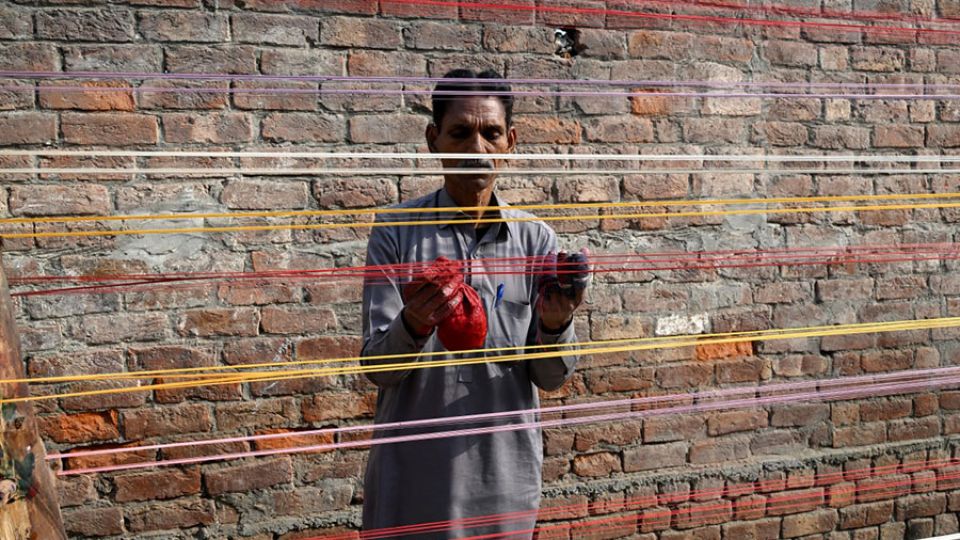
Shopkeepers sit behind teetering stacks of brightly coloured guddis, and spools of string hang like festive garlands above counters. Weeks before Basant, Lahore’s kite markets are already humming with a familiar mix of nostalgia and excitement.
As expected, prices are sky-rocketing. A kite that was worth Rs200 just days ago is now retailing for nearly double the price. Balls of kitestring that cost up to Rs7,000 are now selling for at least Rs12,000.
Around the walled city, rooftops are just as valuable, if not more, as shopfronts. Mohsin Fraz, a resident of Bhati Gate, hopes that allowing Basant to return after around two decades will bring with it festivity, culture, tourism and business opportunities for locals.
According to him, walled city residents rent out their rooftops for two to three days at prices starting from Rs50,000 and ranging into the millions, depending on their location, size, and facilities.
“People spend on food, special Basant clothes, sound systems. Even overseas Pakistanis are planning to come,” he says. “There are middlemen now whose job is just connecting roof owners with renters.”
Fraz believes celebrations in the old city are livelier than anywhere else. “All the rooftops are connected. You can cross dozens of houses without coming down. It becomes one giant celebration.”
65-year-old Javed Mughal tells Dawn he has two rooftops — one is for 40 to 50 people and the other for 10 to 12 people. “The complete package includes provision of rooftop, kites, string, food, tea, snacks, sweets, and other facilities. And we will only give our venue to people coming with their families,” he says, adding that previously, there was no concept of renting out rooftops in their neighbourhood.
According to Muhammad Aqeel, owner of a handicraft shop-cum-café in the old city, the minimum rent of a big rooftop for around 50 people for Basant’s three days is being charged at Rs300,000. And with food, kites, string, and other facilities, it goes up — Rs15,000 per person or so.
Bilal Sabir, an artist working voluntarily for the Walled City of Lahore Authority (WCLA), says that a number of rooftops in the walled city have already been booked by private sector companies and brands for hosting Basant-related activities.
According to Khawaja Nadeem Saeed Wyne, founder of the Lahore District Kite Flying Association — the first association registered in 1996 — the upcoming festival is reviving Lahore’s economy, which used to boom in the past whenever spring rolled around.
He compared it to Eidul Azha, for which traders would procure and raise sacrificial animals the whole year, and then sell them over the last one month.
While arrangements for venues, kite flying, food, and others are underway, city markets have started witnessing a rush of people, especially women. “Mostly women visiting our shop are buying yellow cloth for making Basant dress. Besides this, they are also buying mehndi from other shops,” a shopkeeper in Ichhra bazaar tells Dawn. “I have also seen some foreigners, including some women, frequenting the bazaar,” he says.
As the festivities approach, most hotels are fully booked, with special Basant-related packages also on offer.
A reservation agent from the Pearl Continental Hotel told Dawn that most rooms had been reserved from people coming from outside the city, or foreigners.
The hotel will host a concert by Abrarul Haq on Feb 7, which will also feature kite flying for their guests.
Meanwhile, a booking manager from the Avari Hotel also said they had no rooms available until Feb 9.
Keeping the populace safe during Basant
THE Punjab government has announced that buses and rickshaws will ply on city roads over the Basant weekend, to minimise the use of bikes.
As part of large-scale initiatives to make the upcoming three-day Basant festival safe and successful, 300 buses and 6,000 auto-rickshaws will provide free travel to citizens within the city, and 160 others will transport Basant lovers to Lahore from adjoining cities including Kasur, Sheikhupura, and Muridke to celebrate the three-day cultural event.
“We have finalised agreements with online taxi apps—Yango and InDrive. Under these agreements, both companies will provide as many as 180,000 free rides (each up to 8km) to people across Lahore city district from February 6 to 8. In return, we have provided various prime sites (roads, intersections) to these companies for advertising, branding, or marketing of their business for a certain period,” shares Zeeshan Ranjha, PHA’s additional director general, while talking to Dawn.
Those riding bikes have already been instructed to install steel wire on their bikes for protection, and from February 1, bike riders will have to face heavy fines and legal actions for coming on the roads without the safety antennas.
City police authorities have been given the task of installing safety rods on one million bikes ahead of the three-day Basant festival, according to a senior police officer.
“We have shifted our major focus towards the safety of bike riders during the upcoming three-day Basant festival being revived on February 6,” Lahore Chief Traffic Officer (CTO) Athar Waheed tells Dawn.
“We have identified hundreds of sensitive points where the most fatal and other injuries to bike riders were reported during the last 10 years due to the string of stray kites,” the CTO says.
Additionally, he says, the police have bifurcated Lahore into three zones — high-risk, low-risk, and middle-risk zones, also called Red, Yellow, and Green Zones — as protective measures for motorcyclists.
He says that the city’s senior police officers held brainstorming sessions, analysed the data, and came up with an ultimate decision to bifurcate the provincial capital into three zones, keeping in view the number of incidents that took place in designated areas in the past.
Most areas of the Red Zones fall in the walled city, including Circular Road, Shadbagh, and Ravi Road.
As per the policy decision, no bike rider will be allowed to enter the high-risk/red zone without getting the safety wire installed on his or her bike, with the prime objective being to prevent him or her from fatal or other injuries.
About the possibilities of using sharp strings by suspects, the CTO says that the authorities have made public a list of 600 registered vendors who are allowed to sell strings and kites under the kite-flying ordinance 2025.
Rawalpindi waits as Lahore celebrates
WHILE Lahore prepares to celebrate Basant and fill its sky with kites, in Rawalpindi, the ban is still in place. It is obvious that residents of the garrison city are feeling left out of the discussion around whether or not the festival should be celebrated there as well.
After all, Rawalpindi is the second city after Lahore to be closely associated with the Basant festival and its traditions, having been home to thriving Sikh and Jain communities in the past.
When contacted, Deputy Commissioner Dr Hassan Waqar Cheema says that there is a complete ban on Basant in Rawalpindi, and the district administration will implement the ban at any cost.
“Why is the ban lifted for Lahore and not for Rawalpindi? It is discrimination, as the Basant festival in winter is a healthy activity for people. In these days of tension, people can enjoy flying kites and celebrate the festival,” says Muhammad Naeem, a 30-year-old resident of Chaklala Scheme-III.
He says that teenagers are unaware of the festivity of Basant and should know their culture. He adds that kite flying should be allowed, but metal strings and other dangerous paraphernalia should be banned.
Shamshair Hussain, a resident of College Road, says that there is no other sporting activity for people living in the narrow streets of his locality, and kite-flying is a healthy activity. The government should not impose a ban, he feels.
Shujaat Haider, a resident of Sarafa Bazaar, says that Basant provides an opportunity for many people to earn money. “People start preparations in January and celebrate in March, and for three months, kite makers do thriving business,” he says.
Despite the ban, people are still flying kites in Pindi, and even residents of Islamabad come over to partake in the festivities.
In yesteryears, people were seen making strings on the roadside, selling kites of different varieties like guddi, tukal, pari, and dabba for the nights. Strings had many varieties like tandi, cotton string, and chemical-coated.
Ustad Raffique and Allah Dita were famous in Naya Mohallah, Bholla in Sabzi Mandi, and many others whose services were hired for kite-flying matches.