


December 23, 2025
JAKARTA – Traditional textiles do not merely serve as articles of clothing but also as living records of cultural memory, identity and inherited wisdom. Each piece is painstakingly woven or drawn by hand with care, often accompanied by quiet prayers for the well-being of its wearer. That sensibility feels increasingly distant in this age of fast fashion.
In an exhibition titled State of Fashion: Perspectives On… Weaving Threads at Erasmus Huis Jakarta in Setiabudi, Dutch visual artist Nazif Lopulissa, in collaboration with fashion designer Chitra Subyakto of Studio Sejauh in Pekalongan, Central Java, revisits this and other traditions through a deeply personal journey shaped by displacement, memory and life between cultures.
“I am a Moluccan from Holland, but also Turkish,” Lopulissa said on Nov. 1, during an interview on the sidelines of the exhibition opening.
“So they do not see me as Indonesian, also not as Dutch and not as Turkish, but as someone in between.”
Born in the central Dutch town of Tiel, the artist was born to a Turkish father and a mother from Maluku, known as the Moluccas during the colonial era. His grandfather once served in the Royal Netherlands East Indies Army and migrated to the Netherlands after the war, though he never stopped calling Ambon home.
“My grandfather, when he went to Ambon and came back to Holland, he always brought ikat scarves,” Lopulissa recalled. “And that became the embodiment of home in Ambon for me.”
Years after his grandfather passed away, one of those scarves resurfaced in his studio and prompted a deeper search.
Lopulissa began studying the fabric not only in terms of technique but also meaning. He was drawn to the idea of ikat, derived from the Indonesian word mengikat (to bind), and translated that principle into his own visual language.
He soon developed a series of woven canvases by cutting painted surfaces into strips and weaving them back together, a method that earned him the prestigious Wolvecampprijs award for painting in 2022.
For his solo exhibition Warp and Weft the following year in Amsterdam, he continued exploring Indonesian textile techniques across materials ranging from banana fiber and corrugated sheets to shoes.
That sustained exploration drew the attention of State of Fashion, an international platform based in Arnhem that examines the future of fashion and textile practices, which later invited him to take part in a residency at Studio Sejauh.
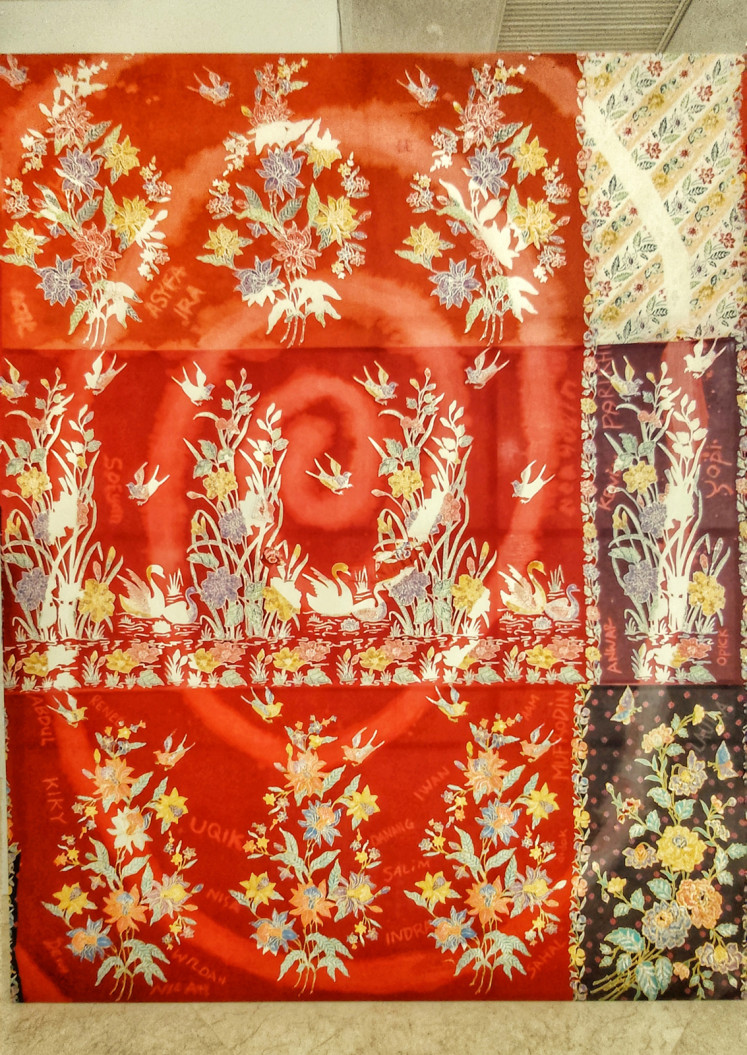
A large piece by Dutch artist Nazif Lopulissa, created by stitching together three batik sarongs with buketan (bouquet) motifs, is displayed at the State of Fashion: Perspectives On… Weaving Threads joint exhibition at Erasmus Huis Jakarta, the Netherlands cultural center in Setiabudi, South Jakarta. PHOTO: THE JAKARTA POST
Cross-cultural residency
“I met Chitra Subyakto during a program at Shanghai Fashion Week last year,” said State of Fashion director Iris Ruisch.
That initial conversation grew into a wider reflection on responsibility, craft and the urgency to rethink fashion.
Struck by Chitra’s long commitment to circular and sustainable practices, Ruisch shaped a special residency under the platform’s Perspectives program, bringing a Dutch artist into direct dialogue with Pekalongan’s textile tradition.
Lopulissa was invited for his background and long engagement with ikat closely aligned with this year’s edition focusing on identity, heritage and cross-cultural exchange.
He arrived at Studio Sejauh in mid-October and immersed himself in the studio’s daily rhythm.
“It felt very organic and natural,” Chitra said. “We talked through the fabrics he wanted to work with. And he’s truly brilliant. In just a couple of days, he already knew what to do.”
Staying close to his personal exploration of identity and history, Lopulissa chose clove as his main coloring agent.
“Clove was one of the main reasons the Moluccas were colonized by Holland,” he explained.
For the Studio Sejauh team, turning cloves into dye was a shared experiment, as they had never worked with the spice before. When boiled and applied, the cloves produced a soft gray that transformed into a warm brown hue when treated with soda ash.
Working closely with the studio’s artisans and longtime production partner Craft Denim, Lopulissa experimented with various threads, textiles and upcycled materials.
Given the season, however, the weather also became part of the practical challenges.
“We worked on the rooftop of the studio,” he said. “But when it rained, we had to go inside. It was so hot and sweaty.”
In just 10 days, they completed nine textile works that now form the heart of the exhibition.
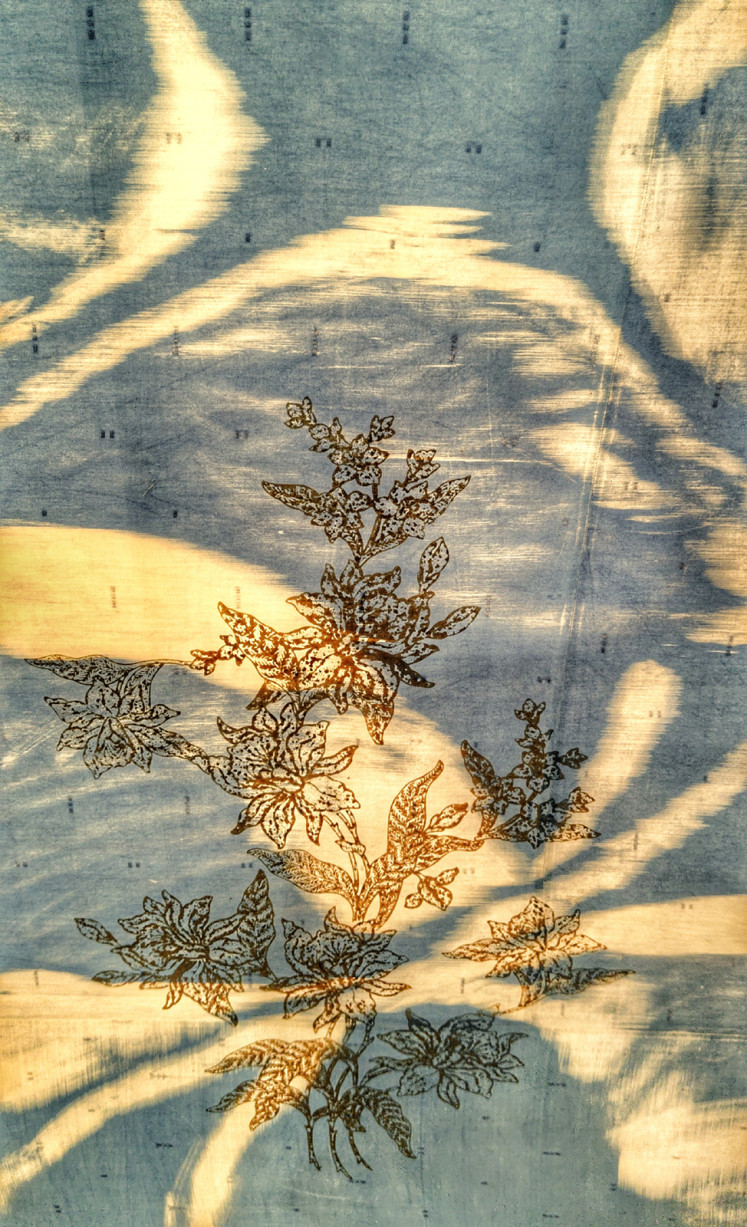
This handwoven textile made from Tencel and cotton threads by Craft Denim, a longtime production partner of Studio Sejauh, is among the works presented in the State of Fashion: Perspectives On… Weaving Threads exhibition at Erasmus Huis Jakarta. PHOTO: THE JAKARTA POST
Reading threads
Inside the foyer of Erasmus Huis, these works line the walls in quiet restraint, allowing the fabrics to speak for themselves.
There are no display labels beside them: Instead, visitors are invited to pick up a brochure and scan a QR code to unlock the stories, processes and ideas woven into each piece.
The works feel raw and unadulterated. Floral motifs reminiscent of Elisa van Zuylen, a 19th-century Dutch batik designer, flow across contrasting textures, some soft and translucent, others dense and rugged. Clove, indigo and soda ash lend the works earthy tones of gray, deep blue and brown. Up close, the word “decolonize” appears repeatedly, either stitched or otherwise marked.
A lush gray textile just across the entrance is dominated by a sweeping spiral that unfurls from its center. For Lopulissa, the motif speaks to an enduring sense of home, one he has spent much of his life searching for.
“For me, the spiral is like a shell, the home of a [mollusk] that is carried everywhere,” the artist said. “As it grows outward, it also reflects how ideas and shared knowledge expand together.”
Layered over the surface, silk tulle is embroidered with a repeating grid of the word “decolonize”.
“For me, decolonizing means unlearning the dominance of Western traditions that shaped my art education,” said Lopulissa, who graduated from the Willem de Kooning Academy in Rotterdam.
“Craft traditions like ikat and tenun [traditional textiles] existed long before Western painting, yet they were never seen as art. Through this work, I want to challenge that and reclaim them as a contemporary practice,” he said.
Fashion consultant Diaz Parzada was among the visitors deeply impressed by the exhibition.
“As I walked through the space, I kept asking myself, ‘Is this art or is this craft?’” he said.
“What I see is a powerful meeting between fine art and textile craft. And what makes it even more meaningful is that many of the works are created from upcycled materials. There is care, not only in the ideas behind them but also in how the materials are treated,” said Diaz.
Another key work is a deep blue handwoven textile by Craft Denim featuring an oversized buketan (boutique) motif.
Lopulissa created the motif by bleaching the fabric rather than applying color, explaining the flipped technique as part of how I try to decolonize the design”.
“The motif is often credited to Van Zuylen, but many people do not know that it was actually drawn by two highly skilled Chinese-Indonesian artisans, whose work brought it to life and carried it through generations,” he added.
He also stamped a smaller buketan motif in beeswax and left the wax in place instead of boiling it off, as is customary in batik making, leaving the process visible to invite questions about who “owns” the pattern and who should be credited as its creator.
The most striking work in the exhibition is a vibrant Pekalongan batik formed from three handwoven buketan sarongs stitched into one. Across the surface, Lopulissa used bleach to paint a large spiral. He then invited each artisan who worked with him during his 10-day residency to write their names on the fabric in bleach, turning the textile into a shared record of labor and recognition.
Textile enthusiasts in the Netherlands, including members of the Indonesian diaspora, can anticipate viewing Lopulissa’s works next spring in Arnhem, which will welcome his textile creations at the city’s main art museum and the State of Fashion Biennale 2026 from May 14 to June 28.