

July 16, 2026
SEOUL – Korean bells are distinguished by their aesthetic refinement, spiritually resonant sound, and extraordinary achievements in metal casting and acoustic engineering.
The supreme surviving example of the classical Korean bell is the Divine Bell of King Seongdeok the Great, cast in the Silla Kingdom in 771. Now housed at the Gyeongju National Museum, it stands 3.66 meters high and weighs 18.9 metric tons. Its harmonious proportions, celestial figures, monumental inscription, and deep, lingering sound represent the culmination of Silla bell-making technology.
Classical Silla bells are distinguished by a single sculpted dragon forming the suspension loop and a cylindrical sound tube, or eumtong, rising beside it. Their surfaces typically feature lotus medallions, celestial figures, floral bands, and other Buddhist imagery.
Nearly a millennium later, Korean artisans in Pyongyang produced a monumental bell with a markedly different visual language.
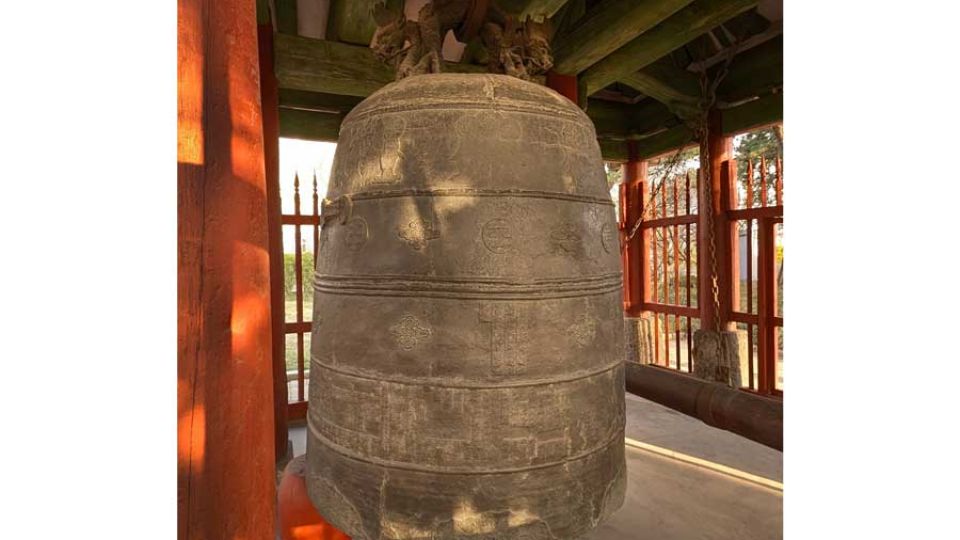
I encountered the Pyongyang Bell during a morning walk along the Taedong River on April 13, 2026. Standing within its historic pavilion beside Taedong Gate, the bell rises 3.1 meters and measures 1.6 meters across its mouth. According to its National Treasure plaque, it weighs 12.9 tons. Cast in 1726 during the reign of King Yeongjo, it is designated National Treasure No. 23 in North Korea.
The Pyongyang Bell is counted among Korea’s six great historic bells, together with the Yeonboksa Bell in Kaesong, the Yujomsa Bell from Mount Kumgang, the Sangwonsa Bell in Pyeongchang, the Divine Bell of King Seongdeok in Gyeongju, and the Seonggeosan Cheonheungsa Bell in Cheonan. Together, they span the Silla, Goryeo, and Joseon periods and embody the continuity of Korea’s ancient bell-making tradition across the divided peninsula.
The 1469 Yujomsa Bell survived the destruction of its temple during the Korean War after being buried for protection. It was later recovered and transferred to Bohyonsa Temple on Mount Myohyang. During my reporting in North Korea, I became the first Western journalist to confirm firsthand that the historic bell still exists.
Unlike classical Silla bells, the Pyongyang Bell has no cylindrical sound tube. Its crown is formed not by a single dragon but by two intertwined dragons whose bodies and claws create the suspension structure.
Its most distinctive feature, however, is the eight trigrams, or palgwae, prominently cast in a continuous band around the bell.
Formed from combinations of broken and unbroken lines, the eight trigrams symbolize heaven and earth, water and fire, thunder and wind, lake and mountain. Together, they represent the order, balance and continual transformation of the cosmos.
Their meaning is rooted in the Juyeok, one of the oldest and most enduring foundations of Korean spiritual and philosophical thought. Over several millennia, its principles of yin and yang, natural transformation, time, direction and harmonious order have shaped Korean understandings of the relationship between heaven, earth, society and human conduct.
The trigrams on the Pyongyang Bell therefore functioned as far more than decoration. They placed the bell within a spiritual universe in which nature, civic order and human life were interconnected.
This symbolism was particularly appropriate because the Pyongyang Bell served not only as a Buddhist ritual object but also as a civic instrument. It announced the opening and closing of the city gates and warned residents of fires, invasions and other emergencies. Its sound regulated time and movement within the fortified city.
As the bell sounded across Pyongyang, the eight trigrams expressed the hope that the life of the city would remain aligned with the larger order of the cosmos. Buddhist figures and guardian deities appeared alongside cloud motifs and the cosmology of the Juyeok, joining Buddhist sacred sound with Confucian civic order, Daoist cosmology and popular hopes for protection.
Neither purely Buddhist nor merely secular, the Pyongyang Bell embodies the layered spiritual history of Korea. Its paired dragons and distinctive Eight Trigrams design give it a monumental identity unmistakably its own.
By Hyungwon Kang
Hyungwon Kang is a Korean American photojournalist, columnist, author and two-time Pulitzer Prize winner. He reported on North Korea in 1995, 1997 and 2026. Kang is the author of “Visual History of Korea” and “Seonbi Country Korea, Seeking Sagehood,” and his ongoing Visual History of Korea project documents Korean history and culture across all of Korea for global audiences.
The views expressed in this article are the writer’s own.